Stellantis Patents AI-Powered Electric Trailer Dolly That Could Revolutionize Heavy Towing

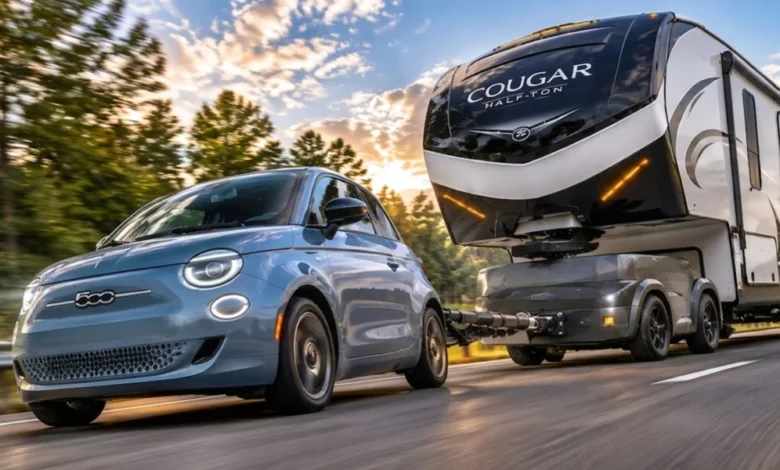
Automotive manufacturing conglomerate Stellantis has secured a United States patent for a sophisticated, artificial intelligence-powered electric trailer dolly designed to fundamentally transform how vehicles handle heavy towing tasks. Officially designated as US Patent No. 12,779,916, the technology introduces a self-powered dolly equipped with independent propulsion, regenerative braking, and advanced steer-by-wire capabilities. This innovation aims to shift the physical burden of towing away from the primary vehicle, potentially allowing smaller, more fuel-efficient passenger cars and electric vehicles to manage heavy loads traditionally reserved for full-sized pickup trucks and commercial haulers.
The patent application, which was originally submitted to the United States Patent and Trademark Office (USPTO) in 2023, was formally published and granted on November 3, 2026. As the automotive industry continues to navigate stringent global emissions regulations and the transition toward electrification, inventions that decouple towing capability from heavy vehicle weight are gaining significant attention. Stellantis’s newly patented hardware represents a potential paradigm shift in utility vehicle engineering, addressing long-standing efficiency trade-offs faced by consumers who require occasional heavy hauling capacity.

Core Engineering and Patent Mechanics
According to documentation filed with the USPTO, the Stellantis electric trailer dolly functions as an intermediate motorized unit positioned between a primary lead vehicle and a towed trailer. The system utilizes either a standard ball hitch or a fifth-wheel plate to shoulder the primary hitch load of the trailer. Unlike conventional passive dollies, this unit incorporates an integrated high-capacity battery pack and an on-board electric motor capable of delivering independent driving torque.
Furthermore, the machine integrates an advanced autonomous control architecture. This system relies on a network of high-definition cameras, proximity sensors, central processing controllers, and a four-wheel steer-by-wire mechanism. By managing acceleration, braking, and steering dynamically, the dolly assists the primary vehicle in real-time. The incorporation of regenerative braking allows the unit to recapture kinetic energy during deceleration, reducing thermal strain on the braking systems of both the trailer and the lead vehicle. Additionally, integrated active sway control algorithms monitor lateral stability, mitigating the risk of trailer jackknifing or fishtailing at highway speeds.
Chronology and Development Timeline
The path to patent issuance reflects a multi-year effort within Stellantis’s research and development division to solve the inefficiencies inherent in conventional towing setups:

- 2023: Stellantis engineers officially file the utility patent for the electric trailer dolly, outlining the integration of autonomous stabilization and independent electric propulsion.
- 2024–2025: As global markets experience accelerating adoption of electric passenger vehicles, industry analysts increasingly highlight the severe driving range penalties incurred when EVs engage in heavy towing. Stellantis continues refining the sensor suite and drivetrain integration for the dolly system.
- November 3, 2026: The USPTO officially grants US Patent No. 12,779,916 to Stellantis, bringing the concept into the public domain of intellectual property and sparking widespread discussion across automotive media channels.
Shifting the Paradigm: From Tow Vehicles to Lead Vehicles
Traditional towing dynamics dictate that a vehicle must possess a high-output engine or electric motor, a reinforced heavy-duty suspension, a robust chassis, and oversized braking components to manage the combined gross vehicle weight rating (GVWR) of the transport vehicle and its cargo. Consequently, millions of motorists purchase large, heavy-duty internal combustion engine trucks or high-capacity battery-electric trucks primarily for utility tasks that occupy only a small fraction of their driving lifetime.
The Stellantis patent documentation explicitly addresses this inefficiency. The filing notes that the dolly system’s compact footprint and potential utility bed integration allow operators to experience the heavy-load functionality of a truck strictly when required. For the remainder of daily commuting and errand-running, consumers could theoretically rely on smaller, lighter, and more aerodynamically efficient vehicles—such as compact city cars, standard hatchbacks, or small-battery electric vehicles—without sacrificing the ability to tow large campers, utility trailers, or equipment.
In practical terms, the primary vehicle acts less as a heavy-duty "tow truck" and more as a "lead vehicle" that simply dictates trajectory, speed commands, and navigation inputs, while the motorized dolly executes the heavy lifting.

Industry Implications and Technical Challenges
While the patent outlines a compelling technological framework, automotive engineers and market analysts point out several substantial hurdles that must be overcome before such a device could transition from intellectual property to a viable commercial product.
- Battery Capacity and Range: Powering a heavy trailer up steep inclines demands significant electrical energy. The dolly would require a battery pack large enough to sustain its own propulsion without rapidly depleting its charge, raising questions about total unit weight and recharging infrastructure compatibility.
- Dynamic Weight Distribution and Safety Certification: Regulating braking forces synchronously between a light lead vehicle, a heavy motorized dolly, and a massive trailer requires fault-tolerant software. Emergency braking scenarios on slick or uneven road surfaces present complex control challenges for automated steering and traction systems.
- Market Strategy and Commercialization: Filing a patent does not guarantee immediate manufacturing plans. Major automakers frequently patent advanced technologies defensively to protect intellectual property portfolios or to secure future market optionality while continuing to generate strong profit margins from traditional, high-demand truck segments.
Broader Economic and Environmental Context
The conceptual introduction of automated, motorized tow dollies arrives at a critical juncture for the global transportation sector. As consumers and commercial fleets evaluate the total cost of ownership for electric vehicles, towing remains a notable friction point. Heavy towing significantly reduces the driving range of battery-electric trucks, necessitating larger, heavier battery packs that increase resource extraction demands, vehicle purchase prices, and overall curb weight.
By delegating the power requirements of towing to a specialized auxiliary unit, automakers could theoretically reduce the necessity for oversized primary vehicle batteries. This architectural shift could lower the threshold cost of electric vehicle ownership, reduce highway wear caused by excessively heavy consumer trucks, and improve fleet-wide energy efficiency metrics.

Whether Stellantis intends to bring this specific electric tow dolly to assembly lines or is simply staking an early claim in the evolving landscape of modular vehicle utility remains to be seen. Nonetheless, the patent underscores an ongoing industry-wide pivot toward rethinking how personal mobility, freight management, and auxiliary utility interact in the twenty-first century.