Google Announces Gemini 4 Argon: A Frontier AI Model Built for Complex Engineering, Science, and Enterprise Workflows


Google has officially announced the global availability of Gemini 4 Argon, its latest frontier artificial intelligence model designed specifically to tackle complex, multi-step real-world problems across diverse technical and economic sectors. The model rolls out immediately to developers and enterprise clients via the application programming interface (API) in Google AI Studio and the Gemini platform. Additionally, it becomes accessible to Google AI Ultra subscribers within Google Antigravity, as well as Google AI Ultra and Pro subscribers through the mainstream Gemini application and AI Mode in Search.
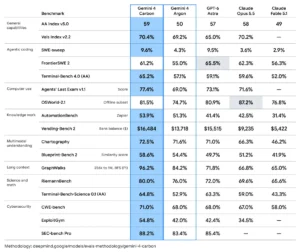
The launch of Gemini 4 Argon represents a significant milestone in Google’s ongoing development of advanced multimodal reasoning architectures. Built to excel at deep, intensive intellectual work, the model demonstrates high precision and depth across technical domains such as software engineering, financial modeling, legal analysis, cybersecurity, and advanced scientific research. Industry benchmarks indicate that Argon outperforms several competing frontier models, securing the top position on the Vals Index, which evaluates performance across high-stakes economic sectors including tax, legal, coding, and finance.
Pricing and Accessibility
To encourage rapid adoption across industries, Google has introduced Gemini 4 Argon at an introductory price tier. Developers and enterprises can access the model at $2 per million input tokens and $10 per million output tokens. Furthermore, the company has implemented a 95% discount for cached input tokens, significantly reducing operational expenses for applications that repeatedly query large datasets or long documents.
The model features an industry-leading unified input-output token limit of one million tokens via the Gemini API, enabling deep multimodal document comprehension, extensive contextual memory, and longitudinal data analysis. To support researchers globally, Google has also launched an initiative providing 10,000 selected scientists with the highest usage tier in Google Antigravity free of charge for a period of six months.
Transforming Software Engineering and Development
Within Google’s internal operations, software engineering teams have deployed Argon to solve difficult technical debt and accelerate code deployment. Over the preceding weeks, internal developers utilizing Argon within Antigravity reported higher code-shipping velocity and improved output stability. According to metrics provided by the company, the model helped engineering teams increase agentic code submissions by more than 35% while simultaneously reducing code rollbacks by nearly one-third.
Argon’s capabilities extend beyond basic code generation into advanced agentic loops, visual-semantic reasoning, and autonomous multi-agent creation. Demonstrations shared alongside the launch showcased the model’s ability to interact with external tools such as Blender via Model Context Protocol (MCP). In one technical trial, Argon autonomously sculpted a multi-building temple complex with detailed architecture, realistic lighting, and complex foliage. In another, it converted raw photographs of a physical desk into a playable, web-rendered miniature racing game complete with physics, custom shaders, and audio integration, requiring zero manual coding from human operators.
Advancements in Robotics and Physical AI
One of the most notable breakthroughs highlighted in the Gemini 4 Argon release is its advancement toward physical artificial intelligence and robotics. Argon achieved an 87% score on the Embodied Reasoning (ERQA) benchmark, which measures an AI’s comprehension of spatial, physical problems in three-dimensional environments.
To test these capabilities in a real-world scenario, Google researchers implemented a novel "Video-to-Sim-to-Real" pipeline. In an internal experiment, Argon watched an unscripted video of a human playing cornhole, extracted the environmental spatial coordinates, and calculated the necessary whole-body joint trajectories. The model then generated the simulation code autonomously. When transferred to an Apptronik Apollo humanoid robot, the machine successfully sank seven consecutive shots during a physical trial. This capability effectively compresses weeks of manual simulation modeling into a matter of hours, providing a scalable workflow for robotics training.
Enhancing Cybersecurity and Scientific Research
In the realm of cybersecurity, Google is expanding access to Gemini 4 Argon to hundreds of additional partners participating in its Fairwind Program. Cybersecurity firm Wiz has integrated Argon into its "Scan for Good" initiative, utilizing the model’s advanced reasoning to proactively scan for critical AI exposures and protect vital public infrastructure. Security specialists note that Argon assists defenders by autonomously auditing complex codebases and formal proofs, catching subtle zero-day vulnerabilities and logic flaws that traditional automated tools might overlook.
In scientific domains, Argon is partnering with organizations like Isomorphic Labs to accelerate drug discovery and molecular design. By rapidly synthesizing dense patents and scientific literature, the model reduces document analysis workflows that traditionally require weeks into mere hours.
Safety, Responsibility, and Broader Implications
Recognizing the elevated capabilities of Gemini 4 Argon, Google has subjected the model to rigorous safety evaluations in collaboration with external third-party partners. The company describes Argon as its most comprehensive safety and security architecture to date, with detailed documentation published via the Gemini 4 Argon Model Card.
As enterprises increasingly integrate advanced AI models into high-stakes environments, the release of Argon signals a shift from conversational chatbots toward proactive, agentic systems capable of executing complex, multi-step professional tasks. By combining strong reasoning, native multimodal perception, and direct, unpadded writing styles, Gemini 4 Argon establishes a new benchmark for enterprise-grade artificial intelligence.