The Evolution of RAG and the Visual Data Gap
The history of RAG systems began with simple text indexing, which relied on chunking documents into smaller, searchable segments. This methodology was highly effective for policy manuals, legal transcripts, and simple knowledge bases. However, the rise of "complex documents"—defined as PDFs containing non-linear layouts, multi-column formatting, and graphical representations—exposed the limitations of these early models.
According to recent benchmarks in document AI, approximately 40% to 60% of critical information in technical white papers and quarterly financial reports is embedded within non-textual elements. When a standard RAG pipeline attempts to ingest such a document, the underlying process often ignores images entirely or converts tables into mangled, unreadable text. This results in "hallucination-prone" responses where the model lacks the necessary visual context to verify its conclusions. The shift toward multi-modal RAG represents a strategic pivot, moving from simple keyword matching to holistic document comprehension.
Architecting the Multi-Modal Pipeline: A Four-Stage Framework
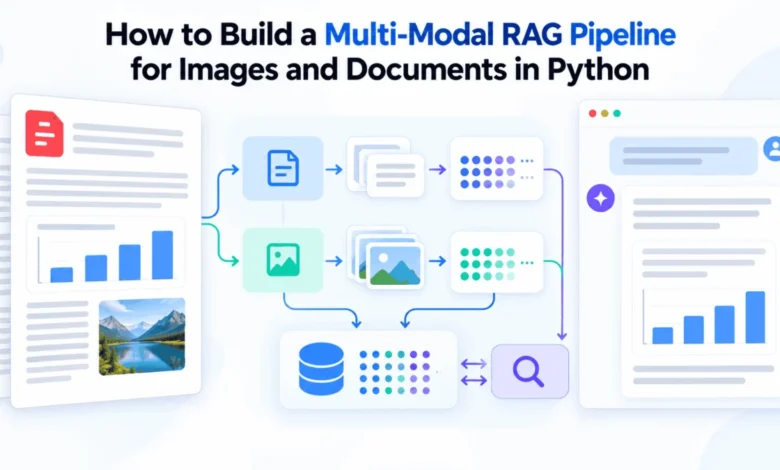
To overcome these limitations, developers are increasingly adopting a four-stage pipeline that ensures both text and image data are preserved, summarized, and cross-referenced.
Phase 1: Intelligent Parsing
The process begins with advanced document partitioning. Tools like the unstructured library, coupled with poppler-utils, allow for the separation of document elements. Rather than flattening a PDF into a single string of text, this stage classifies elements into distinct categories: "CompositeElement" for text blocks and "Image" for visual content. By utilizing infer_table_structure=True, the system can preserve the relationship between data points within tables, ensuring that the semantic integrity of the document remains intact.
Phase 2: Generating Semantic Image Proxies
The most significant hurdle in multi-modal retrieval is that vector databases cannot natively "see" images. To solve this, the pipeline generates textual descriptions for each visual element. By passing extracted images through a multimodal engine like GPT-4o, the system creates dense, descriptive summaries. These summaries serve as "searchable proxies." When a user queries the system, the vector database finds these descriptions rather than the images themselves, effectively linking the visual content to the user’s natural language request.
Phase 3: Implementing the Multi-Vector Store
The heart of the system is the MultiVectorRetriever. Unlike traditional stores, this architecture maintains a dual-storage mechanism: a vector store for high-speed similarity search and an in-memory document store for raw data retrieval. By assigning unique identifiers (UUIDs) to every chunk of text and image summary, the system ensures that when a specific description is matched during a query, the corresponding high-resolution image file can be retrieved and fed directly into the model’s context window.
Phase 4: Multimodal Synthesis
The final phase occurs during the inference request. When a user submits a query, the retriever fetches both relevant text chunks and images. The system then assembles these into a unified prompt, presenting the visual evidence alongside the textual context to the large language model. This enables the model to reason across different modalities, providing answers such as, "The chart on page 4, combined with the text in section 2, indicates a 15% growth in Q3 revenue."
Technical Implementation and Prerequisites
Implementing this system requires a robust development environment. Developers must ensure the installation of key libraries, including langchain, langchain-openai, unstructured, and chromadb. The system relies on the following configuration:
# Core installation for the pipeline
pip install langchain langchain-openai unstructured[pdf] chromadb pillow
apt-get install -y poppler-utils
Following installation, the environment must be authenticated with an OpenAI API key. The use of text-embedding-3-small is recommended for balancing performance and cost-efficiency when generating the vector embeddings.
Implications for Business and Research
The implications of this technology are profound. In the financial sector, analysts can query entire libraries of annual reports to identify trends in competitive landscape visuals. In the manufacturing sector, maintenance technicians can query thousands of pages of engineering manuals to retrieve specific diagrams, reducing downtime.
However, industry experts caution that cost management is essential. Each image processing event triggers an API call; therefore, production-level pipelines should incorporate pre-processing filters. For instance, filtering out small icons or repetitive headers can significantly reduce latency and operational expenditures without compromising the quality of the retrieval results.
Future Trajectories: The Shift to Vision-Language Models
As of late 2024 and moving into 2025, the research community is trending toward "end-to-end" vision-language models (VLMs). Technologies like ColPali represent the next frontier, where document pages are embedded directly as images, bypassing the need for separate OCR or manual summarization steps. While the pipeline described here remains the industry standard for its interpretability and reliability on standard hardware, the future of document AI is clearly moving toward models that natively interpret visual space.
Summary of Best Practices
For teams looking to deploy this in a production environment, three factors are critical:
- Metadata Tagging: Always attach source metadata to your
Documentobjects. This allows for source tracing, which is vital for compliance and auditing. - Persistence: While an
InMemoryStoreis excellent for development, production systems should transition to persistent storage solutions like ChromaDB on disk or enterprise-grade vector databases like Pinecone or Weaviate. - Re-ranking: Integrate a cross-encoder re-ranker after the initial retrieval step to ensure that the retrieved text and images are highly relevant to the specific user question, thereby minimizing noise and improving the final synthesis.
By transitioning from text-only RAG to a multi-modal framework, organizations can unlock the "hidden" knowledge trapped within their document repositories. This architecture not only enhances the accuracy of AI responses but also fundamentally changes how businesses interact with their own internal data, turning static PDFs into dynamic, intelligent assets. As the capability of vision-language models continues to grow, the ability to effectively parse, store, and retrieve visual and textual evidence will become the defining competitive advantage in the AI-driven enterprise.