How SerpApi Markdown Output Drastically Reduces AI Token Consumption and Operational Costs

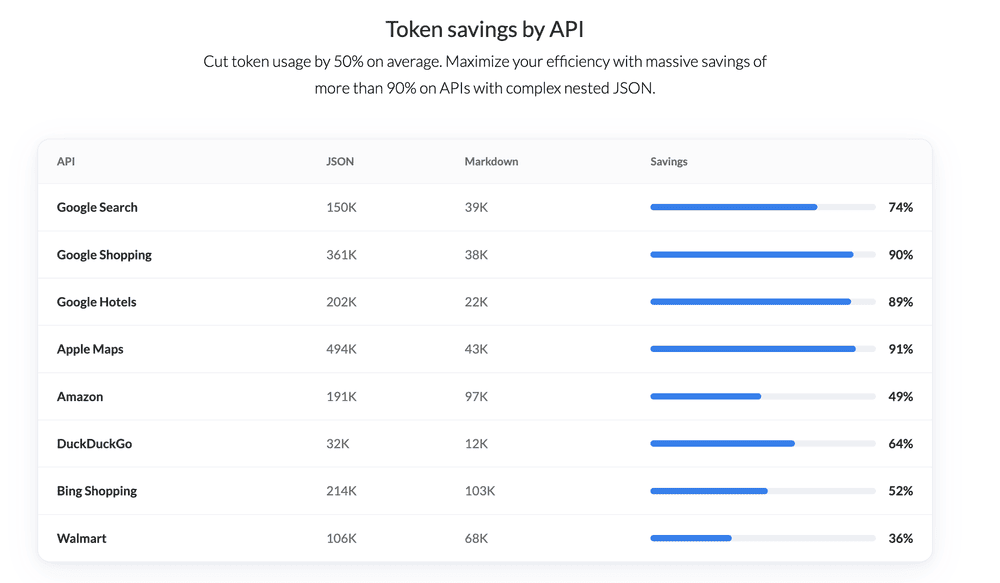
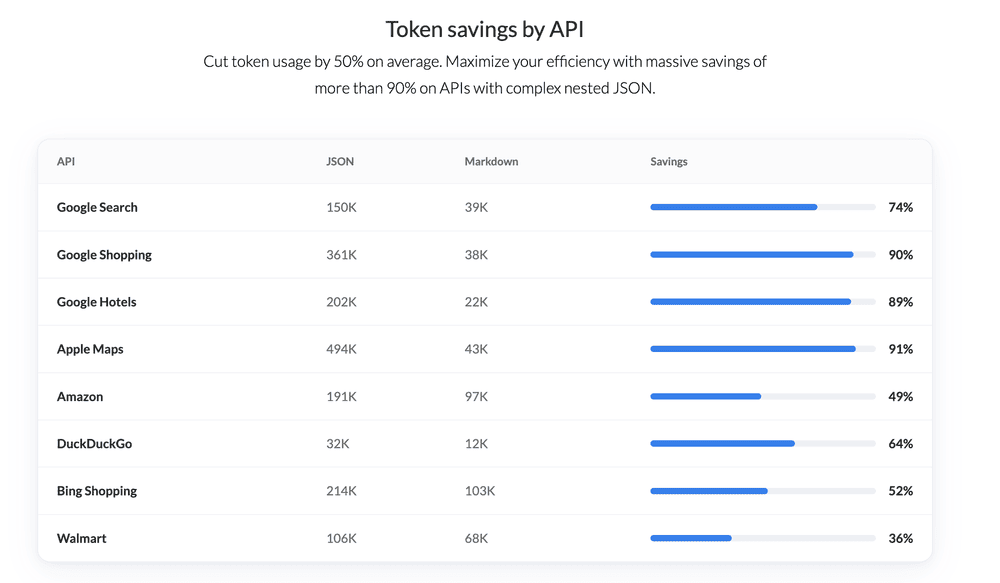
In the rapidly evolving ecosystem of Large Language Models (LLMs) and autonomous AI agents, the efficiency of data retrieval has emerged as a critical bottleneck for both performance and profitability. As developers build increasingly complex agentic workflows—systems that autonomously search, reason, and act—they have encountered an unexpected financial hurdle: the sheer volume of "noise" inherent in traditional data formats. JSON, the industry standard for web APIs, is built for machine readability and structured data exchange, but when fed into an LLM, it carries a heavy tax. Every brace, bracket, and null field consumes expensive input tokens, often resulting in massive operational overhead. SerpApi, a leading provider of search engine data, has introduced a Markdown output format designed to strip away this structural redundancy, offering developers a pathway to slash token consumption by as much as 75 percent.
The Token Economy and the Problem of Data Bloat
The current state of AI development is defined by context windows—the limited amount of information an LLM can "see" at any given time. When an AI agent performs a search, it often pulls in comprehensive metadata, nested objects, and tracking parameters that are essential for a web browser or a database, but largely useless for a model tasked with summarizing information.
For instance, a standard search query for a common topic might return thousands of lines of JSON. In this format, the model must process structural characters that offer no semantic value. If an agent runs recursively—performing multiple searches and filtering through logs—this bloat compounds exponentially. A single query that requires 25,000 tokens in JSON might represent only a few hundred words of actual informational content. By the time the LLM processes this data, the developer has paid for the privilege of the model "reading" thousands of tokens that do not contribute to the final reasoning or output. This inefficiency is not merely a cost issue; it is a latency issue, as processing redundant tokens slows down the response time of the agent, creating a drag on user experience.
Chronology of Data Delivery: From JSON to Markdown
The reliance on JSON has historical roots in the early days of the web, where developers needed a format that was easily serializable and parsable by front-end applications. For years, SerpApi and similar services provided data in JSON because it guaranteed consistency for software engineers. However, the rise of Generative AI necessitated a shift in perspective.
As the industry moved toward Retrieval-Augmented Generation (RAG) and agentic frameworks in 2023 and 2024, the demand for "AI-ready" data formats became undeniable. Developers began manually stripping JSON responses, writing custom parsers to discard metadata before injecting the content into a prompt. Recognizing this shift, SerpApi initiated the development of a native Markdown output feature. By late 2024, the company integrated this capability directly into its API infrastructure, allowing users to request a response in a format that mirrors how a human reads a search results page—prioritizing content, links, and summaries over structural code.
Comparative Analysis: Quantifying the Savings
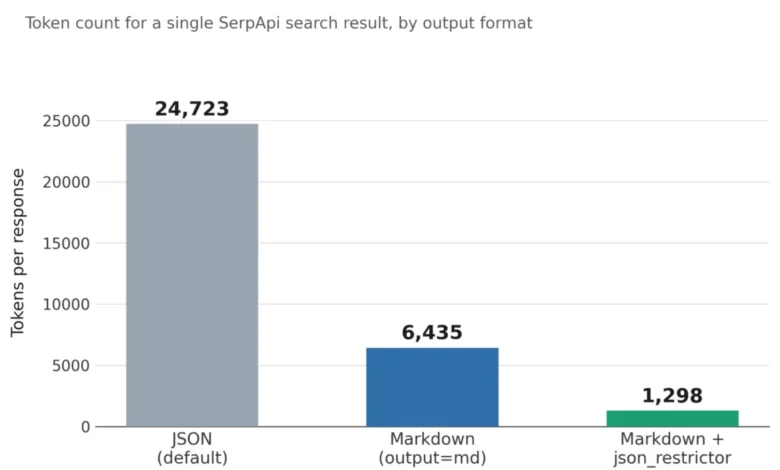
The technical shift from JSON to Markdown is not merely aesthetic; it is a fundamental reduction in data complexity. In a controlled test performed by SerpApi, a search query for "coffee" returned a JSON payload of 24,723 tokens. When the same query was executed with the Markdown output parameter enabled, the footprint dropped to 6,435 tokens—a reduction of approximately 74 percent. Further optimization, such as using field restriction tools, allowed for an even more dramatic reduction to 1,298 tokens.
The implications for enterprise-level applications are profound. If a company runs 10,000 AI agent queries per day, the difference between 24,000 tokens and 6,000 tokens per call is the difference between manageable operational costs and prohibitive expenses. Furthermore, by freeing up space in the context window, developers can fit more retrieved documents into a single prompt, effectively increasing the "intelligence" of the agent without needing to upgrade to a more expensive, larger-window model.
Understanding the Trade-offs: When to Avoid Markdown
While Markdown offers significant advantages for summarization and agentic reasoning, it is not a universal replacement for JSON. The industry standard remains vital for specific use cases. If a pipeline requires precise numeric data—such as currency conversions, stock price analysis, or coordinates for geospatial mapping—JSON’s rigid structure is necessary to ensure data integrity.
In JSON, fields like price, coupon_discount, or rating are explicitly typed as integers or floats. An AI agent might interpret a price in Markdown as text, which could lead to errors if that agent is subsequently tasked with performing mathematical calculations. Consequently, developers must distinguish between "reasoning tasks" and "data processing tasks." When an agent is summarizing a product review, Markdown is superior. When an agent is calculating the total cost of a shopping cart across ten different retailers, JSON remains the required format.
Implementation and Integration
SerpApi has designed the transition to Markdown to be frictionless. By adding a simple query parameter—such as output=md—to an API request, developers can immediately toggle between formats. This feature is available across the entire suite of over 100 search APIs, including Google, Bing, Baidu, and Naver.
The transformation process involves the automatic stripping of internal tracking noise, the flattening of nested objects, and the conversion of data structures into clean Markdown tables and headers. Additionally, SerpApi provides a json_restrictor feature, which allows developers to perform server-side filtering. By requesting only the specific keys required for the prompt, the developer ensures that only the necessary information traverses the network, further minimizing latency and token count.
Broader Implications for the AI Industry
The introduction of native Markdown support for API outputs signals a maturing of the AI infrastructure sector. As the novelty of Large Language Models fades and the focus shifts to production-grade deployment, "token engineering"—the intentional management of data payloads to maximize token efficiency—is becoming a specialized skill.
Companies are realizing that the cost of AI is not just the cost of the model itself, but the cost of the "plumbing" that feeds the model. If data providers continue to evolve their delivery methods to accommodate LLMs, the total cost of ownership for AI agents will likely decline, enabling more complex applications that were previously too expensive to maintain.
Looking ahead, the industry may see a shift toward even more specialized formats. While Markdown is the current solution for human-readable content, researchers are exploring "compressed representation" formats that retain the machine-parseability of JSON while achieving the token density of Markdown. Until those standards are finalized, however, the move to Markdown represents the most accessible and effective way for developers to optimize their AI agents today.
Conclusion
For organizations relying on search data to power their AI agents, the move to Markdown is a clear strategic imperative. It reduces the overhead of redundant tokens, lowers costs, and improves the efficiency of the reasoning process. By shifting the focus from machine-parsable code to human-readable information, SerpApi has provided a blueprint for how data providers can adapt to the constraints of the AI era. Developers are encouraged to audit their existing workflows, compare their current JSON-based token usage against Markdown-optimized results, and integrate these efficiencies to ensure their AI systems remain both competitive and sustainable. As the token economy continues to dictate the feasibility of AI applications, those who optimize their data payloads today will be better positioned to scale their operations tomorrow.