GMKtec NucBox EVO-X1 Pro Review: Powerful AMD Ryzen AI Mini PC Hindered by Pricing and Soldered Memory

The mini PC market has experienced a significant paradigm shift over the past several years, transitioning from simple, low-powered office boxes into high-performance computing powerhouses capable of handling local artificial intelligence models, professional workloads, and even moderate gaming. Manufacturers are continually pushing the boundaries of what is physically possible inside ultra-compact chassis configurations. Among these, GMKtec has established a reputation for rapid iteration, frequently updating its hardware lines to incorporate the latest silicon architectures before previous generations have even fully matured in the consumer marketplace.
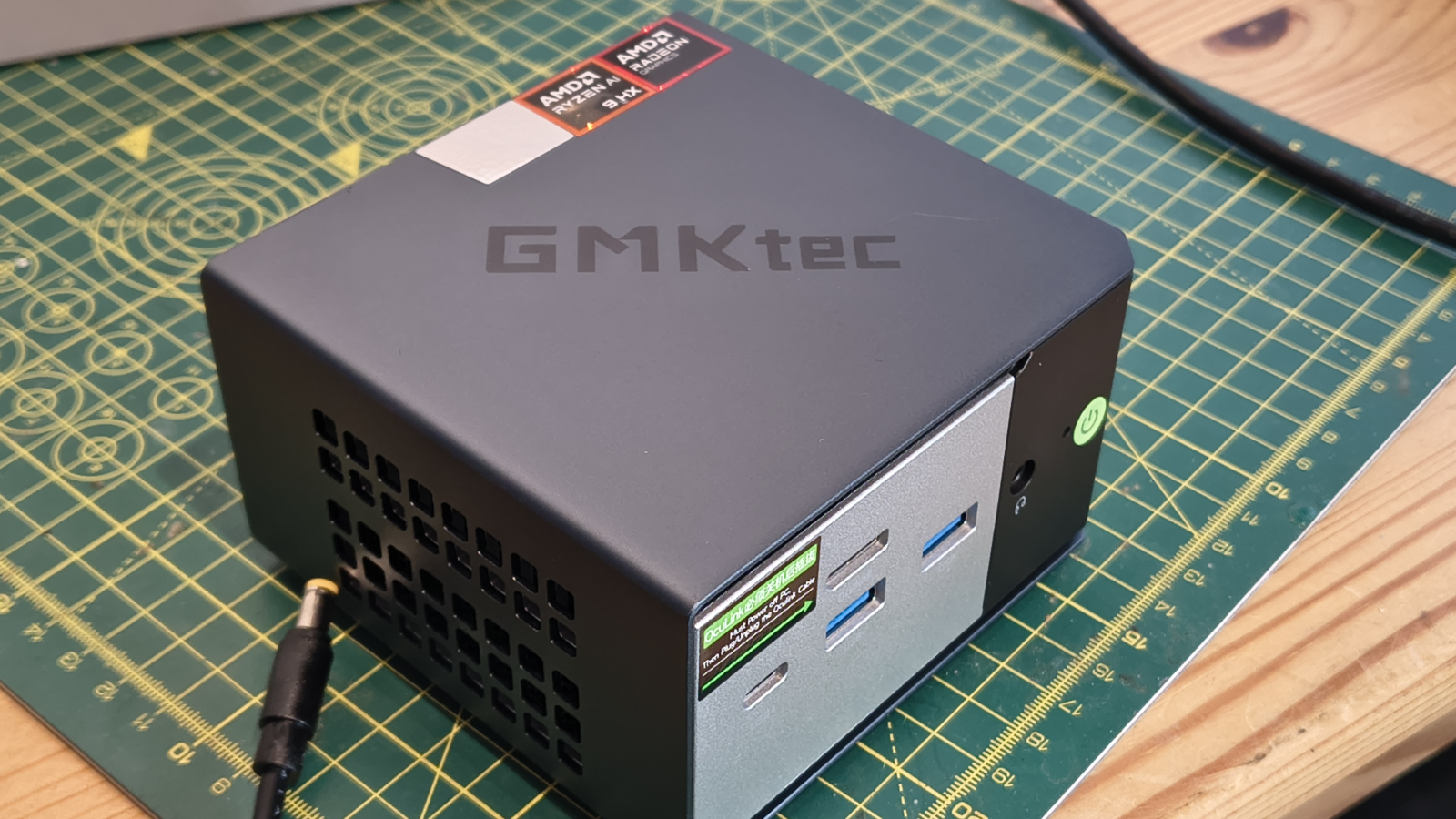
The GMKtec NucBox EVO-X1 Pro AMD Ryzen AI 9 HX 470 AI Mini PC represents the latest attempt to marry cutting-edge processing capabilities with an ultra-small form factor. Built upon AMD’s Zen 5 architecture and Gorgon Point silicon, this device sits firmly at the high end of the current compact desktop ecosystem. However, despite its impressive physical footprint and formidable processing credentials, the machine enters a challenging market where escalating memory costs and architectural design choices force buyers to carefully weigh performance against long-term flexibility and overall financial value.
Architectural Overview and Core Specifications
At the heart of the EVO-X1 Pro is the AMD Ryzen AI 9 HX 470 processor, belonging to AMD’s Ryzen AI 400 family. Codenamed Gorgon Point, this chip serves as a direct architectural refresh of the earlier Strix Point silicon, which notably powered the preceding HX 370 iteration. The core layout remains structurally identical, featuring a hybrid configuration comprising four full-performance Zen 5 cores paired with eight energy-efficient Zen 5c cores, totaling 12 cores and 24 threads.
Performance gains moving from the HX 370 to the HX 470 are incremental rather than revolutionary. The maximum boost clock has been elevated by 100MHz to reach 5.2GHz, while the integrated Radeon 890M graphics engine—boasting 16 compute units—now operates at up to 3.1GHz compared to its predecessor’s 2.9GHz limit. Additionally, the integrated Neural Processing Unit (NPU) sees a modest bump, rising from 50 TOPS to 55 TOPS (Int8), contributing to an aggregate platform AI throughput of up to 86 TOPS across the CPU, GPU, and NPU combined.
Thermal and power management on the 4nm processor have been engineered to scale flexibly. While AMD’s baseline design specifies a default thermal design power (TDP) of 28W—configurable between 15W and 54W—GMKtec has pushed the boundaries further via a system-level tuning profile that allows the processor to hit a 65W peak in its most aggressive performance mode. To manage this thermal output, the chassis utilizes a sophisticated vapor chamber dual-fan cooling system, separating airflow for the main processor and the internal system components.
Pricing, Configurations, and Market Positioning
Market availability and pricing strategies for high-end mini PCs have faced intense scrutiny recently, driven largely by global fluctuations in dynamic random-access memory (DRAM) and NAND flash pricing. GMKtec lists the EVO-X1 Pro on its official US storefront with an introductory price tag of $1,599.99 for the baseline review configuration, which pairs the Ryzen AI 9 HX 470 processor with 64GB of RAM and a 1TB solid-state drive. A larger storage tier featuring a 2TB capacity is priced at $1,769.99.
These figures place the EVO-X1 Pro in direct competition with other flagship compact systems from established manufacturers. For instance, the MINISFORUM AI X1 Pro-470, which utilizes the exact same core processing platform, commands a slightly higher price of $1,655 for an equivalent 64GB and 1TB specification. Similarly, the Beelink SER10 MAX, equipped with the same AMD Ryzen AI 9 HX 470 silicon, retails at approximately $1,699 for a matching configuration.
A critical point of divergence among these competing platforms lies in how memory is integrated onto the motherboard. While competitors like MINISFORUM and Beelink frequently opt for socketed SODIMM memory slots—allowing users to upgrade or replace RAM modules down the line at the expense of minor speed penalties—GMKtec has chosen to solder 64GB of high-speed LPDDR5 memory directly onto the mainboard of the EVO-X1 Pro. Operating at 6400MT/s, this soldered memory configuration delivers exceptional speed and bandwidth, which proves particularly beneficial for memory-intensive multi-threaded tasks and local large language model (LLM) execution. However, it entirely eliminates any future upgrade path, meaning buyers must commit to their maximum memory requirements at the point of purchase.
For consumers operating on tighter financial constraints, GMKtec also offers a lower-tier alternative utilizing the older HX 370 processor paired with 32GB of soldered RAM and 1TB of storage for $1,149.99. This creates a notable $450 price gap between the 32GB HX 370 model and the 64GB HX 470 flagship, forcing a critical cost-benefit analysis for prospective buyers regarding whether the marginal processing gains and doubled memory capacity justify the substantial financial premium.
Design, Physical Layout, and Connectivity
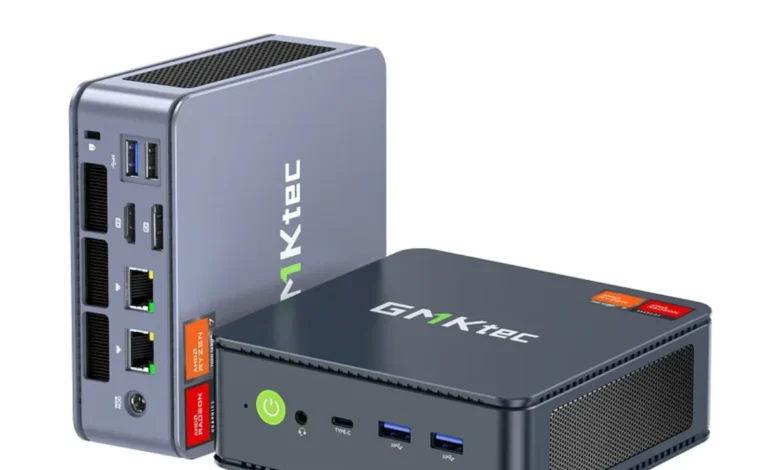
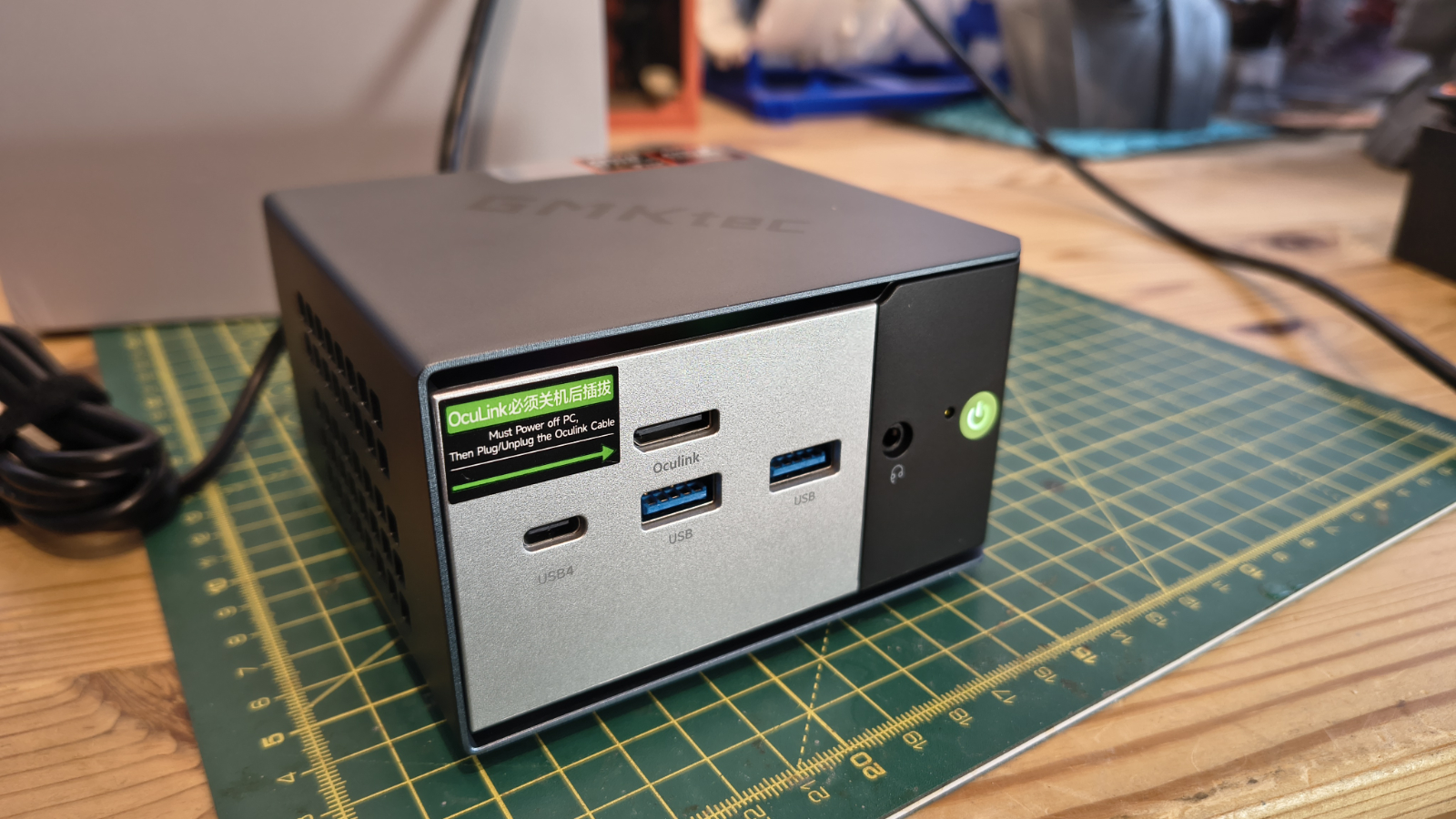
The physical chassis of the EVO-X1 Pro remains unchanged from its predecessor, maintaining a compact footprint measuring 107 by 111 by 63 millimeters and weighing approximately 590 grams. This small-form-factor design makes the device ideal for desktop placement or discreet mounting behind a monitor using the included VESA mounting bracket.
Despite utilizing a dual-fan cooling architecture that drew occasional criticism for noise in earlier iterations, the EVO-X1 Pro operates remarkably quietly under standard workloads and benchmarking stress. Under heavy multi-core loads in performance mode, the exhaust air expelled from the side vents becomes noticeably warm, confirming that the vapor chamber cooling system is actively dissipating thermal energy away from the dense internal components.
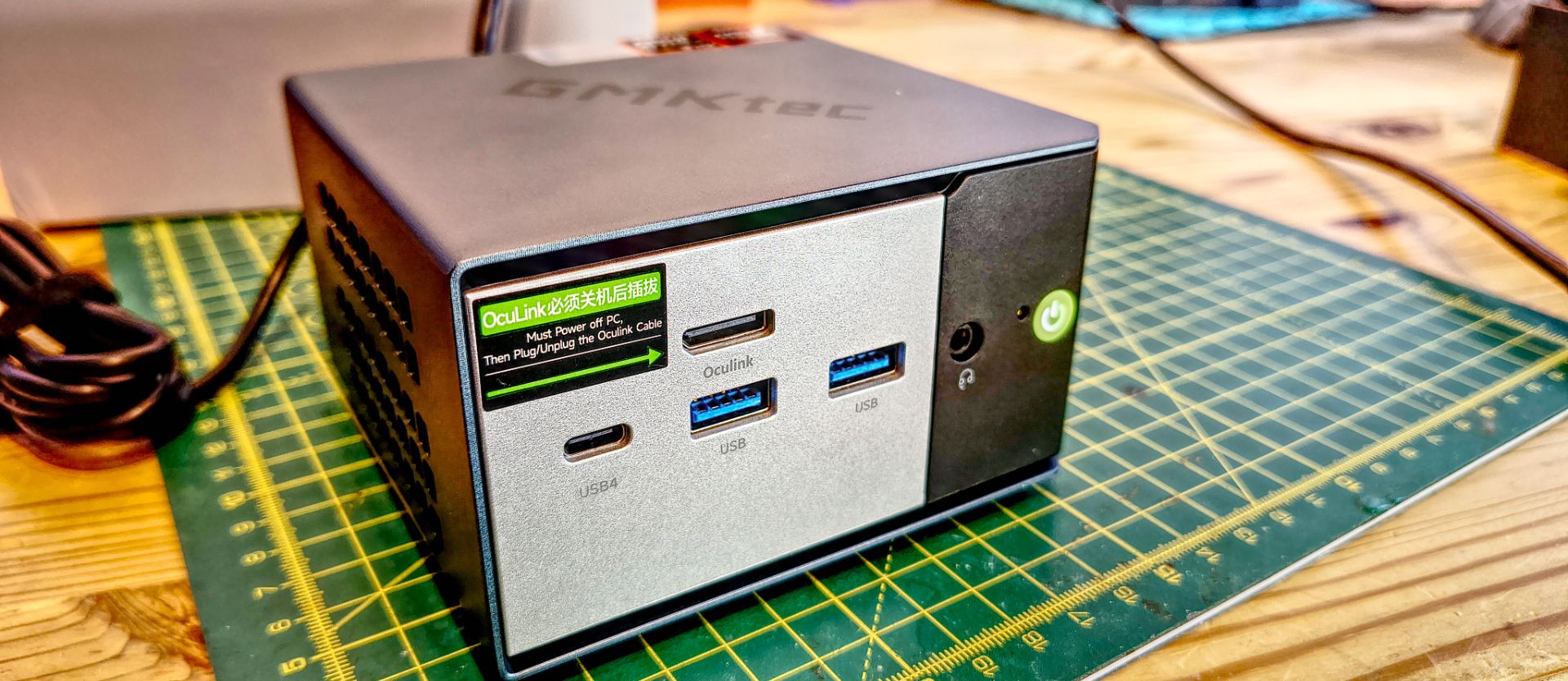
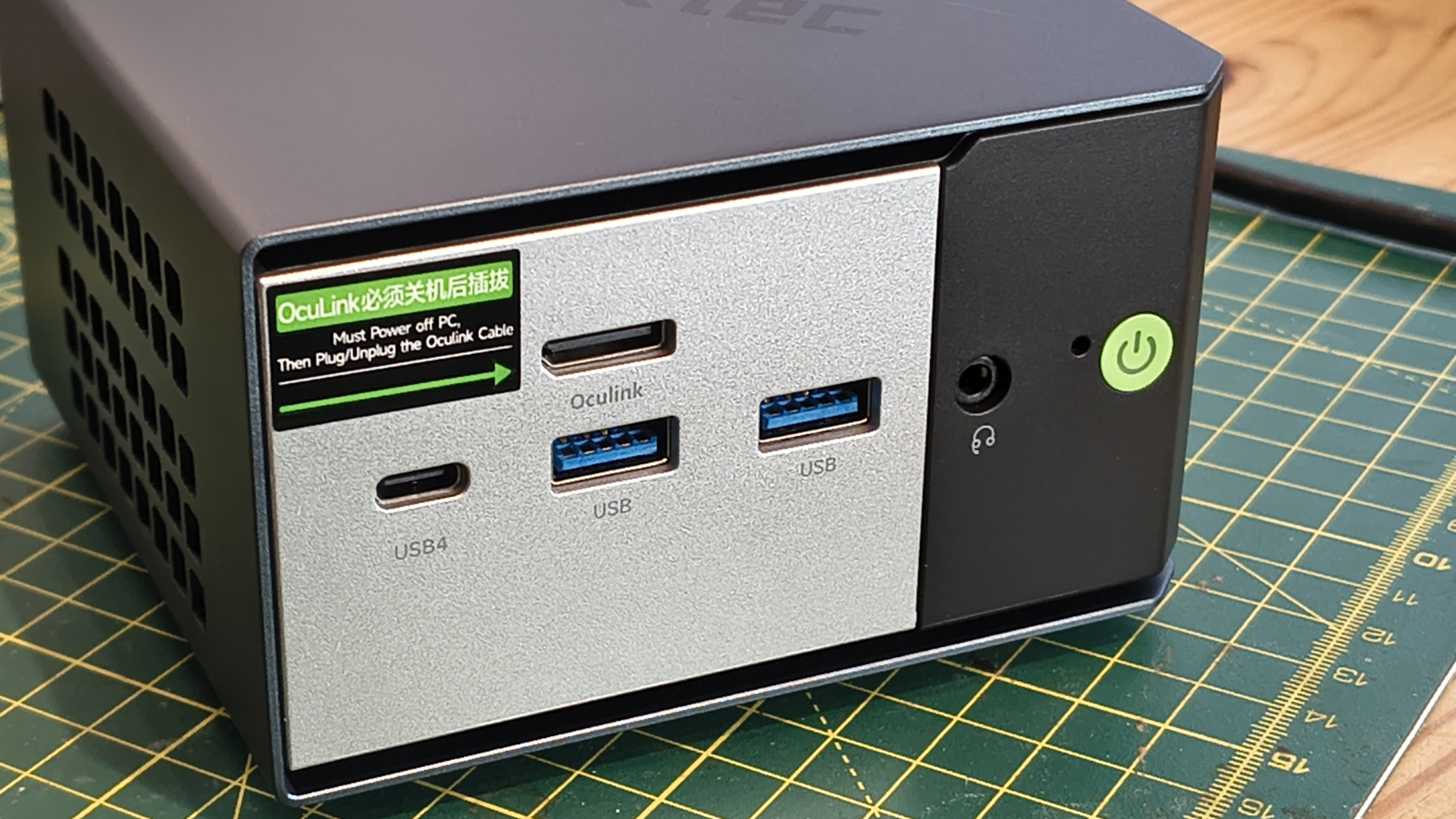
Port selection is a distinct strength of the EVO-X1 Pro ecosystem. The front panel features a generous array of connections, including two USB 3.2 Gen 2 Type-A ports, a high-bandwidth USB4 port supporting 40Gbps data transfer, Power Delivery 3.0, and display output, alongside a 3.5mm CTIA audio jack and an illuminated power button. Uniquely, the front panel also houses an OCuLink port, providing a direct PCIe 4.0 x4 connection for external high-performance hardware such as dedicated desktop graphics card docks.
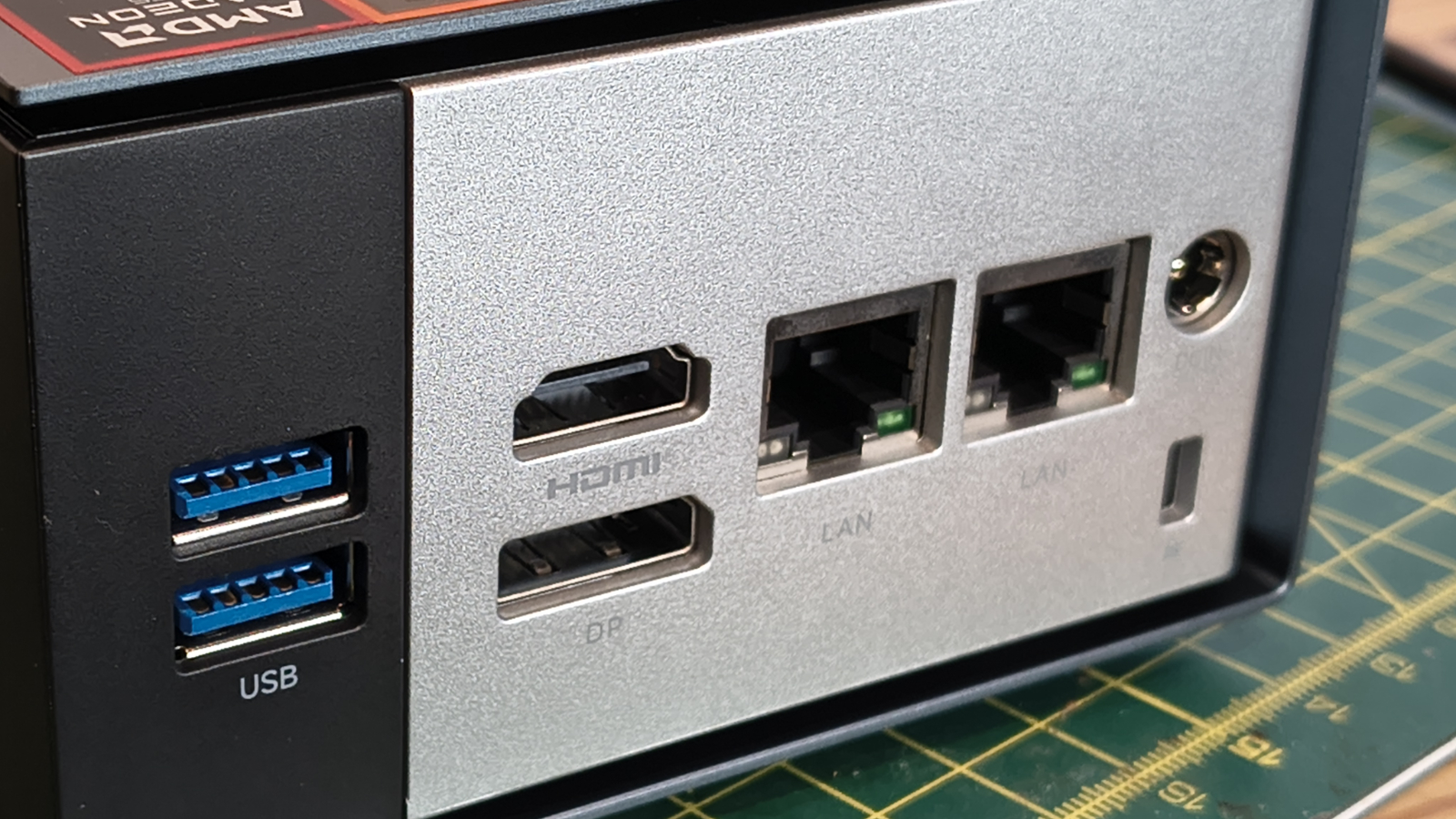
The rear panel expands connectivity further with two additional USB 3.2 Gen 2 Type-A ports, dual 2.5GbE RJ45 Ethernet LAN ports for robust wired networking, an HDMI 2.1 port, and a DisplayPort 2.1 port. Both video outputs are capable of driving resolutions up to 8K at 60Hz. When combined with the front-facing USB4 port, the machine can effortlessly orchestrate a triple-display workstation setup. Wireless communication is handled via cutting-edge Wi-Fi 7 and Bluetooth 5.4 modules.
Internal Expansion and Storage Capabilities
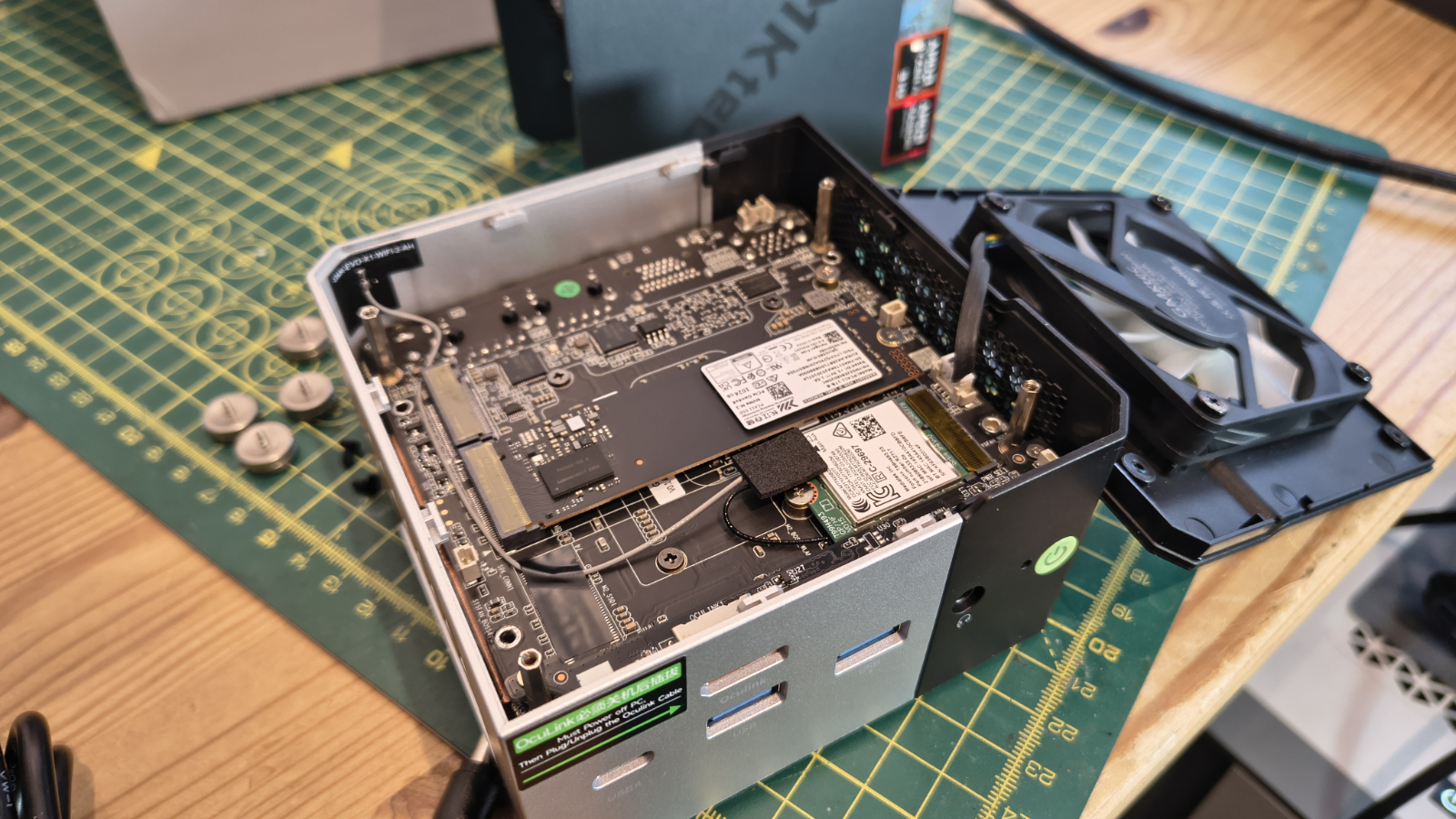
Accessing the internal components of the EVO-X1 Pro requires a multi-step procedure. Initial removal involves unscrewing the threaded rubber feet at the base of the unit, which allows the outer metal casing—covering the bottom, top, and left side—to slide away. From there, an internal secondary shroud secured by four additional screws must be removed to access the primary storage bays.
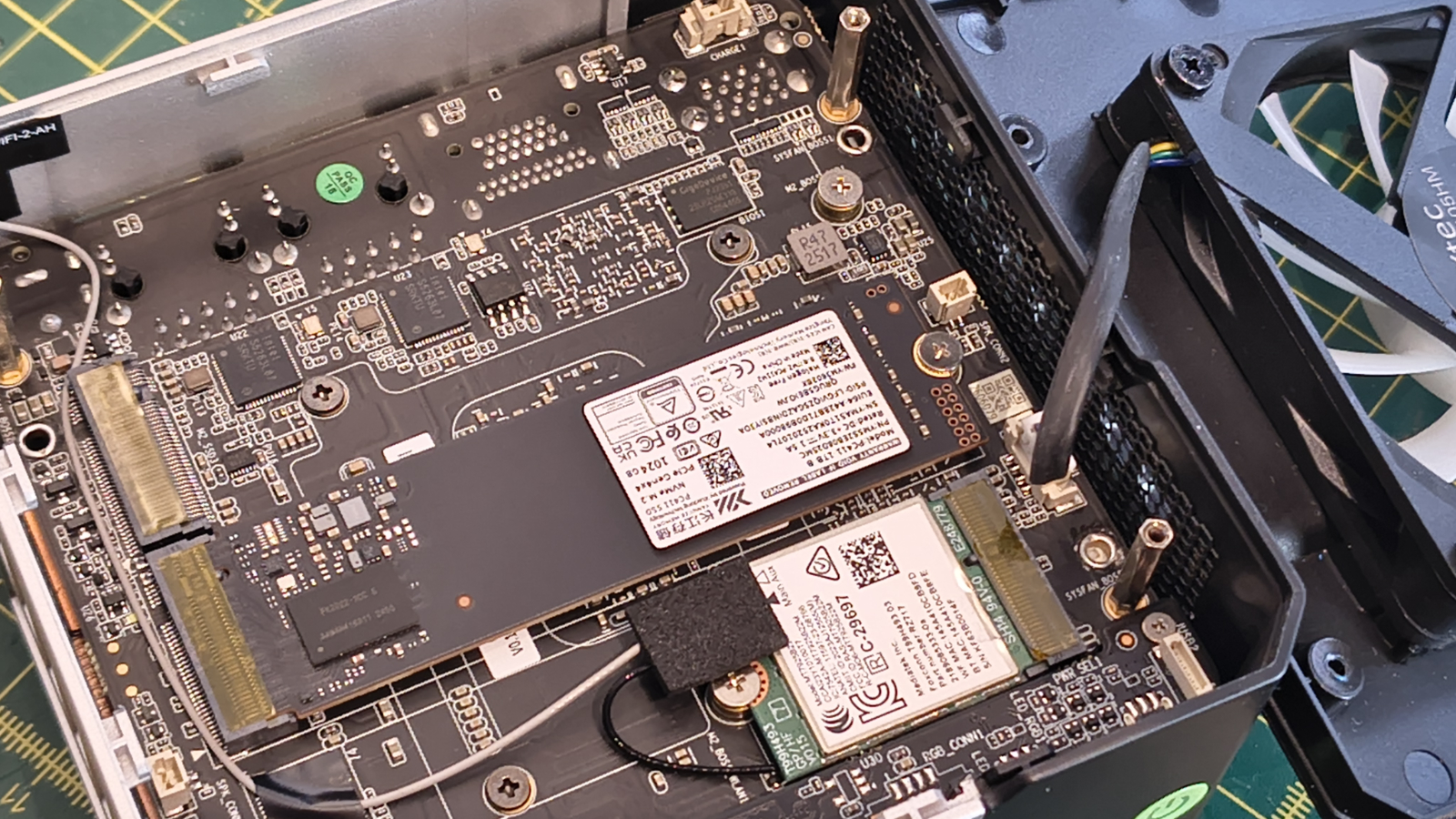
Storage expandability is exceptionally robust for a device of this size. The motherboard features two M.2 2280 NVMe PCIe 4.0 x4 slots. One slot comes pre-populated with a 1TB Gen4 solid-state drive, while the second slot remains fully open for user expansion. Because modern 2280-form-factor NVMe drives are available in capacities reaching up to 8TB, users can theoretically outfit this miniature desktop with a staggering 16TB of high-speed internal storage. Furthermore, enthusiasts willing to sacrifice the pre-installed wireless card can potentially repurpose the M.2 2230 Wi-Fi slot for additional proprietary expansion, although doing so requires forfeiting native wireless networking capabilities.
Performance Evaluation and Comparative Analysis
In benchmark testing, the AMD Ryzen AI 9 HX 470 platform demonstrates commanding multi-threaded processing power and graphical efficiency. In synthetic evaluations such as Cinebench 2024 and Geekbench 6, the processor yields scores that closely rival or exceed comparable Intel-based offerings in the mini PC segment, such as Intel Core Ultra 9-powered systems utilizing socketed memory architectures.
In graphics-focused benchmarks, the integrated Radeon 890M GPU performs exceptionally well for an integrated solution. Allocating dedicated system RAM to the frame buffer yields solid results in 3DMark suites like WildLife, FireStrike, and TimeSpy, making casual gaming and graphical rendering entirely viable without an external GPU. However, for users demanding desktop-class gaming performance or intensive machine learning model training, the inclusion of the front-facing OCuLink port serves as an essential lifeline, permitting the attachment of an external desktop graphics card over a high-bandwidth PCIe lane.
Power efficiency remains a hallmark of the AMD silicon. Operating with a baseline TDP of 28W and scaling up to a 65W peak in performance mode, the EVO-X1 Pro strikes a favorable balance between electrical draw and computational output.
Implications and Industry Outlook
The release of the GMKtec NucBox EVO-X1 Pro highlights both the incredible maturation of mini PC engineering and the economic pressures currently facing the hardware industry. On a purely technical level, the machine is a masterclass in packing desktop-grade performance, extensive connectivity, and robust storage expansion into a housing no larger than a thick paperback book.
However, broader economic factors heavily influence its market reception. With component costs—particularly for high-density LPDDR5 memory—remaining elevated, the $1,599 starting price makes the EVO-X1 Pro a significant financial commitment rather than a casual purchase. Furthermore, GMKtec’s decision to offer a limited one-year warranty stands in contrast to competing brands that provide multi-year coverage periods, introducing a consideration for long-term enterprise or consumer investment.
For professionals, developers, and power users who require massive multi-threaded computational power, extensive port versatility, and ample memory in an ultra-compact form factor, the EVO-X1 Pro delivers on its technical promises. Conversely, budget-conscious buyers or those who do not strictly require 64GB of soldered memory would be wise to evaluate the more economical HX 370 configuration, which provides nearly identical day-to-day performance at a significantly reduced cost. Ultimately, while the EVO-X1 Pro is an exemplary piece of engineering, its long-term market success will largely depend on future adjustments in component pricing and manufacturer warranty support.