Google DeepMind Introduces Gemini 3.8 Flash and Gemini 3.8 Flash Cyber to Advance Agentic Workflows and Enterprise Cybersecurity

Google DeepMind has officially unveiled its latest generation of artificial intelligence models, Gemini 3.8 Flash and Gemini 3.8 Flash Cyber, marking a significant milestone in the rapid evolution of the company’s Flash architecture. Announced by Raluca Ada Popa, Gemini Security Lead at Google DeepMind, this release comes just three weeks after the rollout of Gemini 3.7 Flash and represents the third major Flash product launch within a compressed six-week development window. The new models are engineered to deliver next-generation intelligence, robust reasoning, and advanced coding capabilities while maintaining the cost-efficiency and operational speed that have defined the Flash series.

Both variants share a common foundational core that has been significantly accelerated by long-running agentic loops. These loops are designed to recursively evaluate and refine the underlying models, allowing them to tackle complex, multi-step tasks with unprecedented diligence. While the standard Gemini 3.8 Flash is tailored for broad enterprise autonomy and long-horizon software engineering, the specialized Gemini 3.8 Flash Cyber variant is engineered specifically to address critical cybersecurity challenges. This dual release underscores Google DeepMind’s strategic focus on empowering developers and security professionals with frontier-level capabilities at a fraction of the cost of traditional high-end models.
A Chronology of Rapid Innovation
The release of Gemini 3.8 follows a fiercely competitive period in the generative artificial intelligence sector, characterized by iterative updates and accelerated deployment cycles. Over the past year and a half, tech giants have shifted from yearly model refreshes to rapid, continuous deployments, aiming to capture market share in enterprise automation and specialized developer tools.
The timeline leading to the Gemini 3.8 launch highlights Google’s aggressive engineering pace. Just weeks prior, the introduction of Gemini 3.7 Flash set a new benchmark for speed and affordability in high-throughput applications. However, user demand for deeper reasoning, more complex tool-calling capabilities, and enhanced multi-step problem-solving pushed Google DeepMind to fast-track its next generation. By integrating rigorous cybersecurity training directly into the foundational pre-training and alignment phases, the research team was able to elevate the coding and logical deduction skills of the entire model family. This culminated in the simultaneous introduction of the general-purpose 3.8 Flash and the security-focused 3.8 Flash Cyber, the latter of which introduces a novel approach to targeted deployment via trusted partner ecosystems.
Technical Performance and Benchmark Evaluations
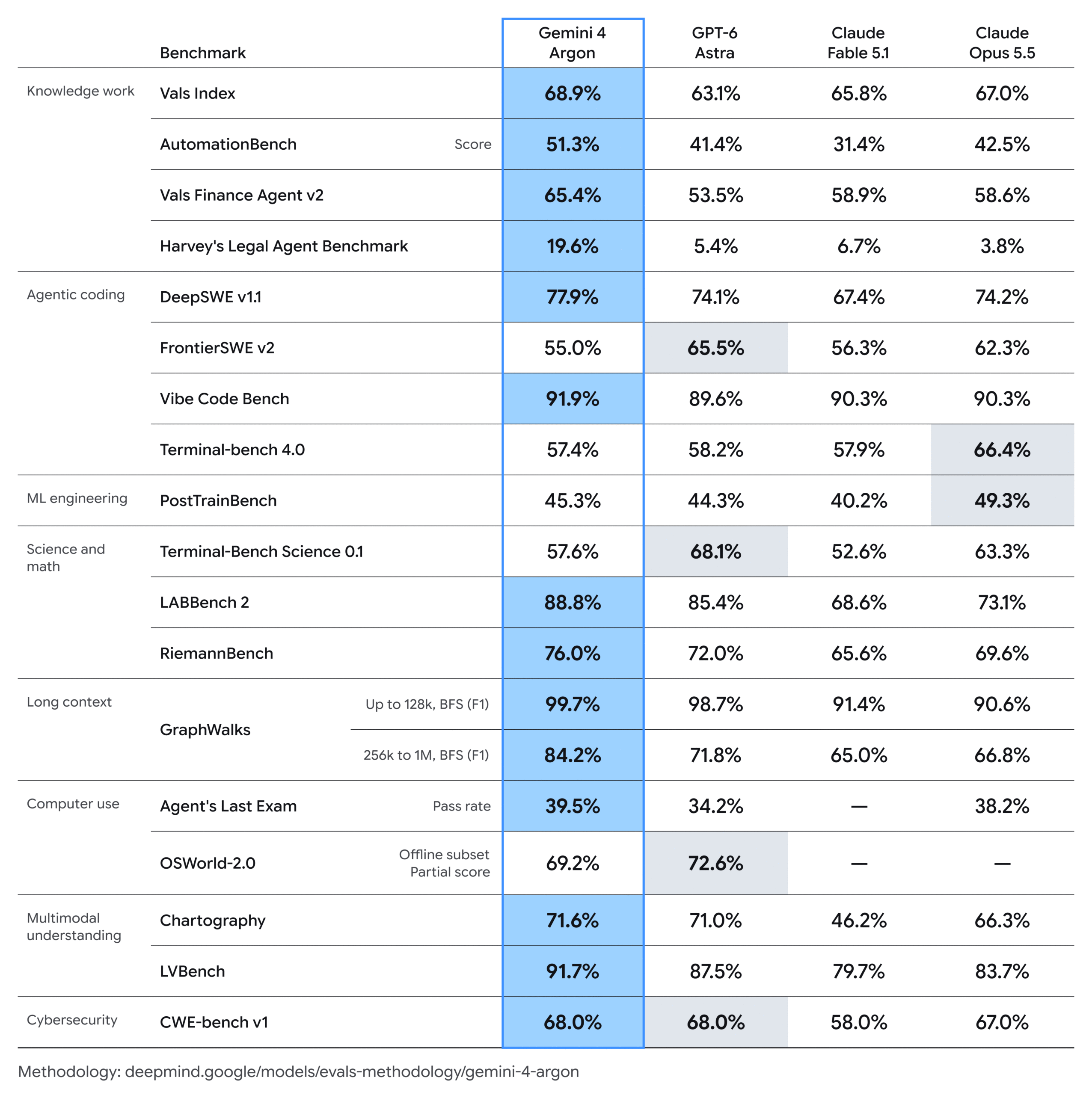
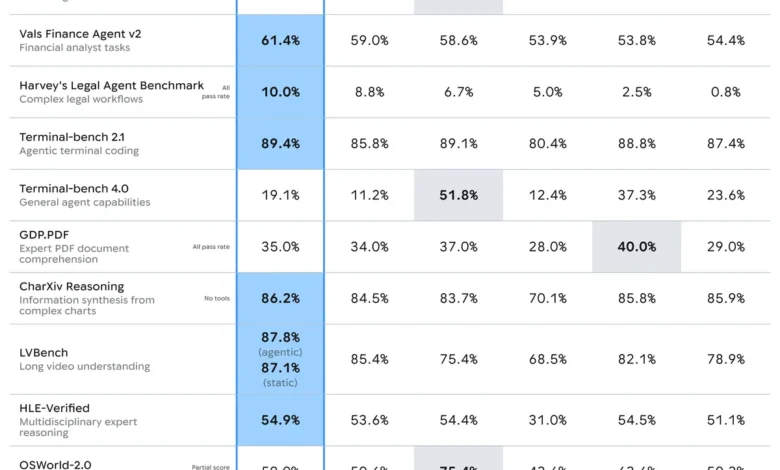
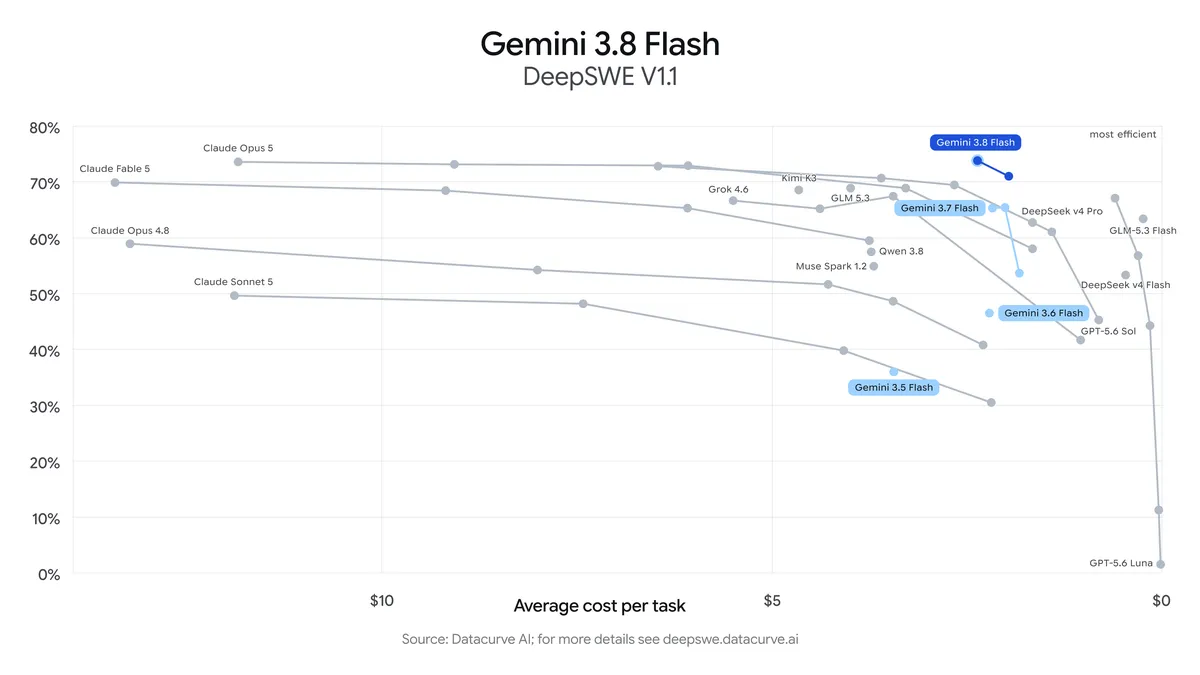
In benchmark evaluations, Gemini 3.8 Flash demonstrates performance that frequently rivals or exceeds much larger, higher-cost frontier models. On the DeepSWE v1.1 benchmark, which measures long-horizon software engineering capabilities, 3.8 Flash excels at autonomously solving complex, multi-file software engineering problems end-to-end. This ability to maintain logical consistency across extended coding sessions addresses one of the primary limitations of earlier lightweight models.
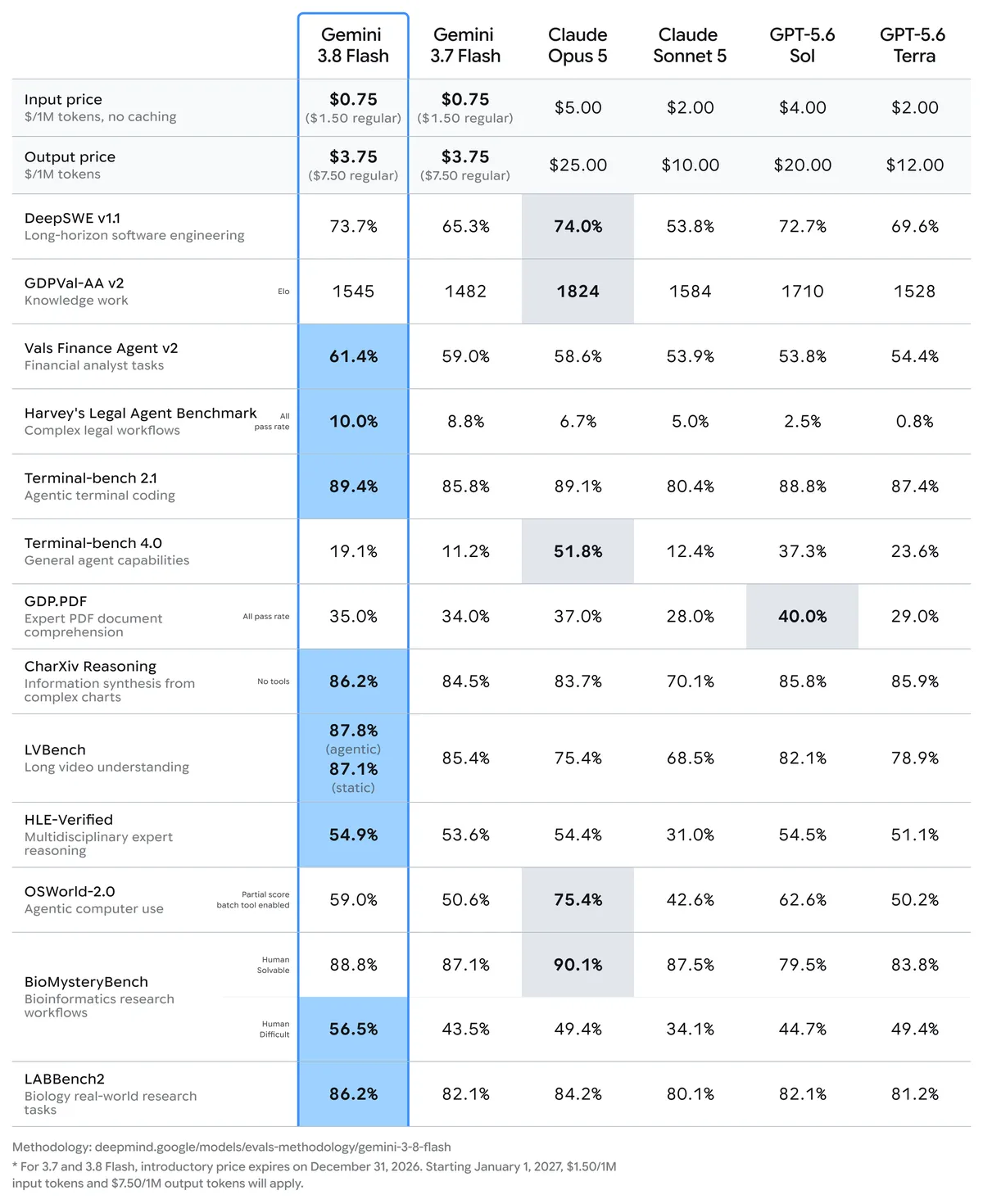
Beyond software engineering, 3.8 Flash exhibits the dependability required for critical enterprise autonomy across specialized knowledge domains. In quantitative and professional fields demanding advanced analysis and reporting, the model surpasses its predecessor and competing frontier architectures on benchmarks such as the Vals Finance Agent V2 and Harvey’s Legal Agent Benchmark. Furthermore, Gemini 3.8 Flash achieves a score of 54.9% on HLE-Verified, illustrating its capacity to handle rigorous, multi-step reasoning across science, technology, engineering, mathematics (STEM), humanities, and professional services.
These performance gains are driven by a deliberate architectural choice: Gemini 3.8 Flash is designed to work harder when confronted with complex tasks. Rather than rushing to a single-pass answer, the model exhibits greater diligence by executing extra reasoning steps and calling external tools iteratively. While this approach may occasionally utilize more tokens to maximize output quality—particularly at higher user-configured effort levels—developers retain granular control. Applications prioritizing compute efficiency can utilize lower effort settings to minimize token overhead or continue leveraging Gemini 3.7 Flash, which Google DeepMind confirmed will remain fully supported for efficiency-first workloads.
Gemini 3.8 Flash Cyber: Expert Performance for Defenders
The introduction of Gemini 3.8 Flash Cyber addresses a critical imbalance in the modern threat landscape, where attackers have increasingly sought to leverage artificial intelligence for malicious objectives. Available initially to a select group of trusted defenders through the Fairwind Program, Gemini 3.8 Flash Cyber provides a decisive advantage in vulnerability discovery and automated patching.
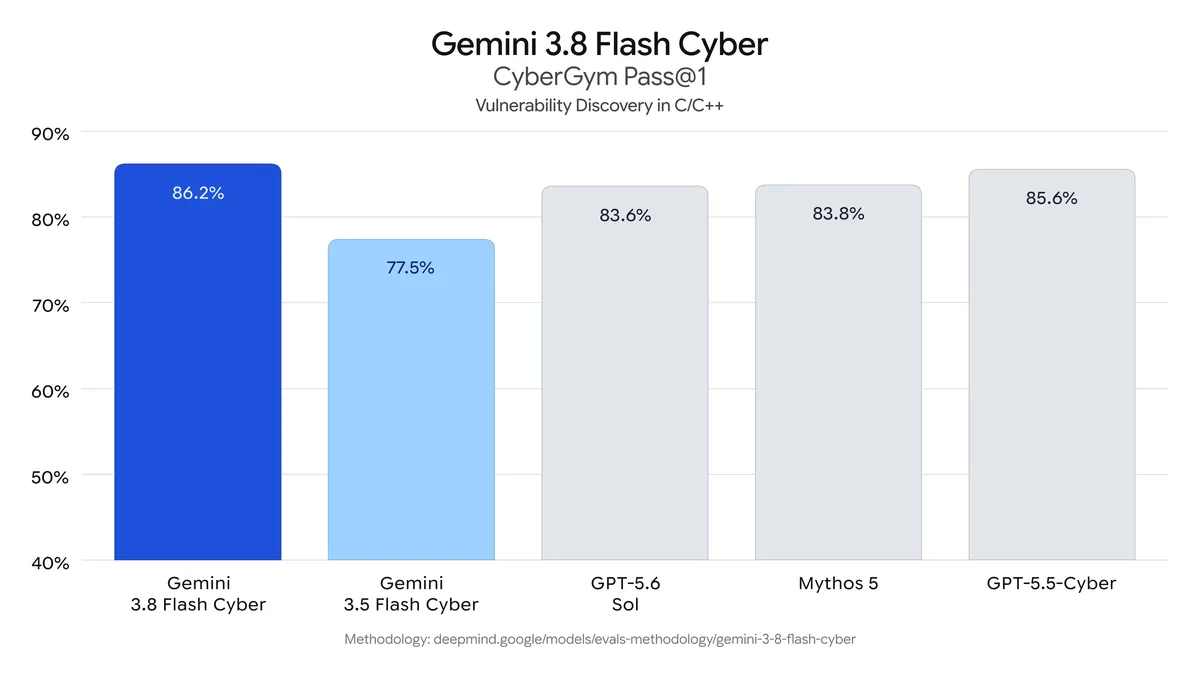
On the CyberGym benchmark, the industry-standard evaluation for autonomous vulnerability discovery in C/C++ codebases, Gemini 3.8 Flash Cyber delivers frontier-level performance, outperforming both its predecessor, 3.5 Flash Cyber, and significantly larger general-purpose models. To reflect real-world defensive requirements—which extend far beyond C/C++—Google DeepMind also evaluated the model against a comprehensive internal benchmark spanning complex codebases written in 20 distinct programming languages. In these evaluations, the model achieved a success rate exceeding 70%, representing a substantial leap in multi-language security analysis.
Crucially, Google DeepMind prioritized vulnerability remediation over offensive capabilities. On CWE-Bench, a challenging external benchmark for automated software patching administered by Collinear, Gemini 3.8 Flash Cyber achieved a Pass@1 score of 47.2%. This places it on the Pareto frontier alongside leading, far more expensive frontier models—which scored 47.8%—while offering the economic advantages and rapid iteration speeds characteristic of the Flash family. Google reports that the model is already actively deployed to secure codebases internally across its own engineering infrastructure.
Industry Reactions and Partner Ecosystem
The unveiling of the Gemini 3.8 family has drawn strong validation from early enterprise partners participating in the security and developer ecosystems. Cybersecurity and cloud infrastructure leaders have emphasized the operational value of combining high-speed inference with expert-level vulnerability management.
David Slater, Founder and Chief Architect at Armadin, noted that the model’s ability to reason through complex code structures quickly transforms how security teams approach proactive threat hunting. Similarly, representatives from Palo Alto Networks, Snowflake, and Wiz highlighted the potential for Gemini 3.8 Flash Cyber to streamline remediation workflows, reducing the window of exposure for enterprise applications. By integrating seamlessly into existing security operations centers (SOCs) and developer environments, these partners anticipate significant reductions in the time required to identify, analyze, and patch critical vulnerabilities.
Safety Frameworks and Robustness Against Adversarial Attacks
Deploying high-capability security models necessitates stringent safety protocols to prevent dual-use exploitation. Google DeepMind has structured the release of the Gemini 3.8 family around its Frontier Safety Framework. While standard 3.8 Flash models ship with robust safeguards against misuse in Chemical, Biological, Radiological, and Nuclear (CBRN) domains and cyber offense, Gemini 3.8 Flash Cyber incorporates a more permissive set of mitigations specifically tailored for authorized cybersecurity defenders. This controlled availability ensures that advanced defensive tooling remains restricted to verified organizations with a legitimate need for comprehensive cyber capabilities.
In addition to defensive security enhancements, the Gemini 3.8 models demonstrate a marked improvement in resilience against adversarial manipulation. Evaluations using the Gray Swan Indirect Prompt Injection (IPI) Benchmark show that the new models achieve a substantial leap in prompt injection robustness. This enhancement provides stronger protection for end-users and enterprise systems against malicious inputs designed to hijack model behavior or exfiltrate sensitive data.
Broader Implications and Market Outlook
The launch of Gemini 3.8 Flash and Flash Cyber signals a broader maturation in the generative AI market, moving away from simple parameter scaling toward algorithmic efficiency and domain-specific specialization. By proving that lightweight models can achieve near-frontier performance through advanced reasoning loops and iterative tool usage, Google DeepMind is lowering the economic barrier to entry for sophisticated enterprise automation.
As businesses increasingly adopt agentic workflows—where AI systems operate autonomously over extended periods to execute multi-step business or technical processes—the demand for reliable, cost-effective reasoning engines will intensify. The ability of Gemini 3.8 Flash to balance deep cognitive processing with high-throughput execution positions it as a versatile tool for software engineering, financial analysis, legal compliance, and enterprise security. Moving forward, the industry will likely observe an accelerated convergence of security intelligence and general-purpose reasoning, as organizations seek out models capable of both building complex digital infrastructure and defending it against sophisticated threats.