The rapid proliferation of Large Language Models (LLMs) across enterprise sectors has encountered a persistent technical ceiling: the latency of token generation. Because modern LLMs—such as those based on the Transformer architecture—generate text autoregressively, they produce output one token at a time. This mechanical limitation imposes a significant bottleneck on the scalability of real-time applications, including AI-driven customer service platforms, interactive coding assistants, and autonomous agents. Speculative decoding has emerged as a premier optimization strategy to circumvent this constraint, offering a path to 2x to 3x faster inference speeds without the need for model retraining or compromising output fidelity.
The Architectural Bottleneck: Memory-Bandwidth Constraints
To understand why speculative decoding is transformative, one must first examine the hardware-level reality of LLM inference. Modern high-performance GPUs, such as the NVIDIA H100 or A100, are theoretically capable of immense computational throughput. However, in the context of LLMs, the primary constraint is not the speed of the mathematical operations (the compute-bound phase) but the speed at which model weights can be moved from High Bandwidth Memory (HBM) to the GPU’s processing cores (the memory-bandwidth bound phase).
In a standard autoregressive loop, the model reads billions of parameters to generate a single token. Once that token is produced, the model must essentially "re-read" or utilize those same billions of parameters to generate the next token. This results in a scenario where the GPU spends the vast majority of its time waiting for data transfer, with the compute units remaining idle for significant fractions of a second. This "memory-bound" state is the fundamental reason why increasing raw GPU compute power does not yield linear improvements in inference latency.
The Chronology of Speculative Decoding Development
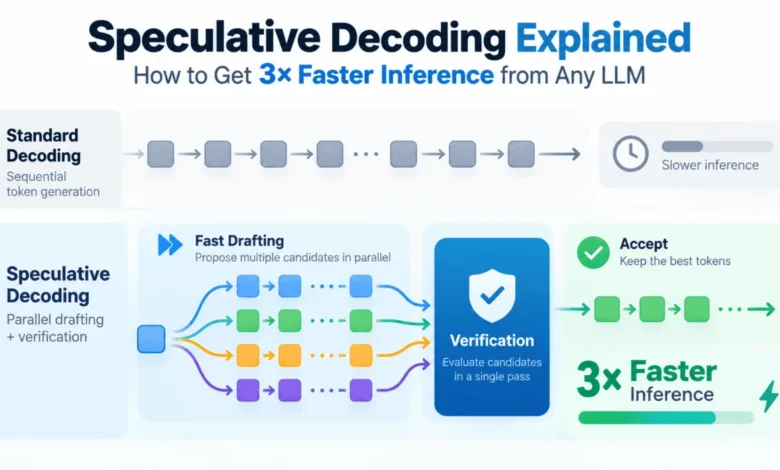
The concept of speculative decoding gained significant traction in early 2023, following research papers from Google and DeepMind, as well as independent researchers. The core philosophy was to decouple the generation process into two distinct phases: a rapid "drafting" phase and a rigorous "verification" phase.
- The Drafting Phase: A lightweight, smaller "draft" model—often with a fraction of the parameters of the main "target" model—generates a sequence of several tokens in quick succession. Because the draft model is smaller, the memory-bandwidth cost of reading its weights is negligible, allowing it to "speculate" on the future tokens at high speed.
- The Verification Phase: The target model receives this batch of speculative tokens. Unlike the draft model, which runs sequentially, the target model processes these tokens in parallel. Because modern GPUs are optimized for parallel matrix operations, evaluating a sequence of four to eight tokens simultaneously takes only marginally longer than evaluating a single token.
- The Acceptance Step: The target model compares its internal probability distributions for the sequence against those of the draft model. If the draft model’s predictions align with the target model’s logic, the sequence is accepted. If there is a discrepancy, the target model rejects the incorrect tokens and samples replacements. This statistical framework ensures that the final output is mathematically indistinguishable from a standard, non-speculative generation process.
Empirical Performance and Data Analysis
Industry benchmarks have consistently validated the efficiency gains of this approach. In tests conducted on models such as Llama-3-70B or Mixtral-8x7B, organizations have reported throughput increases of approximately 200% to 300%. For instance, while a standard model might generate 30 tokens per second on a specific hardware configuration, the addition of a speculative head or a smaller draft model can push this to 80 or 90 tokens per second.
The efficacy of this technique is highly dependent on the "acceptance rate"—the frequency with which the draft model correctly predicts the target model’s output. Data indicates that when the draft model is well-aligned with the target model (e.g., using a 7B parameter model to draft for a 70B parameter model), acceptance rates often hover between 70% and 80%. These figures are particularly high in domains with structured, repetitive, or predictable output patterns, such as source code generation or standardized technical documentation.
The Evolution of Modern Implementations
While the two-model paradigm remains the gold standard for accuracy, the engineering community has shifted toward more sophisticated implementations to reduce the complexity of managing two separate models.
- Medusa and Head-Based Drafting: Rather than relying on a separate model, the Medusa architecture introduces multiple "prediction heads" to the final layer of the target model. These heads are trained to predict the next several tokens simultaneously. This allows the model to draft for itself, eliminating the need to load a second model into memory.
- Eagle (Extrapolation Algorithm): This method advances the drafting capability by looking at the hidden states of the target model. By leveraging the internal context of the transformer layers, Eagle achieves higher acceptance rates, particularly in complex, non-linear text generation tasks.
- Prompt Lookup Decoding: This is perhaps the most minimalist implementation. It requires no additional model or training. Instead, it utilizes a sliding window to search for matching patterns within the existing prompt or conversation history. If the model sees a sequence of tokens in the prompt that is likely to recur in the output, it "speculates" that those tokens will appear next. This is exceptionally effective in document summarization and chat-based interactions.
Industry Implications and Deployment Realities
The adoption of speculative decoding is fundamentally changing how AI infrastructure is managed. By reducing latency, companies can provide a more "human-like" experience for end-users, where the delay between a user’s prompt and the AI’s response is minimized. However, there are caveats for production engineers.
In high-throughput environments where a server is handling hundreds of concurrent requests (large batch sizes), the overhead of managing speculative sequences can actually reduce overall system efficiency. Speculative decoding is most beneficial for "latency-sensitive" applications, such as a single user interacting with a coding assistant, rather than "throughput-sensitive" tasks like offline batch processing of millions of documents.
Leading inference frameworks, including vLLM, Hugging Face’s Text Generation Inference (TGI), and llama.cpp, have integrated these techniques directly into their APIs. For the average developer, this has transformed speculative decoding from a complex research challenge into a simple configuration flag.
Broader Impact on Future AI Systems
The rise of speculative decoding underscores a broader shift in AI research: the move away from "brute force" scaling toward "algorithmic efficiency." As the industry hits physical limits in terms of GPU memory bandwidth and power consumption, the ability to do more with existing hardware becomes a primary competitive advantage.
By mathematically guaranteeing that output quality remains unchanged while simultaneously boosting speed, speculative decoding provides a "free lunch" in the context of computational efficiency. As these techniques continue to evolve—likely incorporating even more efficient drafting mechanisms and better integration with hardware-level scheduling—the gap between the speed of human thought and the speed of machine generation will continue to narrow. The integration of speculative decoding into the standard LLM deployment stack is not merely a transient trend; it is a fundamental shift in how we approach the delivery of generative AI at global scale.