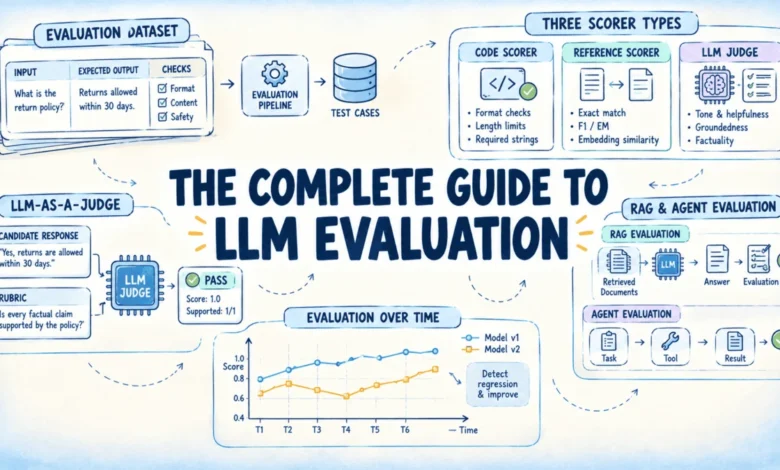
As Large Language Models (LLMs) transition from experimental prototypes to mission-critical infrastructure, the informal practice of "spot-checking"—where developers manually review a handful of outputs to gauge quality—has become a significant liability. This reliance on intuition fails to account for the stochastic nature of generative AI, where a minor adjustment to a prompt or a change in retrieval parameters can induce regressions that remain hidden until they impact end-users. Establishing a systematic, reproducible, and automated evaluation framework is no longer optional; it is a fundamental requirement for the modern AI development lifecycle.
The Failure of Traditional Software Testing in AI
In conventional software engineering, unit tests assert strict equality: input X must produce output Y. However, LLM applications operate in a landscape of semantic nuance. A customer service bot might provide two factually correct, grammatically perfect responses to a return policy inquiry, yet utilize different phrasing. A standard string-comparison test would flag one as a failure, while a human would deem both acceptable. This highlights the inherent conflict between deterministic software testing and probabilistic AI outputs.
The industry is currently shifting toward a multi-layered evaluation architecture. This approach treats evaluation as a regression-testing loop, where a dataset of inputs is paired with specific "scorers" to grade performance against predefined criteria. By tracking these scores over time, teams can isolate the specific impact of model updates, system prompts, or RAG (Retrieval-Augmented Generation) pipeline modifications.
Categorizing Evaluation Scorers
To build a robust evaluation suite, engineers must categorize their metrics based on the nature of the task. Scorers generally fall into three tiers:
- Deterministic Code-Based Scorers: These are the gold standard for structural requirements. They use regex, JSON parsing, or length constraints to verify output format. Because they are non-probabilistic, they are free, fast, and 100% consistent. They should be the first line of defense in any pipeline.
- Reference-Based Metrics: For tasks with a "ground truth," such as data extraction or specific question answering, traditional metrics like Exact Match or F1 scores remain useful. However, they struggle with paraphrasing. Modern approaches utilize BERTScore, which leverages cosine similarity between token embeddings to assess semantic alignment, though these still cannot measure subjective attributes like tone or groundedness.
- LLM-as-a-Judge: This involves using a high-performing model—often a more capable version than the one being tested—to act as an automated grader. This is essential for evaluating qualitative dimensions such as helpfulness, persona adherence, and reasoning.
The Mechanics of the LLM Judge
The effectiveness of an LLM-as-a-Judge relies entirely on the quality of the rubric prompt. A successful rubric must be structured, providing a clear definition of the criterion, a step-by-step reasoning procedure, and a strict output format, such as JSON.
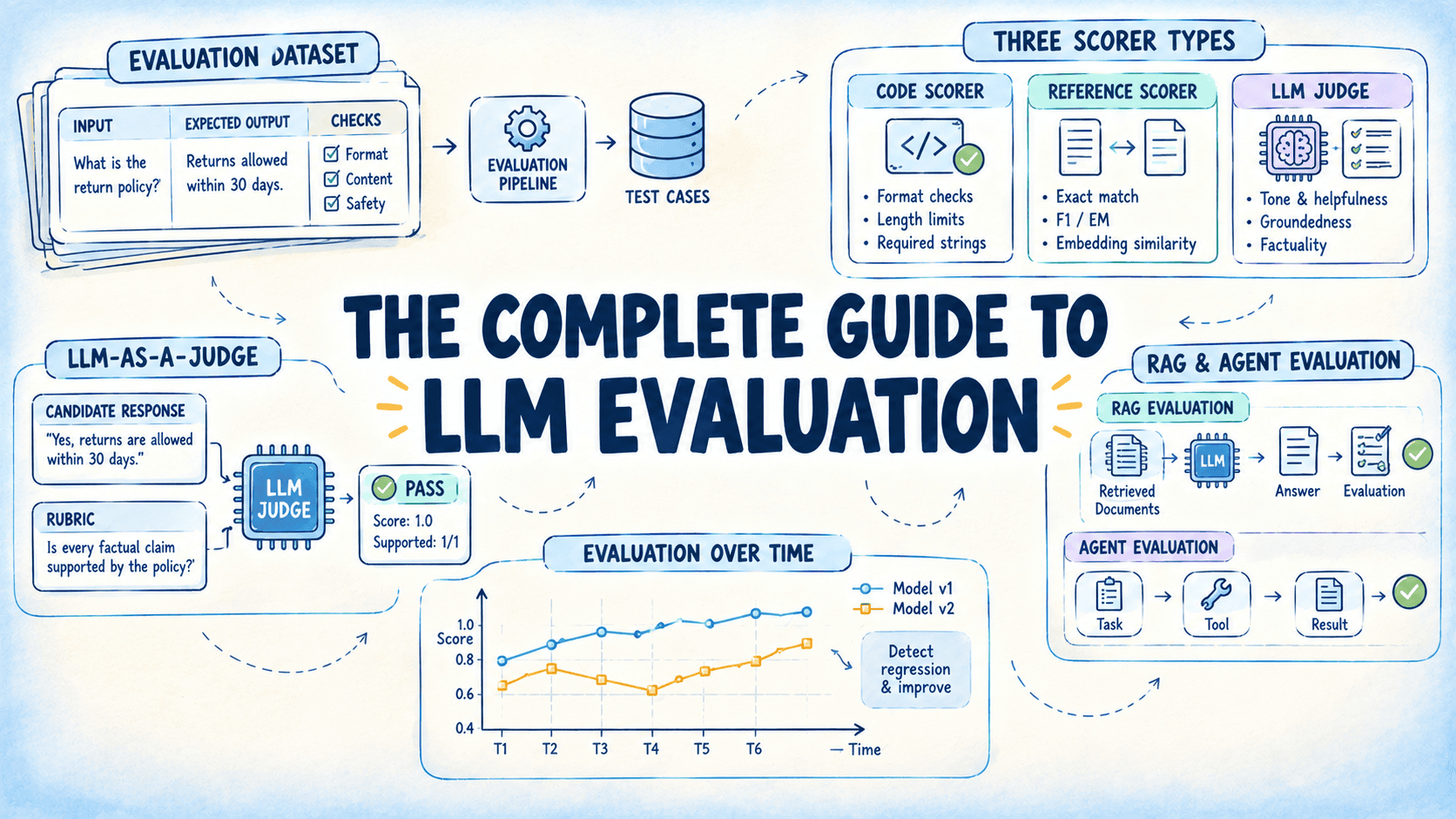
Recent advancements in this space have introduced specialized scoring methodologies that improve consistency:
- Question-Answer Generation (QAG): Instead of asking an LLM to rate a response on a scale of 1–10 (which is notoriously unstable due to the lack of an internal scale), QAG decomposes the answer into atomic claims. The judge then verifies each claim against the source context using a binary yes/no classification. This classification task is something models perform with high reliability.
- G-Eval: For subjective criteria where discrete claims are absent, G-Eval uses an Auto-CoT (Chain-of-Thought) process to break down a concept like "coherence" before calculating a probability-weighted score. By evaluating the log-probabilities of tokens (e.g., the probability of the model outputting a ‘4’ versus a ‘5’), the system can produce a granular score, such as 4.4, which is far more indicative of model performance than a rounded integer.
- Pairwise Comparison: To eliminate the bias of absolute scales, developers often use "A vs. B" testing. By asking the judge to select the better of two responses and then repeating the test with the positions swapped, developers can identify true quality differences while filtering out positional bias.
Mitigating Bias in Automated Evaluation
Even the most sophisticated judges are susceptible to inherent model biases, including a preference for longer answers, a tendency toward "sycophancy" (agreeing with the prompt), and position bias (favoring the first answer provided).
Mitigation requires rigorous calibration. Teams should create a "golden dataset" of 30 to 50 samples that have been manually labeled by humans. By running the LLM judge against this set and calculating Cohen’s Kappa—a statistical measure of inter-rater reliability—developers can quantify how closely the judge aligns with human judgment. A Kappa score above 0.6 is generally considered a threshold for substantial agreement. If the judge deviates, the rubric must be refined, and the test set updated.
Evaluating RAG and Agentic Workflows
The complexity of evaluation increases when dealing with RAG systems. A RAG application fails if the retriever fetches the wrong documents or if the generator hallucinates information not present in the provided context. These components must be scored in isolation.
"Context Precision" and "Context Recall" measure the retriever’s ability to surface relevant information, while "Faithfulness" measures whether the generator adheres strictly to that context. When these metrics are tracked in parallel, they provide a diagnostic map: high faithfulness with low recall indicates a retrieval failure, whereas low faithfulness with high recall indicates that the generator is prone to hallucination, regardless of the quality of the retrieved information.
For autonomous agents, the scope expands to include "Task Completion." An agent might be fluent and polite, but if it fails to execute the user’s goal, the system has failed. Developers should track tool-call correctness, argument validation, and the trajectory of the conversation. In multi-turn systems, the judge must be provided with the entire dialogue history to ensure that context is maintained and that the agent does not contradict its own previous statements.
Establishing the Release Cycle
The deployment of an LLM application should be governed by an "Offline-to-Online" evaluation strategy.
Offline Evals: Before any deployment, the application must pass a versioned suite of test cases. This "golden set" should include diverse scenarios: common queries, complex edge cases, adversarial prompts (e.g., prompt injection attempts), and off-topic questions. Release criteria should be clearly defined, such as "no regression in faithfulness scores" or "minimum 90% completion rate on critical tasks."
Online Evals: Once in production, the work continues. By sampling live traffic and applying reference-free metrics, teams can monitor for "model drift," where the underlying model provider updates their service, causing subtle changes in output quality. Furthermore, every production failure identified by a user should be analyzed and converted into a new case for the golden dataset, ensuring the test suite evolves alongside the application.
The Broader Implications for AI Governance
The shift toward structured evaluation represents a maturation of the AI industry. As organizations face increasing pressure regarding AI safety and reliability, the ability to demonstrate that an application has been tested against objective, traceable, and reproducible rubrics becomes a core business asset.
Data leakage, where evaluation samples inadvertently become part of a future training set, remains a primary concern. To counter this, companies are advised to maintain strict isolation between their development and testing environments. Additionally, the risk of "metric gaming"—where models are optimized specifically to please an LLM judge rather than provide genuine value—necessitates the use of diverse, multi-dimensional scoring methods.
Ultimately, the goal of LLM evaluation is to replace the "it feels right" approach with a scientific process. By standardizing how we measure accuracy, safety, and utility, developers can move past the volatility of early-stage generative AI and build systems that are as dependable as the traditional software they aim to augment. As the tooling ecosystem continues to mature, the gap between experimental LLM demos and production-grade applications will be bridged by those who treat evaluation not as an afterthought, but as the foundation of their development culture.
Related posts: