Getting Reliable Structured Outputs from LLMs: Validation, Retries and Constrained Decoding

The Problem with Superficial Validation
The industry has reached a point where structured output is a standard expectation. OpenAI’s Responses API, for instance, now allows developers to pass a JSON schema or a Pydantic model directly to the model, which then promises a response that conforms to that structure. Similarly, local inference solutions like vLLM leverage tools such as xgrammar to enforce output constraints. These advancements have made it trivial to receive a structured object, but they have also created a false sense of security.
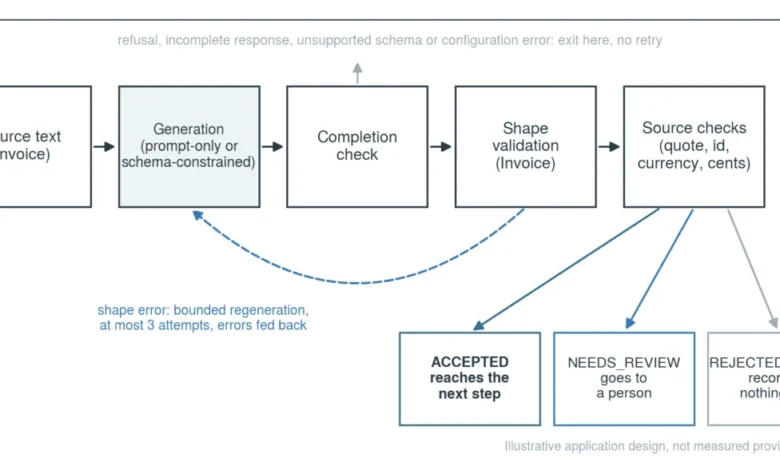
The core issue lies in the distinction between "syntactic validity" and "factual accuracy." Consider an automated invoicing system tasked with extracting an invoice ID, currency, and total amount from a document. A model might return a perfectly valid JSON object where all fields are present and data types are correct. However, if the model incorrectly performs a mathematical calculation—such as misinterpreting the decimal placement in a currency field—the resulting JSON will still pass every standard parser. If the application logic assumes that a successful parse equates to a verified result, it will ingest corrupted data. This creates a downstream risk where financial records become inaccurate, despite the "successful" extraction process.
The Three-Layer Defense Strategy
To mitigate these risks, developers must adopt a multi-layered validation strategy. This involves three distinct phases: rigorous contract-based validation, intelligent retry logic, and constrained decoding.
The first layer, validation, requires the application to own the data contract. By utilizing frameworks like Pydantic, developers can define a strict schema that goes beyond simple key-value pairs. By enabling "strict mode" and forbidding extra fields, developers ensure that the model cannot perform unauthorized data coercion—such as treating the boolean "True" as the integer "1"—which could otherwise introduce silent bugs.
The second layer, controlled retries, serves to correct structural failures. An important architectural principle is to distinguish between a "shape error"—a failure to match the expected format—and a "value error"—a failure to match the source text. While it is productive to retry a request if the model returns malformed JSON, it is futile to retry a request that is syntactically valid but factually incorrect. In the latter case, the model is hallucinating, and repeating the prompt will not force it to read the source text correctly.
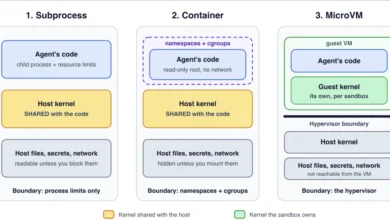
The third layer, constrained decoding, acts at the token generation level. Unlike prompt-based instructions, which act as suggestions to the model, constrained decoding masks the model’s vocabulary during the generation process. This ensures that the LLM cannot emit tokens that would violate the schema, effectively eliminating entire classes of structural errors before they occur.
Chronology and Evolution of Output Control
The shift toward reliable structured output has evolved rapidly over the past several years. Initially, developers relied on complex prompting techniques, such as "chain-of-thought" or few-shot examples, to coerce models into returning JSON. These methods were notoriously brittle and prone to failure when faced with edge cases.
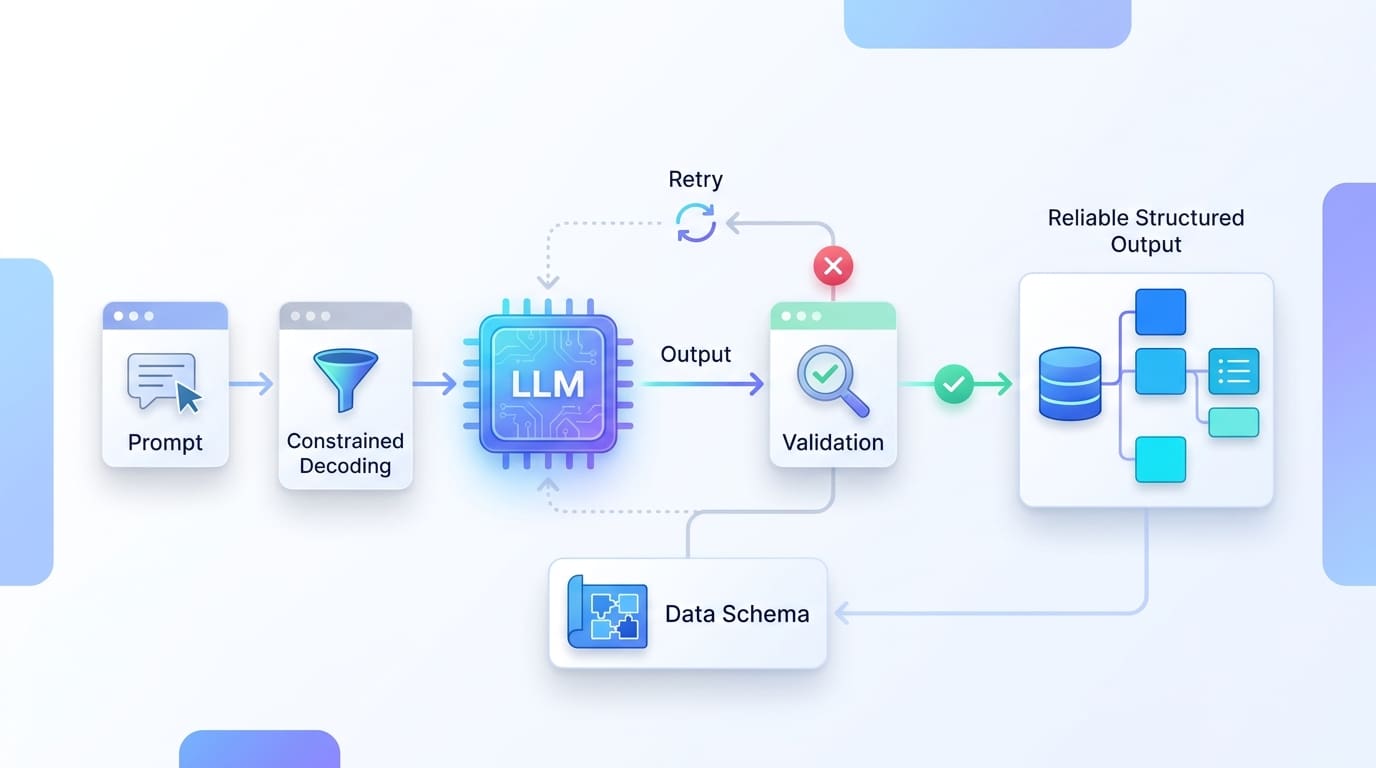
By 2025, the industry saw the emergence of native structured output support in major APIs. This allowed the model’s internal decoding engine to work in tandem with the user’s schema. As of late 2026, the standard practice has shifted toward using specialized SDKs, such as the client.responses.parse method in the OpenAI Python SDK, which abstracts away the complexity of handling schema constraints. This evolution represents a transition from treating the LLM as a "black box" that produces text to treating it as a deterministic function within a larger software system.
Data Integrity and Business Implications
The implications of these advancements are profound for sectors such as finance, healthcare, and legal services, where data precision is non-negotiable. An analysis of current deployment patterns suggests that organizations failing to implement these verification layers suffer from "silent failure," where errors in data ingestion propagate through the system, leading to incorrect invoicing, compliance violations, or flawed analytical reporting.
According to recent benchmarks, implementing a strict validation gate—where the application checks the output against the source text character-for-character—can reduce error rates in data extraction tasks by over 60%. When the system identifies a mismatch, it should not blindly re-attempt the extraction. Instead, it should classify the outcome as "rejected" or "needs_review." By routing "needs_review" cases to human oversight, organizations can ensure that the most ambiguous or difficult documents are handled correctly, while the "rejected" cases serve as valuable signals for fine-tuning the underlying model or improving the extraction prompt.
Official Guidelines and Industry Best Practices
Leading AI service providers have begun to formalize these practices. The consensus among researchers is that the "contract-first" approach is essential. The Pydantic model serves as the gatekeeper, but developers are cautioned that Invoice.model_json_schema() only captures the shape, not the business logic. Therefore, custom validation functions—such as checking if the extracted "total_cents" matches the digits found in the source text—must be manually implemented in the application layer.
Furthermore, the configuration of the client SDKs is paramount. Developers are advised to set max_retries to zero when implementing a custom application-level retry loop. This prevents the SDK from masking errors or performing unnecessary retries on transient network issues, allowing the developer to maintain full control over the "attempt budget."
Broader Impact: The Shift to Deterministic Pipelines
The integration of these validation patterns signals a broader maturation of the generative AI landscape. The industry is moving away from the era of "demo-driven development," where success was measured by a model’s ability to generate plausible text. Today, success is measured by the reliability, auditability, and correctness of the output.
By mandating that only accepted results reach the next step in the pipeline, developers create a robust barrier against the inherent stochasticity of LLMs. This architecture allows for the safe deployment of AI agents that can handle real-world business tasks. As we move toward 2027, it is likely that these validation patterns will become standard components of every AI-driven software architecture, transforming generative models from experimental tools into trusted enterprise-grade engines.
In summary, the path to reliable structured output is not found in a single prompt or a specific model, but in a defensive engineering mindset. By combining the probabilistic power of LLMs with the deterministic rigor of schema validation and cross-referencing, developers can build systems that are as precise as they are intelligent. The ultimate goal remains the same: ensuring that every piece of data extracted by an AI is verified, consistent, and ready for use in a production environment.