Trezor Confirms Malicious Hardware Implants in Safe 5 Wallets Sold Through Southeast Asian Reseller CryptoBilis

Cryptocurrency hardware wallet manufacturer Trezor has officially verified that three Trezor Safe 5 devices distributed via the Southeast Asian third-party reseller CryptoBilis were intercepted and fitted with malicious hardware implants. These unauthorized modifications were engineered to surreptitiously capture sensitive user data—most notably recovery phrases and passphrases—and transmit the stolen information back to attackers over cellular networks.
The confirmation arrives following a rigorous laboratory investigation into an escalating supply chain security crisis that has severely rattled the hardware cryptocurrency storage ecosystem. While Trezor has stated that no user funds have been drained as a direct result of these specific implants thus far, the incident highlights persistent, sophisticated vulnerabilities within global retail and distribution channels for high-security digital assets.
Anatomy of a Supply Chain Breach
The scope of the compromise centers on physical alterations made to the internal architecture of the Trezor Safe 5. According to Trezor’s engineering team, the malicious hardware implant consists of a custom-built, unauthorized secondary circuit board meticulously slotted between the device’s main motherboard and its visual display interface.
This design choice is particularly insidious. Because the implant sits entirely separate from the core microcontroller and the dedicated Secure Element—the hardware chip responsible for cryptographic operations—it does not alter or corrupt the legitimate device firmware. Instead, it operates passively as a hardware man-in-the-middle, observing and recording all visual data rendered on the screen.
Whenever a user initializes a new device, generates a fresh wallet backup, restores an existing wallet, or inputs a supplementary passphrase, the recovery words and security keys are displayed on the screen. The hidden microchip captures this text in real-time. It then encodes the sensitive strings and leverages an integrated cellular module to beam the data back to an attacker-controlled remote server.
Engineers noted that the implant is equipped with store-and-forward capabilities. If the device is located in an area with poor cellular reception or if an active connection cannot be established immediately, the malicious hardware retains the intercepted data in local volatile or non-volatile memory, continuously attempting transmission until it successfully connects to the command-and-control infrastructure.
Chronology of the Investigation
The unfolding crisis began in October 2026, when an Indonesian customer who purchased a Trezor Safe 5 through the regional reseller CryptoBilis noticed anomalies with the hardware and discovered an unauthorized circuit board nestled inside the casing. The customer promptly alerted the security community and the manufacturer. At that preliminary stage, Trezor had not yet taken physical possession of the device, preventing technical verification of the implant’s operational capabilities or its true intent.
The timeline of events expanded significantly as Trezor’s incident response team engaged with its customer base and ramped up forensic operations:
- August 20 to September 23, 2026: The window during which the three confirmed compromised Safe 5 devices were purchased by customers from CryptoBilis.
- October 2026: An initial public warning is issued by Trezor following the Indonesian customer’s discovery, though hardware capabilities remain unconfirmed due to a lack of physical inspection units. Simultaneously, parallel supply chain attacks involving compromised Ledger hardware wallets sold through the same vendor, CryptoBilis, come to light, prompting broader regional scrutiny.
- November 2026: Trezor successfully analyzes the original suspect device in its laboratories. Using photographic evidence submitted by alarmed customers, the company identifies two additional compromised units. In total, 48 CryptoBilis customers come forward to have their devices inspected physically or via diagnostic imagery.
- November 11, 2026: Trezor releases firmware version 2.13.1, incorporating advanced behavioral and interface protections designed to render the current generation of hardware surveillance implants entirely inert.
Reseller Network Overhaul and Supply Chain Security

The discovery of tampered devices within authorized distribution channels has forced a radical restructuring of Trezor’s business and supply chain architecture. Acknowledging that traditional retail trust models are no longer sufficient to mitigate advanced physical tampering, Trezor leadership took the drastic step of slashing its global reseller network by approximately 80 percent.
While the company clarified that the vast majority of the terminated third-party resellers were entirely trustworthy and posed no active security threat, they simply could not meet the stringent new compliance, auditing, and physical security standards that Trezor is now enforcing. Remaining retail partners are subjected to heavily audited controls governing how devices are sourced, securely stored, transported, and accessed prior to reaching the end consumer.
Furthermore, in an unprecedented move to restore consumer confidence, Trezor announced a comprehensive remediation program. The company is offering free replacement hardware wallets to anyone who purchased a Trezor device from CryptoBilis at any point since March 2026—regardless of whether their specific unit has been forensically confirmed as tampered with or compromised.
Industry-Wide Implications and the Ledger Precedent
The Trezor Safe 5 incident is not an isolated event, signaling instead a broader, coordinated campaign by sophisticated threat actors targeting the physical supply chain of cryptocurrency hardware wallets. Weeks before Trezor confirmed the implants in its own product line, rival hardware wallet maker Ledger issued urgent warnings across Asian markets after discovering malicious spy implants inside its own devices—also traced back to distribution anomalies linked to CryptoBilis.
Security analysts point out that hardware wallets are traditionally viewed as the gold standard for cryptocurrency security, effectively isolating private keys from internet-connected computers vulnerable to malware, phishing, and remote exploitation. However, these recent compromises underscore a sobering vulnerability vector: the physical supply chain.
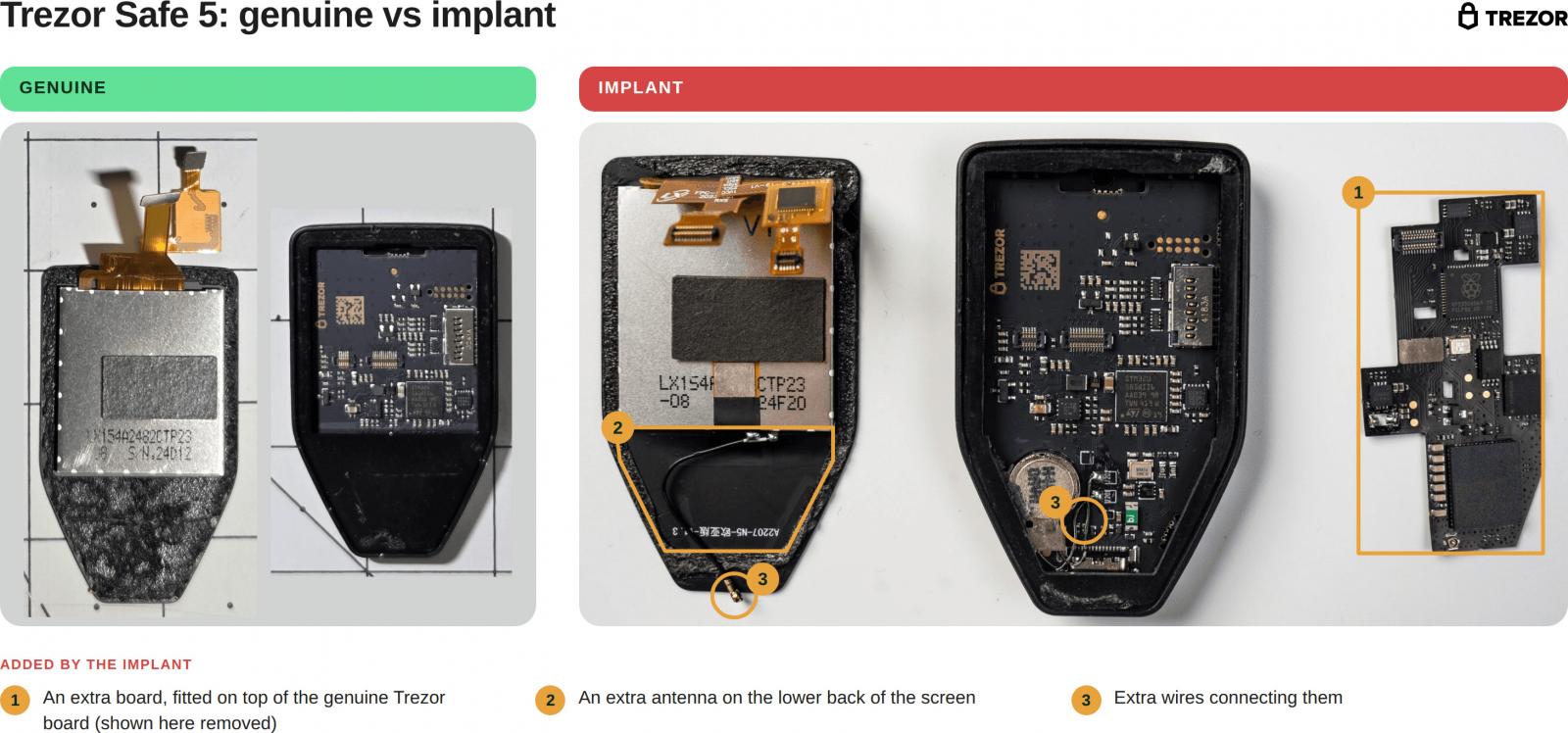
When attackers can intercept physical shipments, disassemble factory-sealed packaging, solder custom espionage hardware onto internal circuits, and carefully repackage the devices to pass casual inspection, the foundational trust in hardware-based self-custody is severely tested.
Mitigation and Defensive Guidance for Users
Although Trezor has confirmed that no user funds have been successfully stolen via the Safe 5 implants, the potential for catastrophic loss remains high for anyone whose recovery phrase was captured before preventative measures were deployed.
In response, Trezor engineers rushed out firmware update 2.13.1. The company emphasizes that while this update successfully blocks the implants from harvesting information moving forward—making existing physical modifications functionally useless—it cannot retroactively protect recovery phrases that were exposed prior to the installation of the patch.
Consequently, security experts and Trezor representatives strongly urge any user who purchased a hardware wallet from CryptoBilis or any unverified secondary vendor to immediately adopt a zero-trust migration strategy:
- Do not attempt to salvage the existing wallet configuration.
- Procure a replacement device directly from Trezor’s official manufacturing channels or a heavily vetted, tier-one partner.
- Generate an entirely new wallet backed by a fresh, uncompromised recovery phrase.
- Securely transfer all cryptocurrency assets from the old, potentially compromised address to the newly generated, pristine wallet infrastructure.
As the cryptocurrency hardware industry grapples with the fallout of these sophisticated supply chain interdictions, manufacturers are expected to transition toward tamper-evident packaging, cryptographic device attestation checks built directly into companion applications, and deeply consolidated retail models designed to eliminate vulnerable middlemen from the delivery pipeline.