Reducing LLM Token Consumption Through Markdown Data Optimization Strategies

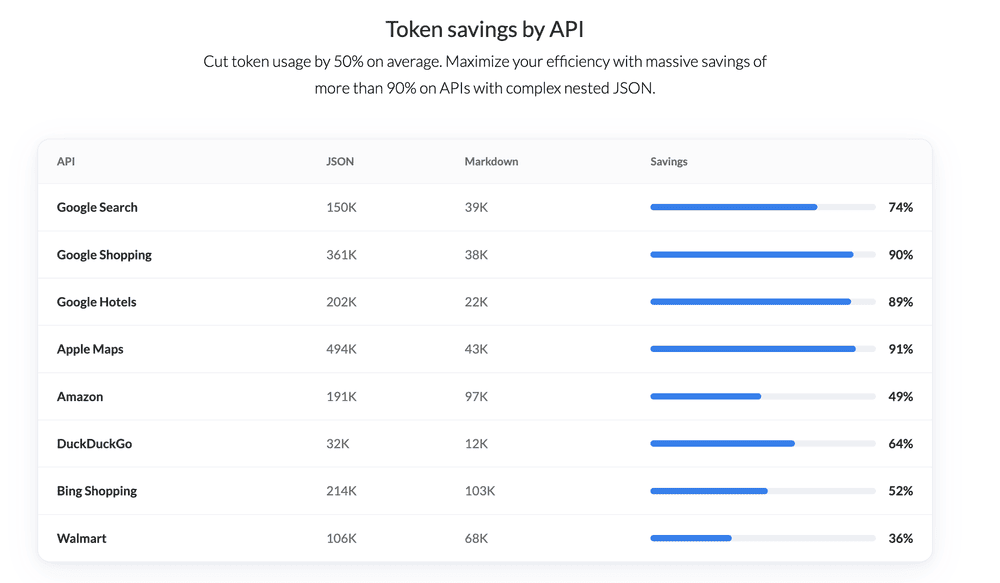
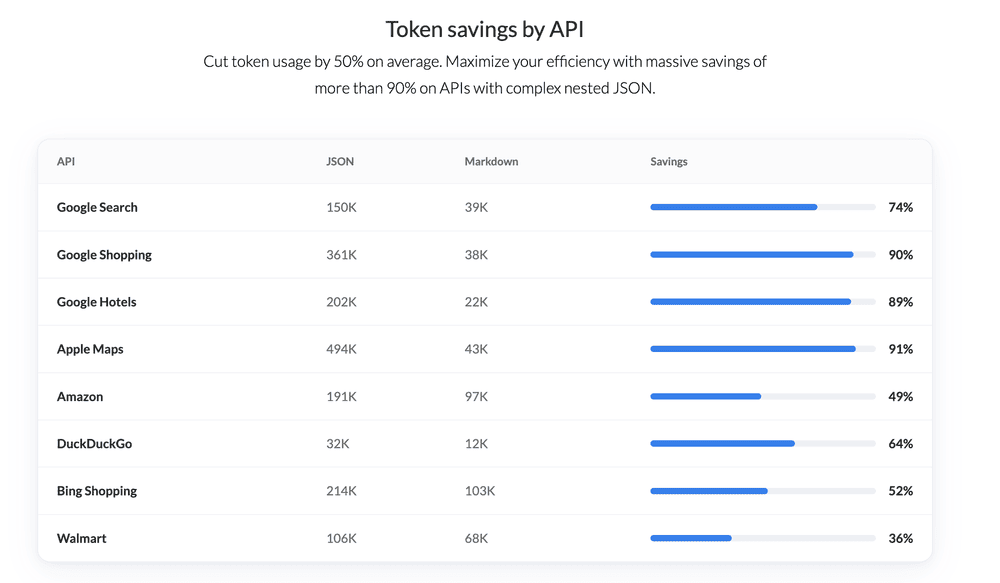
The rapid proliferation of autonomous AI agents has introduced a significant operational challenge: the runaway cost of token consumption. As agents become more complex, their reliance on search results, file retrievals, and recursive logic loops has led to ballooning expenses for developers and enterprises alike. Because Large Language Models (LLMs) charge per token—the fundamental units of text that models process—the inclusion of unnecessary metadata, tracking links, and verbose JSON formatting can inflate costs by orders of magnitude. Recent data from the search API provider SerpApi indicates that shifting from conventional JavaScript Object Notation (JSON) to a streamlined Markdown format can yield token reductions of up to 74 percent, offering a vital pathway for cost optimization in agentic workflows.
The Anatomy of Token Bloat in AI Agents
To understand why token consumption has become a critical bottleneck, one must first examine how AI agents interact with search data. When an agent is tasked with a relatively simple request—such as identifying local coffee shops—the underlying process involves far more than a simple list of names. The agent fetches full-length HTML or structured JSON responses that include deep-nested objects, navigational metadata, tracking parameters, and repetitive boilerplate code.
In a standard JSON response, every curly brace, quotation mark, and key-value pair counts toward the context window. For an LLM, these technical artifacts are essentially "noise." While they are essential for developers building traditional web applications or parsing data into databases, they offer little to no semantic value for an AI model attempting to reason through information. When an agent is forced to process this redundant data, it consumes space within the limited context window of the model, effectively "paying" for characters that provide no analytical benefit.
Chronology of Data Format Evolution
For years, JSON has been the industry standard for web data transmission due to its machine-readable nature. However, the rise of LLMs—which are primarily trained on human-readable text—has created a mismatch between the format in which data is provided and the format in which it is most efficiently processed.
Historically, developers attempted to mitigate this by writing custom "stripper" scripts—regex-heavy utilities designed to remove unnecessary fields before sending data to an API like OpenAI’s GPT-4 or Anthropic’s Claude. This approach, while effective, added latency and complexity to the development lifecycle.
The recent industry shift, led by providers like SerpApi, marks a transition toward "LLM-native" outputs. By offering native Markdown support, these platforms are effectively moving the data-cleaning process from the client side to the server side. This evolution represents a fundamental change in how APIs treat AI consumers as a distinct class of users, separate from traditional web developers.
Comparative Analysis: JSON vs. Markdown
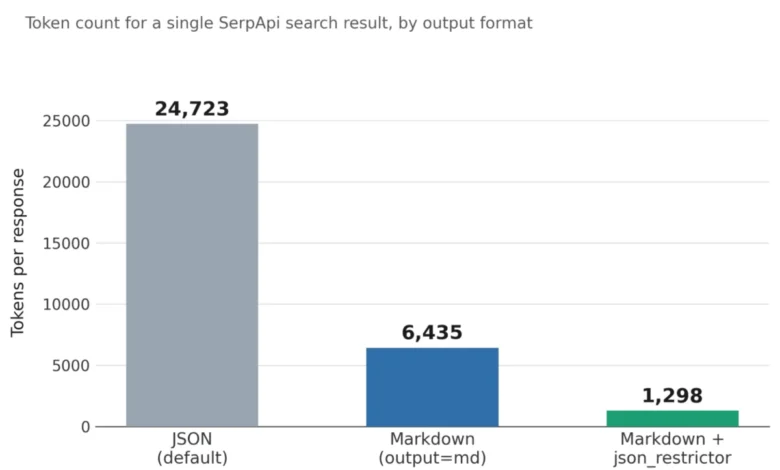
The quantitative benefits of this shift are significant. In a controlled test performed by SerpApi, a standard query for "coffee" returned a JSON payload requiring 24,723 tokens. By switching the output format to Markdown, the same search request was condensed to 6,435 tokens—a reduction of approximately 74 percent. Further refinement, which strips away non-essential descriptive elements, can bring that number down to roughly 1,298 tokens.
The difference in utility is stark. JSON is designed for programmatic reliability, ensuring that every data point is strictly typed and easily mapped to a database schema. For example, a JSON response from a product database might explicitly define price as an integer and rating as a float. This is invaluable for an e-commerce backend. However, an AI agent tasked with summarizing product reviews does not need to know the database structure; it needs the semantic content. Markdown provides this content using tables, headers, and plain text, which the LLM can process with significantly higher density per token.
Implications for Enterprise AI Architecture
The implications for this transition are twofold: cost savings and improved context window management.
1. Direct Cost Reduction: For companies running thousands of autonomous agent queries per hour, a 74 percent reduction in token usage translates to a direct impact on the bottom line. As token prices remain a significant portion of AI operational expenditures, this optimization can be the difference between a project’s profitability and its obsolescence.
2. Context Window Preservation: Perhaps more importantly, LLMs have finite context windows. When an agent consumes massive amounts of metadata, it risks "pushing out" important information from the prompt. By using a more efficient format like Markdown, developers can fit more search results or more detailed instructions into the same context window, thereby increasing the agent’s reasoning capability and accuracy without needing to upgrade to more expensive, high-capacity models.
Strategic Limitations and Use Cases
Despite the advantages of Markdown, industry experts caution against universal adoption. Markdown is a lossy format by nature; it prioritizes readability and conciseness over the strict data integrity required by software engineering pipelines.
If an application requires high-precision data—such as financial calculation engines, inventory management systems, or real-time coordinate tracking for logistics—JSON remains the superior choice. The structure of JSON allows for precise parsing that Markdown cannot replicate without manual, error-prone extraction. Therefore, the strategic approach for most enterprises is a hybrid model: using JSON for data-heavy, high-precision tasks and switching to Markdown for research-oriented, summarization, and agent-led tasks.
Implementation and Operational Best Practices
For organizations looking to implement these efficiency gains, the technical barrier is low. Most modern APIs, including SerpApi, have integrated these changes as simple parameters. By appending a flag such as output=md or utilizing a json_restrictor field, developers can control the payload structure on the server side.
The recommended best practice is to conduct a "token audit." Developers should:
- Identify the most expensive API calls currently in their stack.
- Run a baseline test to determine the current token count for a representative sample of queries.
- Apply the Markdown output parameter and re-measure.
- Use field-level restriction to remove any remaining non-essential keys.
By measuring the "delta"—the difference between the original payload and the optimized one—developers can gain a precise understanding of their potential savings.
Future Outlook
As the AI agent ecosystem matures, the focus is shifting from "what" the models can do to "how" they can do it more efficiently. The industry is currently moving away from the era of brute-force token usage toward a more refined, architecture-aware approach to data ingestion.
While Markdown is not a "magic bullet," it serves as a critical component in the broader movement toward sustainable AI operations. The ability to reshape data payloads based on the end-user—whether that user is a human developer or a silicon-based agent—will likely become a standard feature of API design across the entire technology sector. As enterprises continue to scale their AI initiatives, those that prioritize the optimization of their data streams will find themselves with a significant competitive advantage in terms of speed, cost, and system performance.