Tesla Finally Sets Concrete Reveal Date for the Long-Awaited Next-Generation Roadster

Tesla has officially announced that the long-awaited next-generation Tesla Roadster will make its formal debut on October 1, marking a definitive timeline for a vehicle whose concept was first unveiled nearly a decade ago. The announcement comes after years of repeated delays, shifting corporate priorities, and persistent skepticism from automotive enthusiasts and investors alike. While Tesla has spent the intervening years pivoting heavily toward artificial intelligence, autonomous driving software, and humanoid robotics, the upcoming reveal signals a renewed focus on high-performance flagship engineering.
The initial concept for the second-generation Roadster was originally showcased to the public in November 2017. At the time, CEO Elon Musk promised staggering performance metrics that captured the imagination of the automotive world: acceleration from zero to 60 miles per hour in a blistering 1.9 seconds, a top speed exceeding 250 miles per hour, and an unprecedented driving range of 620 miles on a single charge. However, what was initially slated for a production launch in 2020 was pushed back repeatedly. Musk and other company executives cited the necessity of prioritizing high-volume vehicles, scaling manufacturing capabilities, and navigating global supply chain disruptions during the COVID-19 pandemic. Furthermore, Tesla’s strategic allocation of engineering resources toward full self-driving (FSD) technology and the Optimus humanoid robot project took precedence over low-volume halo cars.
A Decade of Anticipation and Delayed Milestones
The journey of the second-generation Tesla Roadster from a surprise 2017 concept to an impending production-intent reveal has been defined by a protracted timeline of shifting expectations. When the vehicle was first shown alongside the Tesla Semi at the company’s design studio in Hawthorne, California, attendees were given hot laps in prototype models that instantly demonstrated the instantaneous torque and grip characteristic of modern electric powertrains.
Initially, reservations opened with steep financial requirements: standard reservation holders were asked to put down a fully refundable $50,000 deposit, while the first 1,000 slots—designated as the exclusive "Founder’s Series"—required the full payment of $250,000 upfront. For years, reservation holders and automotive analysts watched as the promised production window of 2020 came and went. Subsequent years brought vague updates from Musk, ranging from hints at improved engineering specifications to the incorporation of aerospace technology. Despite the radio silence on production lines, the Roadster remained a symbolic anchor for Tesla’s technical prowess, serving as a reminder of what the brand’s engineering teams could achieve when unconstrained by mass-market cost targets.
The Teaser Campaign and SpaceX Thruster Speculation
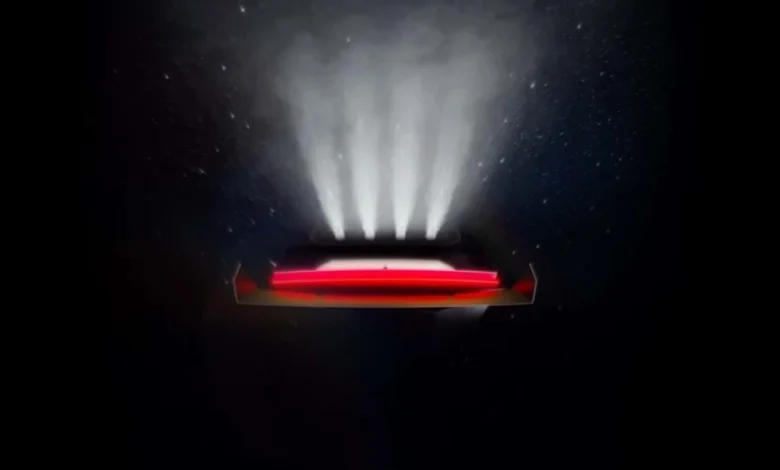
The recent announcement was accompanied by a cryptic teaser image released by the automaker. The visual offers very little in terms of overall design clarity, showcasing what appears to be the vehicle’s updated taillamp signature alongside four distinct circular elements positioned on the upper rear deck. Industry analysts and insiders widely believe these circular openings correspond to the SpaceX-developed cold gas thrusters previously teased by Musk.
Reports surfaced indicating that Tesla and its sister aerospace company, SpaceX, have been working to integrate rocket-derived thruster technology into a specialized variant of the Roadster. According to previous briefings, this technology is designed to drastically enhance acceleration, braking, and cornering capabilities by utilizing compressed air stored in high-pressure overwrapped pressure vessels.
Industry reports suggest that Tesla is preparing two distinct configurations for the vehicle’s public debut: a standard, road-legal variant designed for traditional high-performance driving, and a specialized, ultra-limited-edition "flying Roadster" demonstration vehicle. Due to the immense sound pressure levels, thermal output, and sheer physical force generated by the SpaceX cold gas thrusters, insiders note that the demonstration vehicle intended for the October 1 reveal will likely be operated remotely.
Pricing and Market Positioning
While pricing details for the standard production model remain unconfirmed, financial analysts project that the street-legal variant will command a price tag in the upper tier of six figures. Meanwhile, the specialized, thruster-equipped demonstration version is expected to fetch well over a million dollars, placing it firmly in the territory of hypercars produced by legacy manufacturers like Bugatti, Koenigsegg, and Rimac.
However, industry experts advise caution regarding the commercial availability of the more extreme technological features. It remains to be seen whether the cold gas thruster system will clear regulatory hurdles for customer vehicles or if it will remain a restricted track-only option or a purely technological showcase designed to highlight Tesla’s engineering synergy with SpaceX. Regardless of its homologation status, the vehicle is poised to reestablish Tesla’s presence at the absolute pinnacle of automotive performance metrics.
The Swan Song of the Driver’s Car
In the lead-up to the official October 1 reveal date, high-ranking Tesla executives have begun framing the vehicle within the broader context of the company’s corporate evolution. Lars Moravy, Tesla’s Vice President of Engineering, previously characterized the next-generation Roadster as the company’s "swan song" for traditional human-operated vehicles.
Moravy and other leadership figures have frequently emphasized that the automotive industry is undergoing an irreversible transition toward autonomous mobility. As fleets of robotaxis and software-driven transport networks become ubiquitous, the sheer act of manual driving is projected to shift from a primary mode of daily transportation to a recreational luxury. Viewed through this lens, the new Roadster is positioned not merely as a fast electric vehicle, but as a celebratory engineering milestone—the ultimate driver’s car built before autonomous systems completely take over the wheel.
Implications for the Brand and the EV Landscape
The upcoming reveal carries significant implications for Tesla’s market perception and competitive standing. In recent years, the automaker has faced increased pressure from both traditional legacy automakers and aggressive new entrants in the global electric vehicle market. While high-volume models like the Model Y and Model 3 continue to anchor the company’s financial health, critics have argued that Tesla’s product lineup has aged and lacked the excitement of fresh halo models.
By bringing the Roadster to the forefront, Tesla aims to recapture the cultural dominance and technological aura that characterized its earlier years. A successful debut on October 1 could reinvigorate enthusiast interest, validate ongoing collaborations with SpaceX, and remind the broader market of Tesla’s capability to push the boundaries of physics and engineering.
As the automotive world prepares for the October 1 unveiling, attention will undoubtedly center on whether the production reality can live up to the astronomical expectations set a decade ago. Whether the vehicle serves as a functional hypercar or a futuristic technology testbed, the upcoming presentation promises to be one of the most closely watched automotive events of the decade.