The rapid proliferation of Large Language Models (LLMs) across enterprise environments has introduced a critical challenge: the inability of generalized, static benchmarks to accurately measure specific business outcomes. While industry-standard benchmarks such as the Massive Multitask Language Understanding (MMLU) or the GSM8K mathematical reasoning datasets provide a high-level view of a model’s general intelligence, they remain fundamentally ill-equipped to audit domain-specific performance. For organizations deploying RAG (Retrieval-Augmented Generation) pipelines, customer support automation, or specialized coding assistants, the gap between a model’s general capability and its specific functional reliability is widening. To bridge this divide, software engineering teams are increasingly shifting toward the development of custom evaluation harnesses—bespoke, modular, and repeatable testing frameworks designed to score models against proprietary criteria.
The Evolution of Model Testing
Historically, machine learning model evaluation relied on fixed validation sets—static snapshots of data that remained constant throughout the development cycle. However, the non-deterministic nature of generative AI, coupled with the complexity of conversational context, has rendered static validation insufficient. By the mid-2020s, the industry began to formalize the concept of the "eval harness," a testing scaffold that treats the LLM as a system component rather than a static classifier. This evolution mirrors the transition from simple unit testing in traditional software engineering to sophisticated CI/CD integration for AI agents. A robust harness does not merely check if a model produces a coherent sentence; it verifies if the output adheres to institutional refusal policies, maintains data privacy standards, and retrieves accurate context from internal knowledge bases.
The Four Pillars of an Evaluation Framework
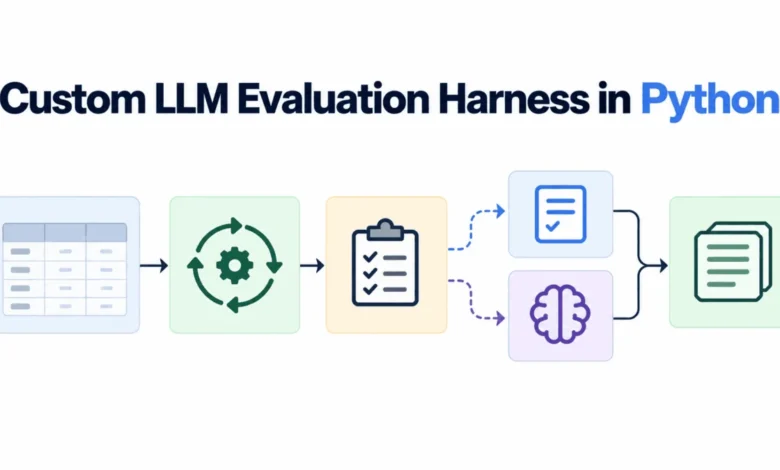
A professional-grade evaluation harness requires a separation of concerns that allows for independent scaling of infrastructure and logic. This is achieved through four distinct, modular components: the Golden Dataset, the Inference Runner, the Judge Layer, and the Logging Infrastructure.
The Golden Dataset: Defining the Baseline
The foundation of any assessment is the "Golden Dataset," a curated collection of input-output pairs that serve as the ground truth for system behavior. Unlike synthetic test cases generated by other models—which often suffer from "happy path" bias—an effective golden dataset must be rooted in historical production logs. Data scientists and engineers recommend a minimum threshold of 20 to 50 high-complexity cases that reflect the "long tail" of user interaction, specifically targeting known failure modes such as prompt injection, hallucination, or sensitive information disclosure. Each record within this dataset must contain a unique identifier, the user-facing input, and a clearly defined, unambiguous "expected concept." By focusing on concepts rather than exact string matching, developers ensure the evaluation remains resilient to minor variations in phrasing.
The Inference Runner: Managing Concurrent Execution
The Inference Runner acts as the execution engine, orchestrating the dispatch of prompts to the model under test. In a production environment, efficiency is paramount. By leveraging modern asynchronous programming—specifically Python’s asyncio library—engineers can execute hundreds of test cases in parallel, significantly reducing the latency associated with sequential API calls. The integration of unified interface libraries like LiteLLM has proven vital in this layer. By abstracting the specific API requirements of various model providers, the runner allows for seamless A/B testing between different model versions (e.g., GPT-4o versus Claude 3.5 Sonnet) by simply modifying a configuration string. For reliability, a production-ready runner must incorporate robust error handling, including exponential backoff, retry logic for rate-limited requests, and strict timeout thresholds.
The Judge Layer: Automated Scoring
Once the model produces a response, the Judge Layer evaluates the output. This is the most complex component of the harness, requiring a strategic choice between deterministic and probabilistic evaluation. Deterministic judges are highly effective for binary or structured requirements, such as verifying the presence of a specific keyword or ensuring a JSON response format. However, for nuanced semantic tasks, the industry is increasingly adopting "LLM-as-a-Judge" architectures. In this setup, a more capable model (often a high-performing frontier model) is tasked with reviewing the output of the model under test against a defined rubric. To prevent the "I think this is correct" style of vague feedback, developers utilize structured output libraries like Pydantic. By forcing the judge to return a strictly typed Boolean and a mandatory reasoning field, the harness transforms qualitative critique into quantitative, auditable metrics.
The Logging Infrastructure: Data Integrity
The final component is the logging system, which captures every interaction, inference result, and score into a persistent, append-only format—typically Line-Delimited JSON (JSONL). The use of JSONL is a deliberate choice for operational stability; if a large evaluation run is interrupted, the preceding results remain preserved and accessible. Furthermore, by logging the raw model output alongside the judge’s score, teams gain the ability to perform "post-mortem" audits. Should the evaluation rubric change, engineers can retroactively re-score the original raw outputs without the cost or time of re-running inference against the model. This decoupling of inference and scoring is the cornerstone of a cost-efficient, long-term testing strategy.
Implications for Enterprise AI Deployment
The adoption of custom harnesses carries significant implications for the reliability and scalability of enterprise AI. By integrating these testing modules into continuous integration/continuous deployment (CI/CD) pipelines, organizations can implement "guardrails" that automatically halt the deployment of model updates if they show a regression in safety or accuracy.
Data from early adopters suggests that implementing a systematic evaluation harness reduces the time required for regression testing by approximately 60% compared to manual, human-in-the-loop review processes. Moreover, the ability to track metrics such as latency, cost-per-case, and pass rates over time provides stakeholders with empirical data regarding the return on investment for specific model updates.
Future-Proofing the Evaluation Architecture
The current trajectory of model development suggests that the complexity of these harnesses will continue to increase. Future iterations will likely include multi-step reasoning evaluation, where the judge must verify not just the final output, but the logic chain leading to it. Additionally, as privacy regulations become more stringent, the need for "local-first" evaluation—where both the model under test and the judge run on private, air-gapped infrastructure—is becoming a requirement for sectors such as finance and healthcare.
Ultimately, the construction of a custom evaluation harness is not merely an exercise in software engineering; it is a fundamental shift toward institutional accountability in AI development. By treating evaluation as a core product component rather than an afterthought, organizations can ensure that their AI systems are not only capable but also predictable, reliable, and aligned with their specific operational requirements. As the ecosystem continues to mature, those who have invested in building their own "scaffolding" will find themselves better positioned to iterate rapidly, confidently deploying new models that are proven to perform under the rigors of real-world use.