Mastering Python Decorators for Robust Software Engineering and Boundary Management


Python decorators serve as a cornerstone of clean, maintainable, and scalable software architecture, providing a mechanism to separate cross-cutting concerns from core business logic. As systems grow in complexity, developers frequently encounter "boundary creep," where essential utility code—such as timing, retries, caching, and input validation—begins to intermingle with the primary functions of a module. This phenomenon often leads to code duplication, increased technical debt, and a higher probability of introducing subtle bugs. By mastering the mechanics of decorators, engineers can encapsulate these behaviors, ensuring that utility logic remains consistent, testable, and unobtrusive.
The Problem of Boundary Creep
The necessity for decorators often becomes apparent during the evolution of a codebase. Consider a standard feature pipeline module designed to load embeddings, fetch vocabulary from an internal service, and perform batch transformations. Initially, these functions may consist purely of operational logic. However, over several weeks, the requirements for production readiness—such as robustness against network instability, performance monitoring, and data integrity—necessitate the addition of boilerplate code.
In a typical scenario, a developer might manually insert a for loop with a time.sleep() interval to handle retries for network requests, or wrap function logic with time.perf_counter() calls to measure latency. Over time, these manual implementations often diverge. One function might implement a three-retry strategy with a linear backoff, while another implements five retries with an exponential delay. This inconsistency makes the system harder to debug and maintain. The accumulation of this boundary code eventually obscures the original purpose of the function, a condition known as "boundary creep."
Understanding the Mechanism: Function Reassignment and Closures
At its core, a decorator is a higher-order function that takes a callable as an input and returns a new, wrapped callable. Syntactically, the @decorator_name syntax acts as "syntactic sugar" for a standard reassignment operation: func = decorator(func). This reassignment occurs during the module definition phase, meaning the decorator logic executes once when the Python interpreter imports the module.
The power of this pattern lies in the use of closures. When a decorator defines an inner wrapper function, that wrapper maintains a reference to the original function through the enclosing scope. By employing *args and **kwargs, the wrapper can transparently pass any number of arguments to the original function, execute pre-processing or post-processing code, and return the final result. This structure ensures that the function’s contract remains intact while allowing the injection of auxiliary behavior.
Critical Infrastructure: The Role of functools.wraps
A frequent oversight when building custom decorators is the loss of metadata. Because a decorator replaces the original function with a wrapper, the original function’s name, docstring, and signature are effectively hidden. This can cause significant issues for debugging, automated documentation generators, and IDE autocompletion features.
To mitigate this, the standard library provides functools.wraps. By applying @functools.wraps(func) to the inner wrapper, developers ensure that the metadata from the original function is copied onto the wrapper. Furthermore, this utility creates a __wrapped__ attribute, which provides a direct path back to the original, undecorated function. This is an essential practice for unit testing, as it allows developers to isolate and test the core logic without being hindered by the decorator’s behavior, such as timing or retry logic.
Pattern 1: Timing and Performance Monitoring
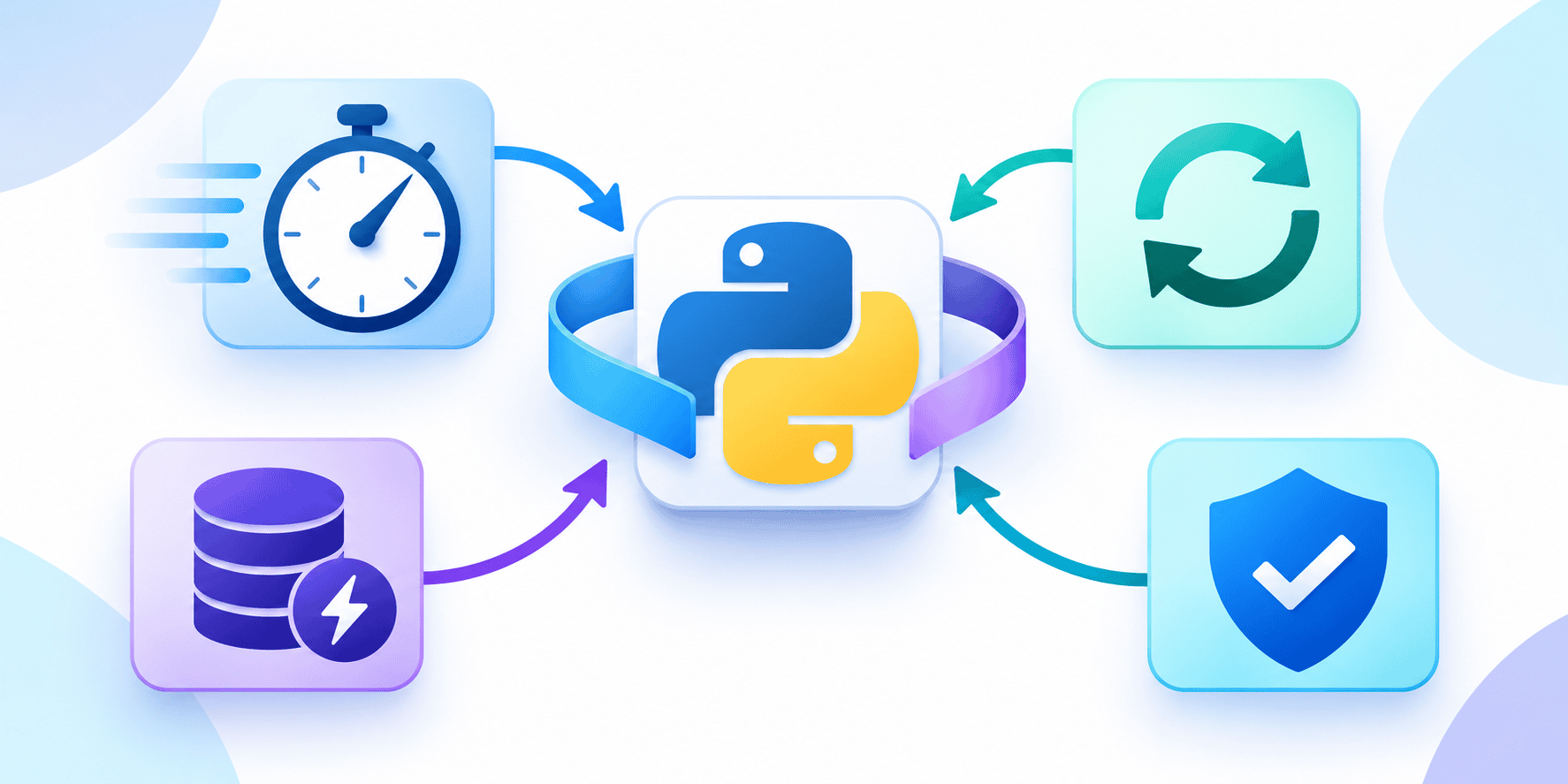
Monitoring performance is a standard requirement for production systems. A robust timing decorator uses the try...finally block to ensure that duration metrics are recorded regardless of whether the function succeeds or raises an exception. By utilizing time.perf_counter(), which provides the highest available resolution for measuring durations, developers can accurately capture the execution time of critical paths.
The inclusion of the finally block is crucial; it ensures that even if a batch transformation fails due to a data error, the system still logs the duration and the failure status. This observability is vital for identifying bottlenecks in data pipelines and distinguishing between transient network issues and code-level regressions.
Pattern 2: Implementing Reliable Retry Logic
Retries are a common defense against intermittent network failures, particularly when interacting with remote services or APIs. A production-grade retry decorator must be implemented as a decorator factory—a function that returns a decorator—to allow for configuration such as the number of attempts, the delay interval, and the specific exceptions to catch.
Safety is paramount here. The decorator should explicitly catch only transient exceptions, such as TimeoutError or ConnectionError. If an unexpected exception occurs, it should propagate immediately rather than being masked by the retry logic. Furthermore, the decorator must re-raise the final exception if all attempts fail, ensuring that the caller is aware of the persistent error. Developers should be cautioned that retries are only appropriate for idempotent operations—those that produce the same result regardless of how many times they are executed. Applying retries to non-idempotent operations, such as financial transactions or database deletions, can lead to data corruption or duplicate actions.
Pattern 3: Caching for Computational Efficiency
For CPU-intensive tasks or redundant API calls, memoization is an effective strategy. While custom caches can be written, the functools.lru_cache (Least Recently Used) is the standard, thread-safe, and highly optimized choice. By caching the results of function calls based on their input arguments, developers can drastically reduce latency and resource consumption.
The primary risks with caching include memory leaks if the cache is unbounded and the unintentional reuse of mutable objects. If a function returns a list or dictionary, subsequent callers might inadvertently modify the shared object stored in the cache. Developers should ensure that cached functions are pure—meaning they return the same output for the same input without side effects—and that the maxsize parameter is set to a value appropriate for the available system memory.
Pattern 4: Input Validation at the Boundary
Validation logic ensures that functions operate within expected constraints. By utilizing the inspect.signature module, a decorator can bind arguments at runtime and verify them against predefined rules before the function ever executes. This "fail-fast" approach prevents invalid data from propagating deep into the system.
This pattern is particularly effective for enforcing invariants on function parameters, such as ensuring a batch_size is positive or a probability value falls within the unit interval [0, 1]. By keeping validation logic at the boundary, developers can maintain cleaner core code. However, it is important to note that this is not a substitute for comprehensive data modeling. For complex objects with interrelated fields, libraries like Pydantic or the use of dataclasses are superior, as they provide a more robust schema-driven validation framework.
Strategic Implications and Best Practices
The effective use of decorators is a hallmark of senior-level software engineering. When applied correctly, they turn scattered, messy code into a coherent, declarative system. However, the overuse of decorators can lead to a "magical" codebase where the flow of execution is difficult to trace. A general rule of thumb is that if a decorator requires more than a few lines of logic or makes the execution flow opaque, it may be time to refactor into a more explicit architectural pattern.
Chronologically, the evolution from manual boundary code to decorator-based management typically follows the maturation of a software team. Initial phases favor "getting it working," which leads to the manual insertion of code. The second phase involves recognizing the repetition, leading to the creation of basic utility functions. The final phase, which defines highly maintainable systems, involves abstracting these utilities into standard, reusable decorators that document intent while enforcing constraints.
In summary, decorators should be treated as infrastructure. They should be thoroughly tested, documented, and kept small enough to be easily understood. By adhering to the contract of preserving function identity through functools.wraps and ensuring that stateful decorators are handled with care, engineering teams can build systems that are both resilient to errors and transparent in their operations. Whether it is timing a process, retrying a request, caching a result, or validating an input, the decorator remains the primary tool for maintaining a clean separation between "what" a function does and "how" it behaves within the larger system architecture.