Google Announces Gemini 4 Hydrogen to Bring High-Speed, Efficient AI Across Developer and Consumer Ecosystems

The artificial intelligence landscape shifted once again today as Google officially unveiled Gemini 4 Hydrogen, a cutting-edge model designed to democratize high-intelligence capabilities while optimizing speed and cost-efficiency for everyday coding and agentic workflows. Positioned alongside the company’s heavy-duty frontier models, Gemini 4 Carbon and Gemini 4 Argon—which are tailored for deep, long-horizon reasoning on complex architectural challenges—Hydrogen is engineered for rapid execution, multi-model orchestration, and widespread accessibility.

The launch marks a significant milestone in Google’s product rollout strategy, making the Gemini 4 architecture available to all tiers of Google AI Studio, the Gemini API, Gemini for business, the core Gemini consumer application, Google Search, and Google Antigravity for paid Pro and Ultra subscribers. By blending low latency with robust performance, the release targets the bottleneck historically faced by enterprise developers and casual users alike: balancing the need for deep analytical thinking with the demand for snappy, responsive day-to-day execution.
A New Benchmark in Speed and Intelligence
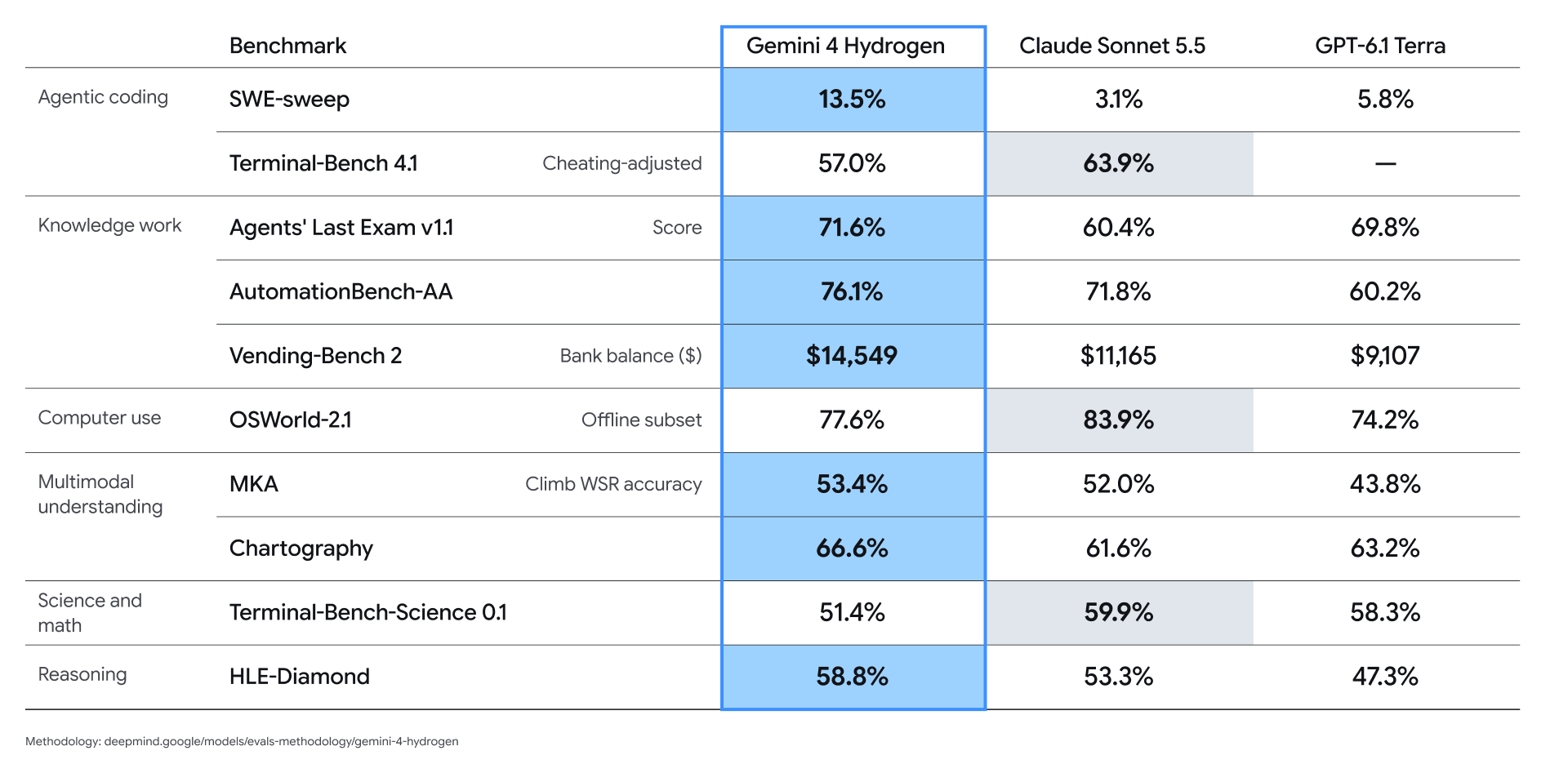
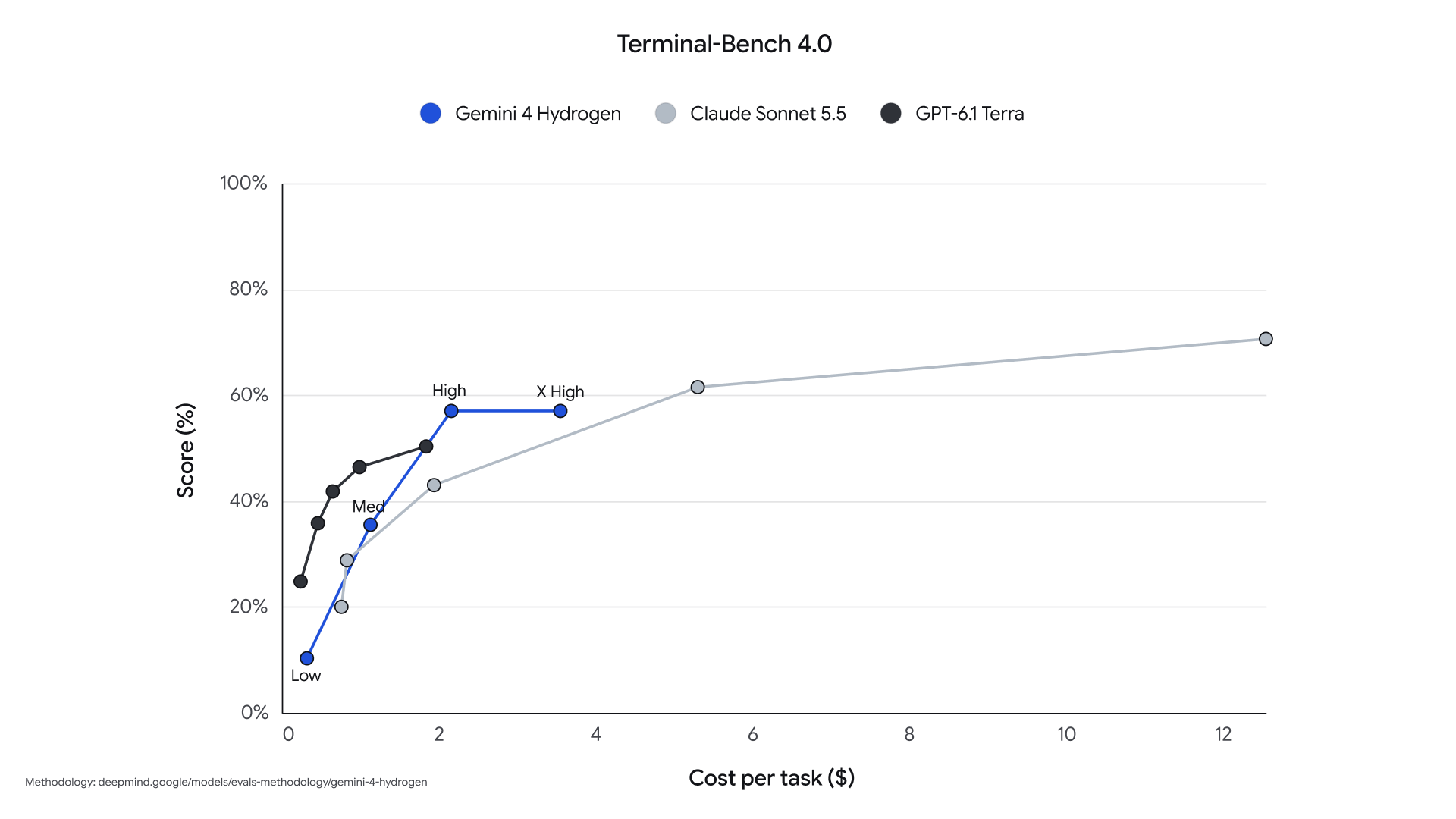
In comparative evaluations, Gemini 4 Hydrogen has demonstrated remarkable technical capabilities, outperforming its predecessor, Gemini 3.8 Flash, across nearly all major performance metrics. According to data released by the company, Hydrogen delivers tasks up to 2.5 times faster at its default high-thinking setting while more than tripling scores on Terminal-Bench 4.1, jumping from 18.2% to 57%. Furthermore, Google reports a fivefold reduction in fabricated claims (hallucinations) and a vastly improved ability to gracefully recover when tool calls fail or web searches return empty results.
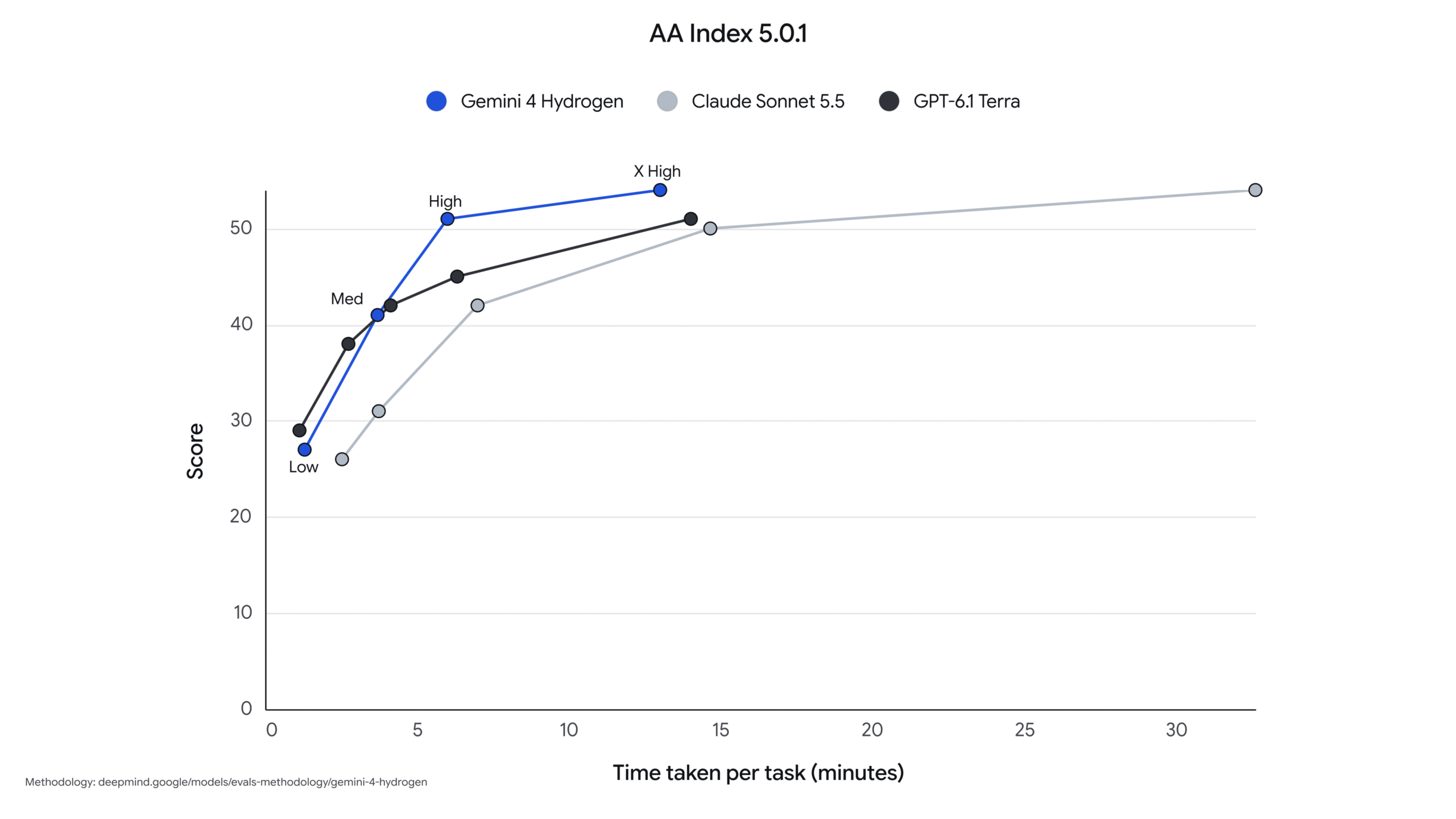
On the Artificial Analysis Intelligence Index, Hydrogen even surpasses its sibling model, Argon, scoring 51 at its default high thinking level and climbing up to 54 when configured to its newly introduced "xhigh" setting. This scalability is powered by four distinct thinking levels—low, medium, high (default), and xhigh—which give developers granular control over the trade-offs between quality, latency, and operational expenditure.
Pricing and Accessibility
Understanding the financial realities of scaling enterprise applications, Google has structured Hydrogen’s pricing model to be flat across its entire 1 million-token context window. The model is priced at $1.50 per million input tokens and $7.50 per million output tokens. This predictable pricing scheme is expected to appeal heavily to software development teams managing massive codebases or processing large volumes of enterprise data, where token costs can otherwise spiral unpredictably.

The global rollout spans multiple surfaces simultaneously. Consumers will notice immediate upgrades within the Gemini app and Google Search, where the model’s enhanced instruction-following capabilities allow for smoother multi-turn conversations and more intuitive information retrieval. Meanwhile, developers can access Hydrogen instantly via Google AI Studio and the Gemini API, while enterprise clients can integrate it through Google Cloud and Gemini for business.
Multi-Model Workflows and the Introduction of Orchestrator
One of the most notable technical contributions accompanying the Gemini 4 Hydrogen launch is the introduction of "Orchestrator in Google Antigravity." In modern software engineering, development teams rarely rely on a single model for every task. While frontier models like Carbon and Argon are ideal for high-level architectural design and debugging subtle system flaws, everyday tasks like writing boilerplate code, executing unit tests, and verifying changes require a faster execution engine.

Orchestrator solves this by dynamically switching between models within a single session. During tests on Terminal-Bench 4.0, Orchestrator achieved success rates nearly matching those of the much larger Carbon model, while consuming 24% less quota and completing tasks 19% faster. In parallel agent workflows, Carbon can act as the central coordinator, while fleets of Hydrogen instances power worker and verifier agents simultaneously across isolated workspaces. This architecture allows engineering organizations to ship complex, multi-layered software projects rapidly without incurring prohibitive computational overhead.
Practical Applications Across Industries
Beyond traditional software development, Hydrogen’s speed and multimodal comprehension unlock creative and enterprise use cases that were previously too resource-intensive for standard flash-tier models. Demonstrations released alongside the announcement showcased the model’s versatility across diverse domains:

- Interactive 3D and Web Audio: Hydrogen successfully generated real-time web applications, such as "Geminisland," where users can build shared voxel environments from a single prompt, or an audio engine mapped to live global lightning strike data to produce ambient music.
- Advanced E-Commerce and Visualizers: Paired with new frontend design skills in Google Antigravity, the model built complete e-commerce storefronts featuring WebGL2 topographic shaders, scrollytelling components, and live configurators in a single generation pass.
- Spreadsheet Automation: In Google Sheets, Hydrogen combined Python scripting, native LET formulas, and conditional formatting to transform standard cells into an animated pixel canvas capable of rendering full-motion scenes.
- Enterprise Productivity: In Google Slides and Sheets, the model autonomously audited presentation layouts to fix overlapping text and converted complex financial figures into interactive forecasting models more than 30% faster than previous iterations.
Safety, Security, and Enterprise Assurance
As artificial intelligence models become more autonomous and deeply embedded in enterprise workflows, safety and alignment remain paramount. Gemini 4 Hydrogen integrates Google’s latest Gemini 4 safety and security stack, combining pre-training safeguards with real-time surface filters to mitigate risks related to model misuse, drift, and hallucination.
According to the official Gemini 4 Hydrogen model card, extensive red-teaming and evaluation protocols were conducted to ensure that the model maintains strict adherence to safety guidelines, even when operating at high speeds across extended context windows. This makes it a dependable option for regulated industries such as finance, healthcare, and enterprise IT, where compliance and data integrity are non-negotiable.
Broader Implications for the AI Ecosystem
The release of Gemini 4 Hydrogen reflects a broader maturation trend within the generative AI industry. As foundational reasoning capabilities reach a high watermark across major labs, the competitive frontier has shifted decisively toward efficiency, latency reduction, and seamless integration into developer tooling and daily workflows.
By offering a model that bridges the gap between ultra-fast flash architectures and deep-reasoning frontier models, Google is addressing a critical market demand. For software developers, businesses, and everyday consumers alike, Gemini 4 Hydrogen provides an adaptable, cost-effective engine designed to turn ambitious ideas into functional digital reality faster than ever before.
Related posts: