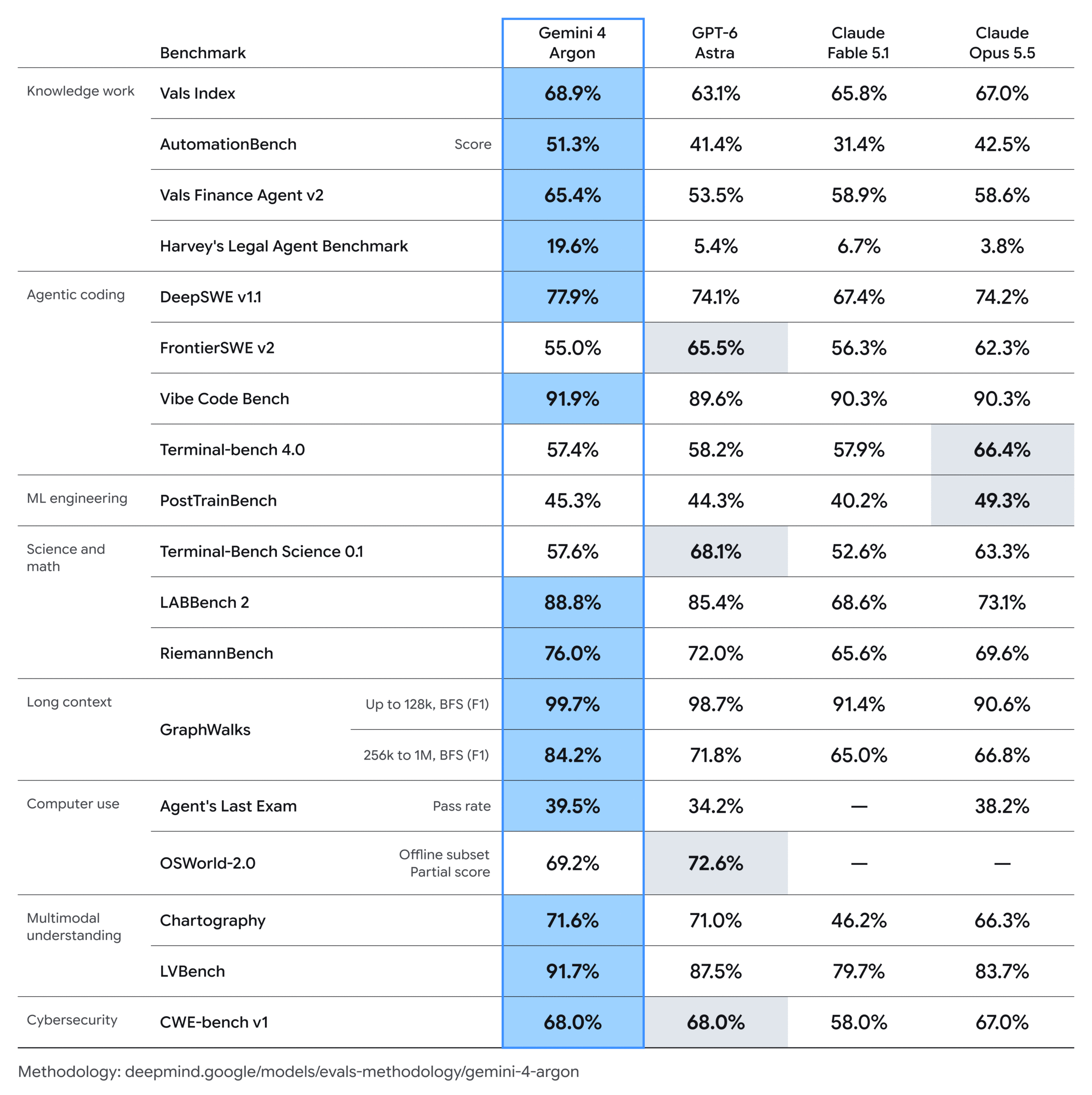
Google Unveils Gemini 4 Neon: A New Frontier in High-Speed Enterprise and Scientific Intelligence

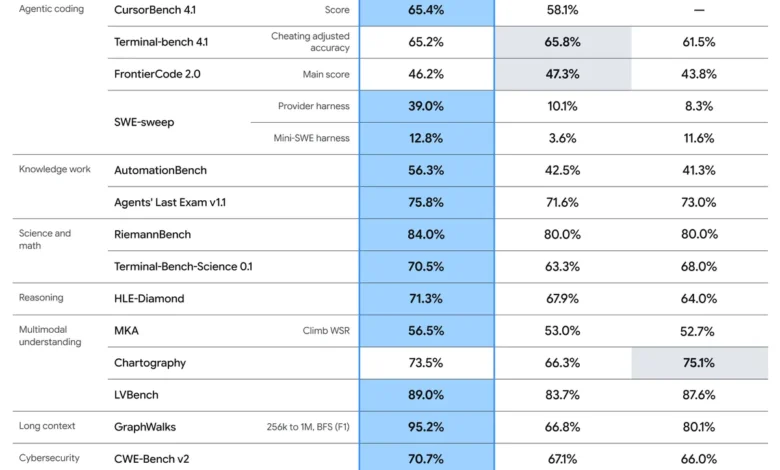
Google has officially introduced Gemini 4 Neon, its latest frontier-level artificial intelligence model designed to deliver rapid, end-to-end task completion across complex software engineering, knowledge work, and advanced scientific workflows. Positioned strategically within the company’s expanding Gemini 4 product family, Neon bridges the gap between raw computational capability and operational efficiency, offering dense multi-modal context handling, superior multi-step instruction-following, and deep agentic control at a significantly reduced cost compared to traditional heavy

models.
The launch follows a rigorous evaluation period across standard industry benchmarks, where Neon has posted competitive scores against peer models in reasoning, mathematics, and complex execution. Available immediately across multiple enterprise and developer platforms, the model represents a structural evolution in how organizations deploy AI for production-grade software development, quantitative analysis, and cybersecurity defense.

Background and Context in the Gemini 4 Ecosystem
The rollout of Gemini 4 Neon comes at a time of rapid transition in the artificial intelligence landscape, as tech giants pivot away from merely scaling model parameters toward optimizing inference speed, cost-effectiveness, and autonomous multi-agent orchestration. Within Google’s internal hierarchy, the Gemini 4 family is segmented to handle distinct operational burdens: Gemini 4 Carbon addresses the heaviest, long-horizon projects requiring exhaustive compute, while Gemini 4 Hydrogen handles high-frequency, everyday execution tasks.
Gemini 4 Neon occupies a vital middle ground. It is engineered specifically to provide deep, frontier-level reasoning for high-frequency analytical workflows without the latency and cost penalties typically associated with maximalist models. By refining its thinking levels—scaled across four distinct tiers—Neon allows development teams and enterprise architects to dynamically calibrate intelligence output and token expenditure based on the precise demands of a given workload.
Performance and Benchmark Analysis
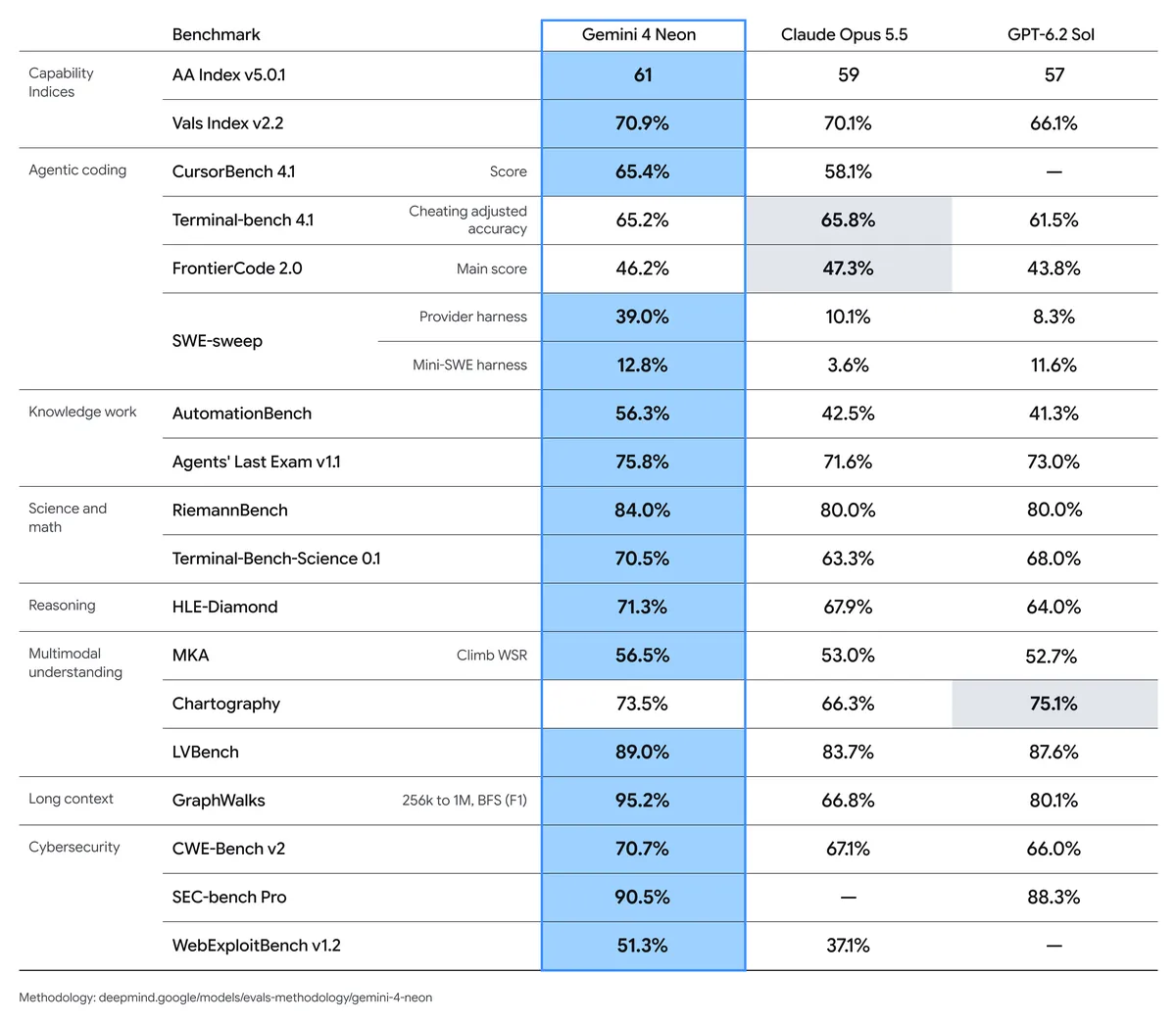
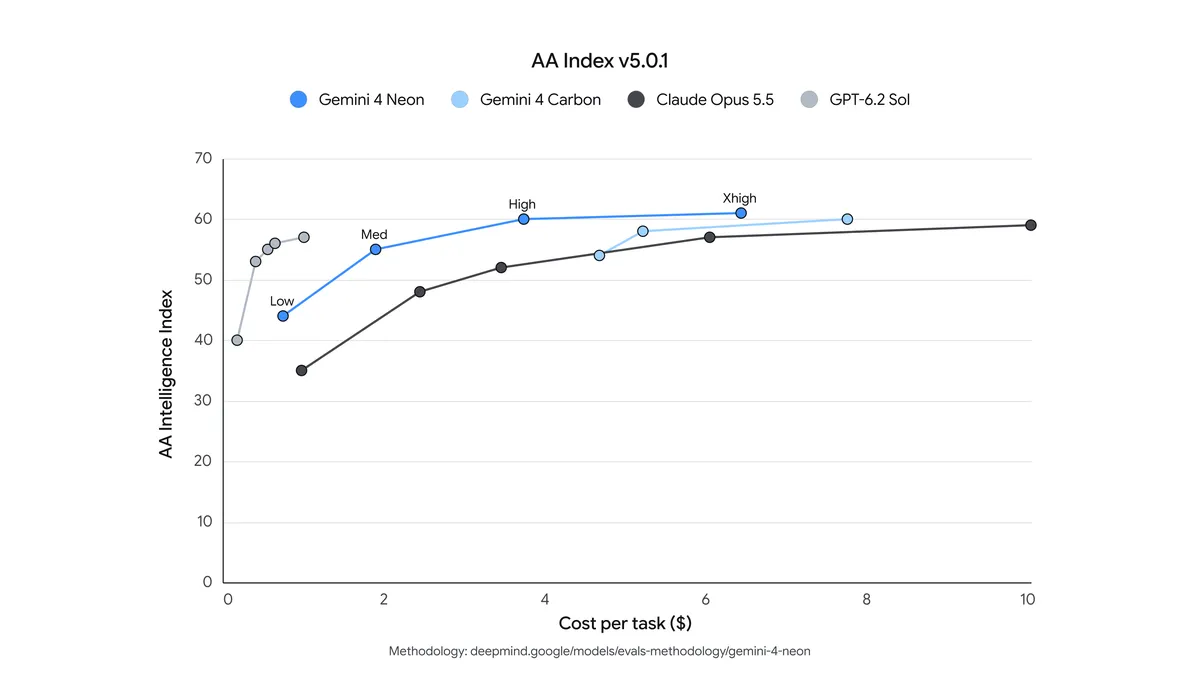
Independent evaluations highlight Neon’s strong positioning across a diverse array of technical and commercial benchmarks. On the Artificial Analysis Intelligence Index, operating at its highest "xhigh" thinking level, Neon secures a score of 61, ranking third overall and trailing only significantly larger, slower architectures. On the Vals Index, the model achieves a score of 70.9%, landing comfortably on the Pareto frontier with a #2 overall ranking. Furthermore, Neon claims the #1 position on specialized evaluations including the Legal Research Bench, the Tax Agent Bench, Zapier’s AutomationBench, and Andon Labs’ Vending-Bench 2, a long-horizon simulation tracking business management capabilities.
In scientific and mathematical reasoning, Neon demonstrates top-tier competence, registering leading scores on Terminal-Bench Science (70.5%), RiemannBench (84.0%), and HLE-Diamond (71.3%). Enterprise applications benefit equally from its unified 1-million-token context window, which enables the model to ingest, synthesize, and structure disparate inputs—ranging from dense spreadsheets and financial PDFs to multimedia charts, audio, and video—within a single processing session.
Production-Ready Software Engineering and Agentic Workflows
Software development represents a primary pillar of Neon’s deployment strategy. Engineered explicitly for long-running agentic workflows, the model sustains high performance across tool-heavy tasks, operating either as a standalone agent or functioning as a high-judgment orchestrator directing parallel subagents within platforms like Google Antigravity.
Developers benefit from Neon’s ability to minimize redundant file reads, manage context compaction during extended sessions, and execute surgical, multi-file debugging and refactoring across entire code repositories. On the Artificial Analysis Coding Agent Index, Neon leads its class with a score of 58.6, alongside strong showings on Terminal-Bench 4.1 (65.2%) and FrontierCode 2.0 (46.2%). In internal testing via the Antigravity harness, Neon more than triples baseline performance on mini-SWE metrics, reaching a state-of-the-art completion rate of 39.0%.
Specialized Deployment: Cybersecurity and the Fairwind Program
Recognizing the escalating need for secure, automated code generation and system defense, Google is also introducing a specialized variant designated as Gemini 4 Neon for cyber. As automated agentic coding becomes more prevalent, the ability to generate inherently secure code from the outset is paramount.
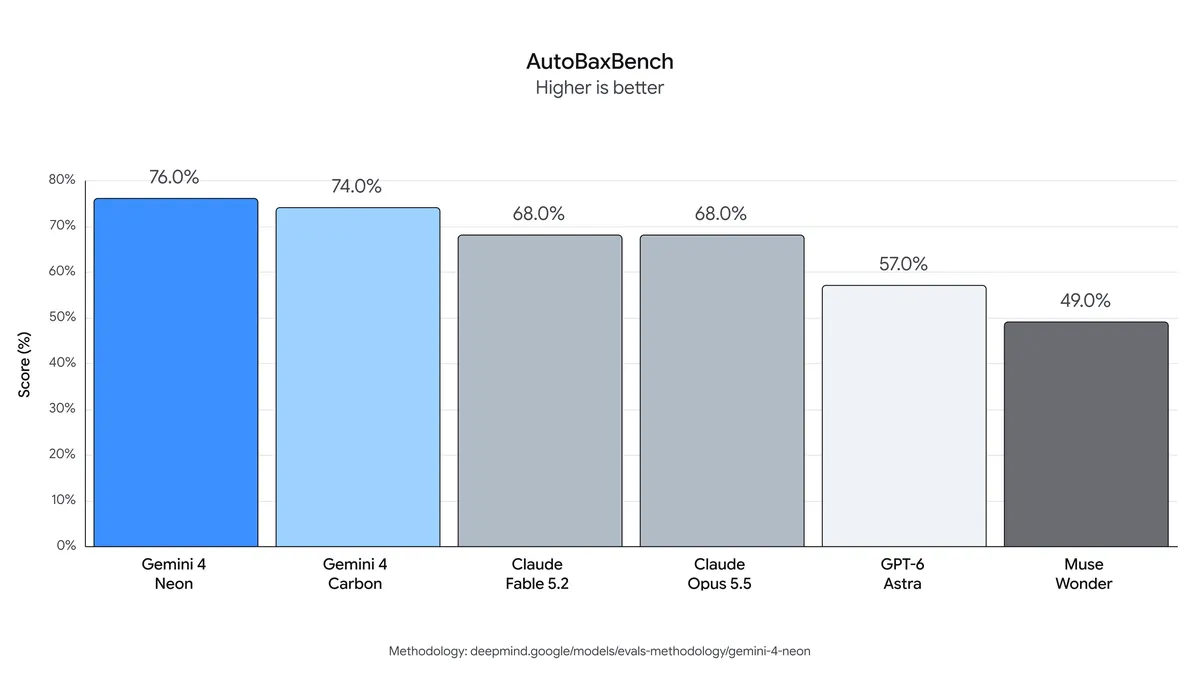
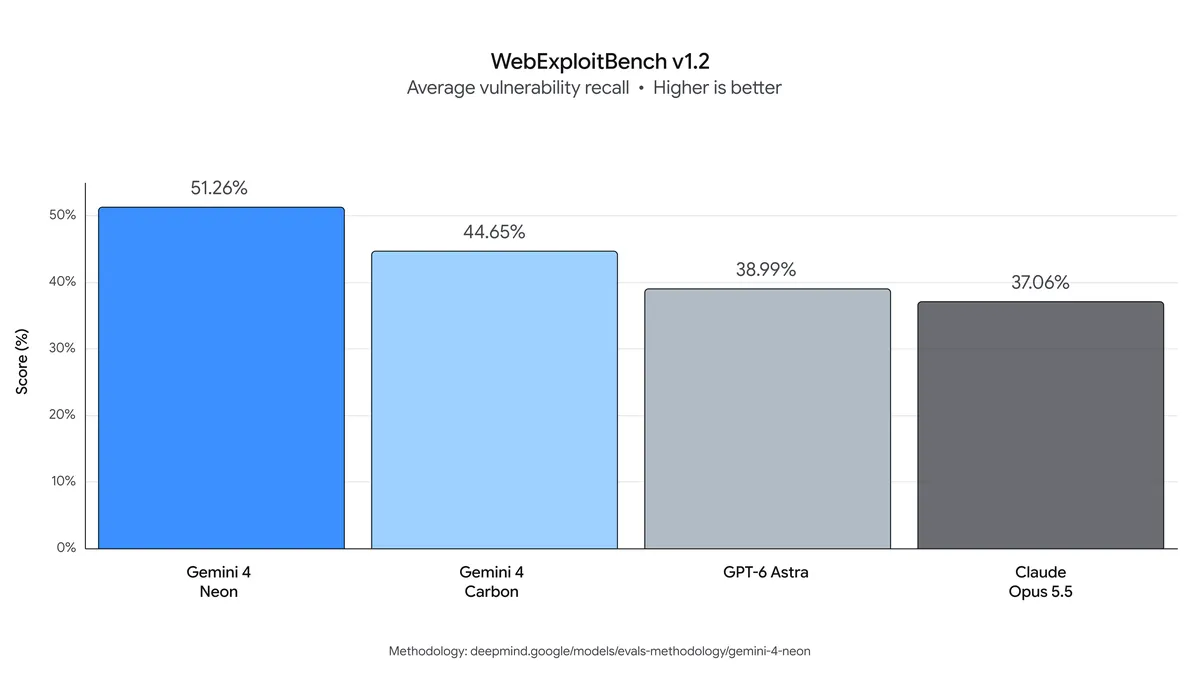
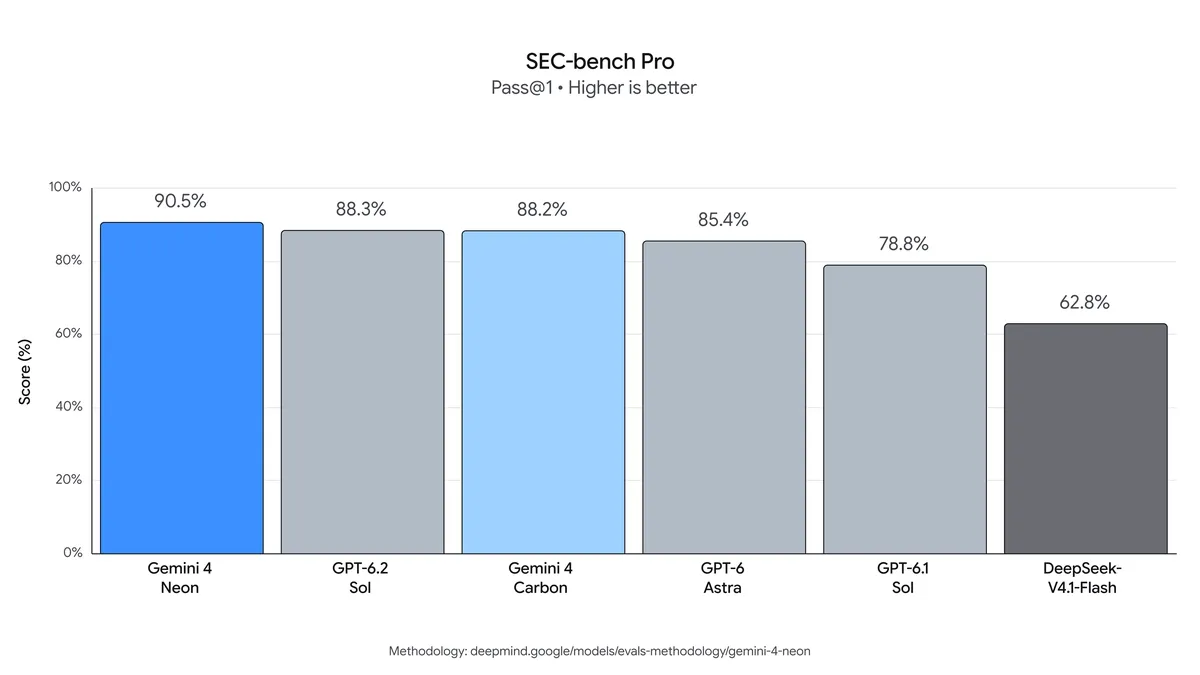
Neon for cyber outperforms previous iterations across easy, medium, and hard challenges on AutoBaxBench, peaking at a state-of-the-art 76% on the most complex tier. For proactive defense, the model achieves a 51.26% success rate on WebExploitBench v1.2, matching or exceeding leading legacy models at roughly half the operational cost. The model manages the full code-hardening lifecycle—encompassing vulnerability discovery, validation, and automated patching—and is rolling out initially to select enterprise defenders under Google’s Fairwind Program.
Pricing, Availability, and Market Implications
Google has structured Gemini 4 Neon’s pricing model to encourage widespread enterprise adoption. The model is priced at $3 per million input tokens—with a 95% discount dropping cached input tokens to $0.15 per million—and $15 per million output tokens, supported by a 1-million-token context window. Independent cost-per-task analyses indicate that Neon delivers up to 32% greater cost efficiency than Carbon at standard high settings, and achieves 50% to 80% cost reductions compared to top competing frontier models on equivalent agentic evaluations.
Gemini 4 Neon is rolling out immediately across multiple Google ecosystems. It is accessible via the Gemini API in Google AI Studio, integrated into Gemini for business through API channels and model dropdown menus, and made available to paid subscribers of Google AI Pro and Ultra within Google Antigravity and the core Gemini mobile and web applications.
Industry analysts observe that Neon’s combination of aggressive pricing, high-tier reasoning, and specialized vertical capabilities—particularly in software engineering and cybersecurity—places mounting pressure on competing AI providers. By lowering the financial barrier to complex agentic execution, Google aims to accelerate the transition of large language models from conversational assistants into autonomous, production-grade enterprise workers.