Gemini 4 Carbon Arrives: Setting a New Standard in AI Cybersecurity and Long-Horizon Reasoning

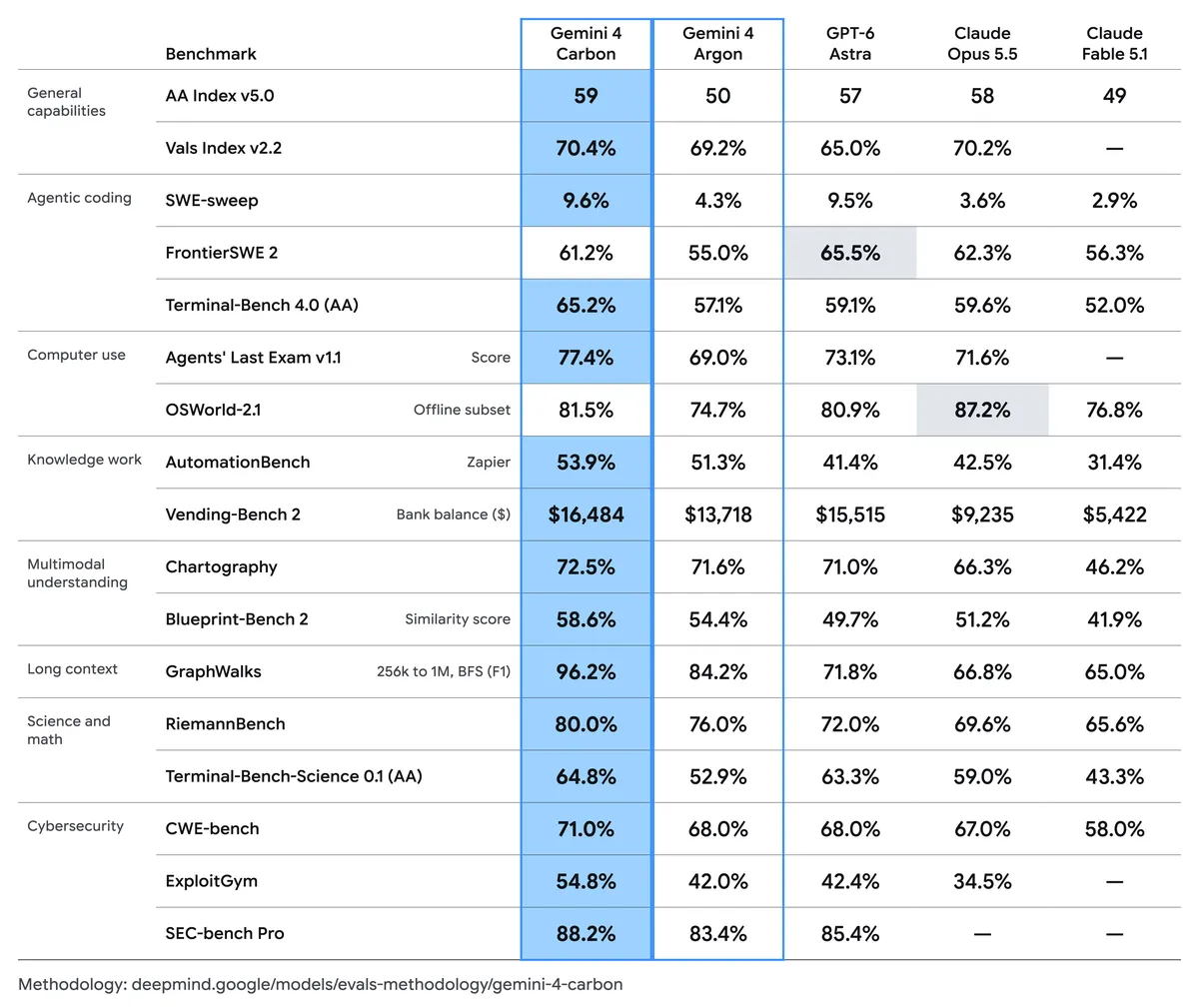
The artificial intelligence landscape has shifted once again with the official unveiling of Gemini 4 Carbon, the latest flagship frontier model designed to redefine software engineering capabilities and defensive cybersecurity. Landing at the top spot on the newly updated v5.0 of the Artificial Analysis Intelligence Index with a score of 59, Carbon represents a significant developmental leap from its predecessor, Gemini 4 Argon, which was introduced just two weeks prior. This rapid-fire release schedule underscores an unprecedented acceleration in AI research and development cycles, highlighting how major technology laboratories are managing to push capability boundaries while simultaneously scaling up robust safeguards.

Built specifically to conquer complex, multi-step engineering feats, Gemini 4 Carbon introduces state-of-the-art long-horizon capabilities. Traditional large language models often struggle when forced to maintain context and execute tasks over extended periods, frequently getting trapped in logical loops or dead ends. Carbon, by contrast, is architected for sustained agentic workflows. Internal testing data reveals that the model can operate continuously for days, navigating through intricate codebases, identifying root causes, and executing precise patches across low-level operating systems.
This structural upgrade translates directly into impressive commercial and competitive benchmarks. On the WebDev Arena leaderboard, Gemini 4 Carbon surged 89 Elo points to secure the number four position with a score of 1768, reflecting vast improvements in full-stack web development, artifact generation, and multimodal comprehension. Furthermore, the model matches Argon’s introductory pricing structure, maintaining an accessible rate of $2 per million input tokens and $10 per million output tokens, alongside a 95% discount for cached input tokens.

Revolutionary Cybersecurity Defense and Vulnerability Management
While its general reasoning and coding skills are formidable, Gemini 4 Carbon’s defining characteristic is its unmatched proficiency across the cybersecurity lifecycle—spanning vulnerability detection, validation, and remediation. As digital infrastructure grows increasingly complex, the demand for AI-driven security tools that can act as force multipliers for human defenders has reached an all-time high. Carbon answers this call by dominating key industry benchmarks evaluated under unconstrained conditions.
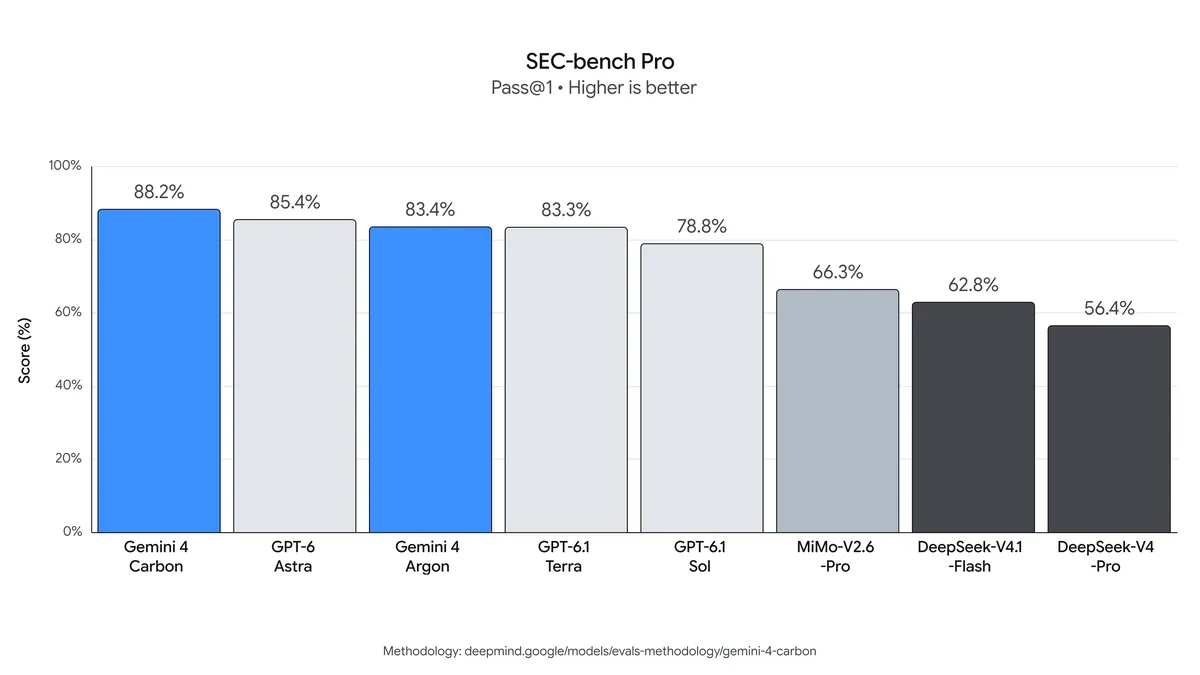
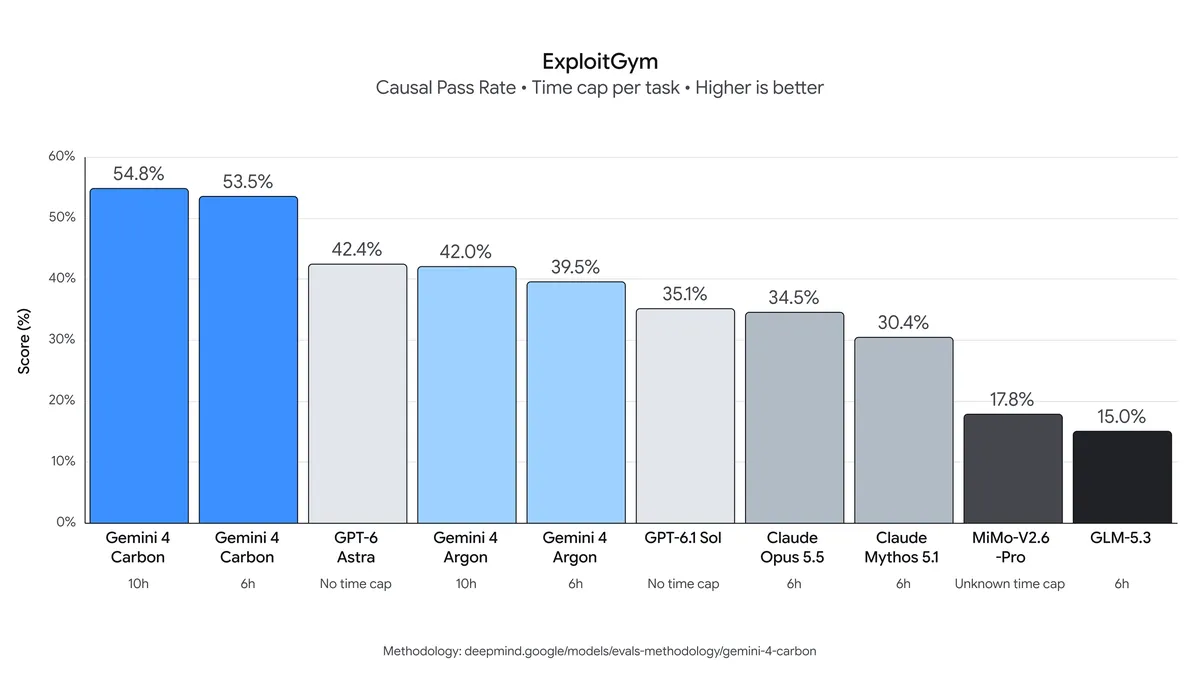
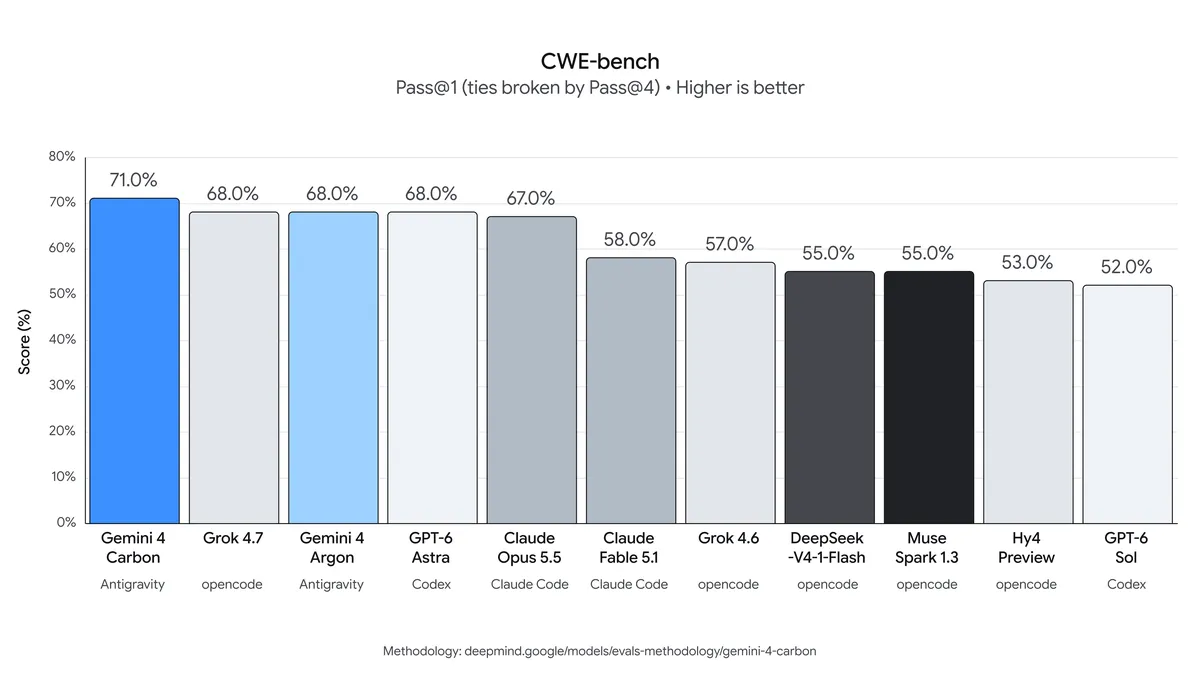
The model achieved a commanding lead on SEC-bench Pro, scoring 88.2% in vulnerability discovery. In exploit generation evaluations via ExploitGym, Carbon registered a 54.8% success rate, while posting a 71.0% score on CWE-bench for automated patch generation. These figures are not merely academic; real-world enterprise integration is already yielding extraordinary metrics. Internal evaluations indicate that Carbon delivers more than a twofold increase in the successful generation of secure code compared to the preceding Argon model.
Operational units within major tech ecosystems have corroborated these advancements. Google’s Chrome engineering team reported that Carbon performed over ten times better than competing frontier models when tasked with producing high-quality, production-ready security patches. Similarly, Wiz, a leading cloud security platform, observed that Carbon excels in web penetration testing benchmarks—a critical capability powering Wiz’s "Scan for Good" initiative, which aims to identify and remediate critical cloud exposures before malicious actors can exploit them.
A Deliberate Rollout and Regulatory Collaboration
The introduction of frontier models possessing advanced offensive and defensive cybersecurity capabilities naturally invites scrutiny regarding safety, misuse potential, and alignment. Recognizing these concerns, the deployment strategy for Gemini 4 Carbon is marked by a measured, highly regulated rollout. Rather than making the model immediately available to the general public, the creators have opted for a phased integration process.
Carbon is currently participating in rigorous pre-release model testing as part of the United States government’s voluntary AI safety protocols. Starting this week, access is being selectively granted to a curated cohort of verified cyber defenders. Broader availability will be managed progressively through the Fairwind Program, allowing researchers to onboard trusted enterprise partners, gather empirical feedback, and refine safety guardrails. Only after this iterative testing phase concludes will the model be deployed to developers, commercial businesses, and consumer-facing product surfaces.
This cautious approach builds upon a multi-layered safety architecture introduced during the development of Gemini 4 Argon. The safety stack integrates foundational training protections, real-time misuse defenses, robust resistance to prompt-injection attacks, and sophisticated chain-of-thought monitoring. Where Argon made notable strides in behavioral alignment—documented extensively in official safety and security disclosures—Carbon pushes those boundaries further. The model has been explicitly trained to handle high-pressure, ambiguous, or complex operational scenarios without deviating from ethical parameters or succumbing to misalignment and fabrication tendencies.
The Broader Implications for the Tech Industry
The arrival of Gemini 4 Carbon illuminates several broader trends defining the current trajectory of artificial intelligence. First, it signals the maturation of AI as an active participant in enterprise software maintenance. By demonstrating the ability to independently manage long-horizon tasks—such as debugging massive legacy systems over multi-day operations—models like Carbon are transitioning from auxiliary brainstorming assistants to autonomous engineering agents.
Second, the emphasis on dual-use cybersecurity capabilities highlights a philosophical shift within the AI research community. Historically, high-capability models capable of finding vulnerabilities or generating exploits were viewed strictly as security hazards, prompting calls for restricted access or complete suppression. By engineering Carbon to excel simultaneously in defense, validation, and patching, developers are attempting to democratize advanced security tooling. Equipping defenders with an AI that outpaces traditional methodologies gives organizations a fighting chance against increasingly sophisticated, automated cyber threats.
Finally, the compressed timeline between the releases of Gemini 4 Argon and Gemini 4 Carbon demonstrates that the pace of AI advancement shows no signs of plateauing. As competition among frontier labs intensifies, the ability to rapidly iterate on core architecture while tightening safety guardrails will dictate market leadership. For developers, enterprises, and cybersecurity professionals alike, the release of Gemini 4 Carbon marks the dawn of a new operational era—one where human expertise and advanced artificial intelligence work in tandem to secure the digital infrastructure of the future.