A paradigm shift in how developers interact with artificial intelligence agents has rapidly emerged, transforming the once-manual, turn-by-turn process into automated, reliable cycles. This evolution, termed "loop engineering," has moved from a niche concept to a widely debated topic within months, fundamentally altering the landscape of AI-assisted development and operations. The core innovation lies in designing systems that prompt, check, remember, and re-run AI agents autonomously, freeing human oversight from constant, granular intervention.
The Genesis of Autonomous AI Cycles
The shift became palpable in the professional lives of developers over a remarkably short period. Previously, a typical evening might involve a developer meticulously guiding an AI coding agent, providing input, analyzing its output, correcting errors, and iterating through prompts. This process was akin to driving a vehicle requiring constant, minute adjustments. However, by mid-2026, a new approach gained traction. Developers began issuing a single instruction, then stepping away, returning the next morning to find completed tasks like draft pull requests, triaged issue lists, or successful continuous integration builds. This transformation was not driven by advancements in the AI models themselves, but by the sophisticated systems built around them.
The term "loop engineering" gained significant momentum in June 2026. This rapid ascent from obscurity to widespread discussion highlights the urgency and relevance of this new methodology. It represents a move from prompt engineering, where the focus was on crafting individual, highly effective instructions, to a more holistic system design approach.
Defining Loop Engineering: Beyond the Single Prompt
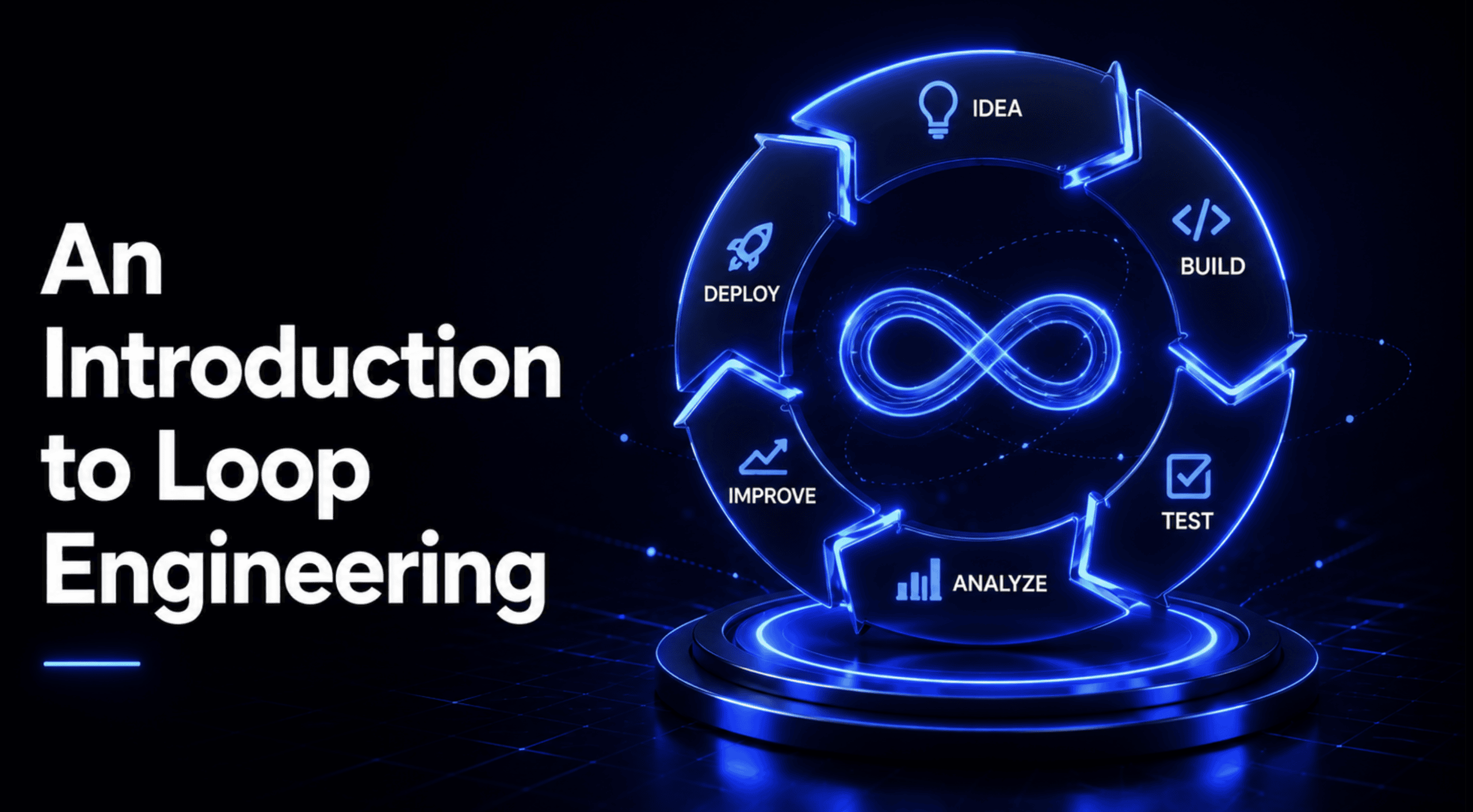
At its heart, loop engineering is the discipline of constructing the intricate systems that manage an AI agent’s workflow. This involves automating the processes of prompting, environmental feedback, self-correction, and iterative execution. The fundamental unit of work shifts from a single interaction to a repeating cycle – a loop. Within this loop, an AI model takes an action, receives feedback from its operational environment, uses that feedback to inform its subsequent decision, and continues this process until a predefined, verifiable condition for task completion is met.
This stands in stark contrast to a linear "chain" of operations, where steps follow a fixed, predetermined order. A loop, conversely, is dynamic and adaptive. An agent might progress from step A to B, encounter an unforeseen issue, revise its strategy, and then proceed to C, or it could even loop back to A if necessary. MindStudio’s conceptualization of a loop emphasizes its continuous nature: it persists until a task is demonstrably complete, a stopping condition is triggered, or the agent determines further progress is impossible. This represents a profound departure from the traditional "ask once, get an answer" model.
The concept of a "recursive goal" is also central to loop engineering. Instead of dictating each discrete step, users define an overarching purpose, such as "ensure the test suite passes" or "triage all open issues and draft solutions for straightforward ones." The AI agent then iteratively works towards this objective, engaging in a cycle of inspection, modification, execution, and evaluation. The developer’s skill set thus evolves from mastering the art of the single perfect prompt to designing robust cycles that can be trusted to operate independently.
A Viral Phenomenon: The Rapid Ascent of "Loop Engineering"
The speed at which "loop engineering" became a recognized term is a crucial part of its narrative. The catalyst for this rapid adoption can be traced to specific, closely timed events in June 2026.
On June 7, 2026, Peter Steinberger, a developer known for the OpenClaw agent project, posted on X (formerly Twitter) that the essential skill for interacting with AI coding agents had shifted. He argued that developers should no longer be directly prompting agents but should instead focus on designing the automated loops that would prompt them. This post garnered significant attention, reportedly exceeding 6.5 million views within days and dominating AI agent-focused discussions for the subsequent week.
The following day, June 8, 2026, Addy Osmani, a Google engineer and noted author, published an essay titled "Loop Engineering." This influential piece provided a structural framework for Steinberger’s observation, detailing key components such as automations, worktrees, skills, connectors, and sub-agents, all underpinned by external memory. Osmani’s essay transformed a viral sentiment into a defined vocabulary, enabling broader discussion and development of the concept.
The significance of this shift was amplified by voices within the AI industry itself. Boris Cherny, who leads Claude Code at Anthropic, was quoted in Osmani’s essay stating, "I don’t prompt Claude anymore. I have loops running that prompt Claude, and figuring out what to do. My job is to write loops." Such statements from developers of leading AI coding agents underscored that loop engineering was not merely an external observation but a fundamental change in internal development practices.
The timing of this emergent terminology is intrinsically linked to the advancements in AI agent capabilities by mid-2026. Coding agents had reached a level of sophistication where they could operate for extended periods without direct supervision, demonstrating an increased ability to recover from errors. When a single agent run could last for an hour and involve modifications across dozens of files, the bottleneck for productivity shifted from prompt refinement to the robustness of the surrounding system – ensuring the agent remained productive, checked, and aligned with its goal throughout the entire operation, even without constant human oversight.
A Layered Evolution: From Prompt to Loop Engineering
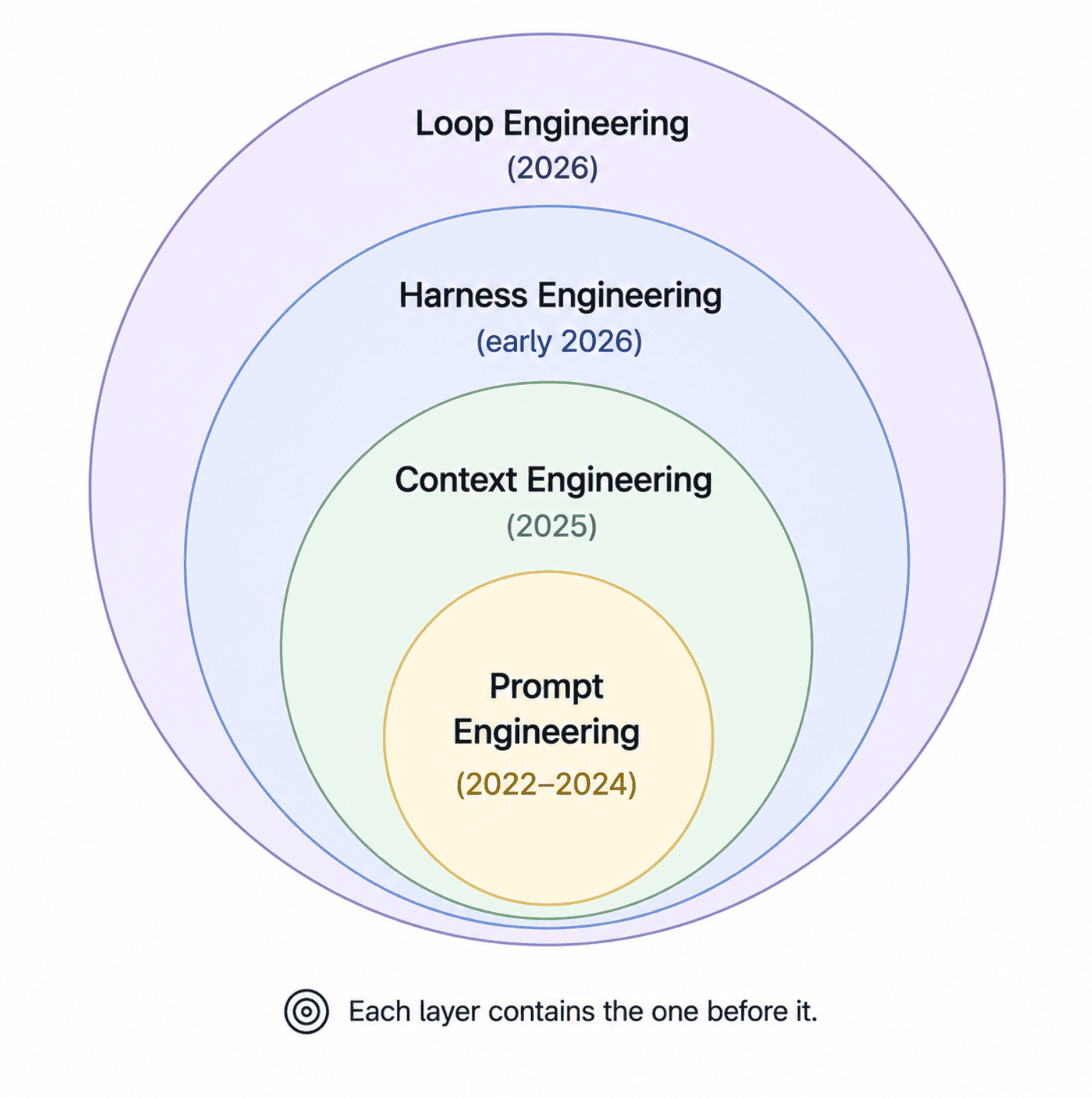
Loop engineering did not emerge in a vacuum but represents the latest iteration in a progression of AI interaction methodologies. Each subsequent layer has built upon, rather than replaced, the preceding ones.
-
Prompt Engineering (circa 2022-2024): The initial phase focused on the art of crafting precise prompts. This involved defining the AI’s role, breaking down tasks into discrete steps, providing illustrative examples, and instructing the model to "reason step-by-step." While effective, prompt engineering’s limitations became apparent when the model lacked necessary information or context, regardless of how well the prompt was worded.
-
Context Engineering (circa 2025): This phase expanded the focus from the prompt itself to the entire informational landscape the model encountered during its response generation. This included conversation history, retrieved documents, tool outputs, and any other assembled data. In mid-2025, Shopify CEO Tobi Lütke defined context engineering as providing all necessary information for a task to be plausibly solvable by the model. Andrej Karpathy echoed similar sentiments, and by September 2025, Anthropic formalized the concept as curating and maintaining the optimal set of tokens available during inference. Prompt engineering effectively became an integral component of context engineering.
-
Harness Engineering (Early 2026): As AI agents began undertaking longer, more autonomous, multi-step tasks in real-world production environments, harness engineering emerged. The "harness" encompasses the entire operational environment for an agent, including its scaffolding, available tools, operational constraints, and feedback mechanisms for error detection. It is what imbues an agent with dependability, transforming raw capability into reliable performance. A harness integrates both prompt and context engineering.
-
Loop Engineering (2026 onwards): This latest layer sits atop the previous three. While harness engineering defines the agent’s environment, loop engineering addresses the operational question: what cycle ensures the agent remains focused on its goal, and crucially, when does that cycle conclude? These layers are cumulative; developers continue to write prompts, curate context, and build harnesses. Loop engineering is the mechanism that orchestrates these components into a functional, dynamic system with a defined rhythm.
This layered approach can be visualized as nested rings, with prompt engineering at the core, followed by context engineering, harness engineering, and finally, loop engineering as the outermost encompassing layer. Each subsequent layer contains and builds upon the foundational elements of the preceding ones.
The Research Underpinning the Buzz: ReAct, Reflexion, and Beyond
While the term "loop engineering" gained widespread recognition in June 2026, its underlying principles are rooted in research dating back to 2022. Understanding this lineage is key to a deeper comprehension of the concept beyond its trend status.
The direct ancestor of loop engineering is the ReAct (Reason + Act) pattern, introduced by Yao and colleagues in 2022. This research, associated with Princeton and Google, proposed interleaving reasoning steps with action steps. The model would first reason about a task, then take an action, observe the outcome, and use that observation to inform its next reasoning cycle. This "reason, act, observe, repeat" cycle forms the foundational loop for many contemporary AI coding agents.
A year later, in 2023, the Reflexion model, developed by Shinn and colleagues, introduced crucial advancements: memory and self-critique. A Reflexion-style agent operates with distinct roles: an Actor for task execution, an Evaluator for scoring results, and a Self-Reflection step that generates explicit lessons, such as "the patch failed because the import path was incorrect." These lessons are stored in an episodic memory, which the agent accesses on subsequent attempts, enabling demonstrable improvement within a single session without retraining the underlying model.
Anthropic’s December 2024 guide, "Building Effective Agents," highlighted two additional relevant patterns:
- Evaluator-Optimizer Pattern: One model generates a candidate solution, while a second model evaluates it against predefined criteria and provides feedback. This cycle repeats until the evaluation criteria are met.
- Orchestrator-Workers Pattern: A central orchestrator model breaks down a large task into smaller components, delegates these to specialized "worker" agents with tailored context windows, and then aggregates their results. This formalizes the "sub-agents" and "worktrees" concept, enabling complex task decomposition and parallel processing.
These research advancements demonstrate that "loop engineering" is not a novel invention of a single week in June 2026 but rather a product name and rallying cry for a research trajectory that has been quietly accumulating results since 2022. The June 2026 moment democratized this research, providing developers with a clear vocabulary and a compelling rationale to actively build and implement these autonomous cycles.
Anatomy of a Reliable Loop
For a loop to function reliably and avoid issues like perpetual operation or inefficient resource utilization, it typically incorporates a consistent set of components, regardless of the specific tools or teams involved.
At its core, a functional loop incorporates the following elements:
- Reasoning/Planning: The agent’s cognitive process to understand the current state, the goal, and to formulate a strategy or decide on the next action. This is often informed by past experiences and available context.
- Action/Execution: The tangible step taken by the agent to interact with its environment. This could involve writing code, executing a command, querying a database, or making an API call.
- Observation/Feedback: The result of the executed action, observed from the environment. This feedback is critical for the agent to assess the outcome and adapt its strategy.
- Decision/Update: Based on the observed feedback, the agent decides on the next course of action, which might involve re-planning, modifying its current approach, or proceeding to the next step. This often involves updating its internal state or memory.
- Verification: A deterministic mechanism to objectively confirm whether the task’s objective has been met. This is a crucial component that distinguishes a truly completed task from a potentially flawed outcome. This verifier should ideally be independent of the AI model itself.
- Escalation/Termination: Clearly defined conditions for exiting the loop. This includes successful completion as verified by the verifier, or scenarios where progress stalls, the budget is exhausted, or an unrecoverable error occurs, necessitating escalation to human intervention.
The effectiveness of a loop hinges on the precise definition of these components. The nature of the verifier.passes condition, for instance, dictates the loop’s definition of "done"—whether it’s a passing test suite, a successful lint run, or human approval. The compact function, which manages the state and summarizes past steps, determines the loop’s ability to handle long-duration tasks without context overflow. Detecting no_progress prevents agents from consuming resources indefinitely on failing approaches. In this paradigm, the AI model itself is often treated as a relatively fixed component, with the engineering effort focused on the sophisticated systems that surround and direct it.
Pseudocode Illustration of a Core Loop Structure
The conceptual anatomy of a loop can be more concretely understood through a simplified pseudocode representation that underlies many production-ready loops:
# state holds the goal itself plus a running scratchpad of what's
# been tried so far; this is what gets fed back into the model
# on every iteration
state = init_state(goal)

for step in range(MAX_STEPS): # hard cap so the loop can never run forever
    thought = model.reason(state) # ReAct's "reason" half: think before acting
    action  = model.choose_action(state) # ...then commit to one concrete tool call
    result  = tools.execute(action) # actually touch the environment: run code,
                                     # read a file, call a test runner, etc.
    state = update(state, thought, action, result) # fold the outcome back in
    state = compact(state) # summarize or prune old steps so the
                           # context window doesn't overflow

    if verifier.passes(state): # deterministic check, not a self-report
        return success(state)

    if no_progress(state) or budget.exhausted():
        return escalate_to_human(state) # stop circling a dead end

return escalate_to_human(state) # ran out of steps without a pass, hand back
This pseudocode highlights that critical design decisions in loop engineering often revolve around specific lines of code. The definition of verifier.passes is paramount; it determines whether the loop’s conclusion is genuinely meaningful. The mechanism of compact affects the loop’s longevity and ability to manage context. The detection of no_progress is essential for preventing resource drain. The AI model is treated as a core component, but the surrounding engineering—the update, compact, verifier, and escalate_to_human functions—is what enables robust, autonomous operation.
Practical Building Blocks for Production Loops
Beyond the conceptual pseudocode, the practical implementation of loop engineering involves a set of concrete building blocks, as detailed by Addy Osmani’s analysis of systems like Codex and Claude Code.
-
Automations: These are the triggers that initiate a loop run without direct human intervention, operating on schedules or in response to specific events. In the Codex app, an Automations tab allows users to configure projects, prompts, and cadences, with results delivered to a triage inbox. Claude Code employs scheduled tasks, cron jobs, and webhooks, alongside an in-session primitive like
/goal, which maintains agent activity until a user-defined condition is met, often with a separate model validating completion. -
Worktrees: To mitigate conflicts when multiple agents interact with the same code repository, worktrees provide isolated development environments. A Git worktree is a distinct directory linked to the same repository, allowing agents to make edits without overwriting each other’s work. This is a critical feature for concurrent agent operations.
-
Skills: These encapsulate project-specific knowledge and conventions, preventing the agent from having to re-learn them in each session. A skill typically consists of a descriptive file (e.g.,
SKILL.md) detailing conventions, build steps, and established practices, thereby preserving institutional memory. -
Plugins and Connectors: Built on frameworks like MCP, these components enable loops to interact with external tools and services, such as issue trackers, databases, staging environments, and communication platforms. Without these, an agent can only describe potential actions; with them, it can actively execute them.
-
Sub-agents: These introduce a separation of concerns, particularly between task execution and verification. A primary agent performs the work, while a secondary agent (potentially a different model) reviews its output against specifications before finalization. This addresses the tendency for AI models to be overly lenient in self-assessment.
-
External State: The AI model itself lacks persistent memory between runs. Therefore, all learned information and progress must be stored externally—in files, databases, or logs—which the next loop iteration can access. This durable record is fundamental for any long-running agent setup.
These building blocks are essential for creating robust and scalable AI agent systems:
| Building Block | Function in the Loop | Significance |
|---|---|---|
| Automations | Initiates runs based on schedule or events | Transforms one-off sessions into recurring, automated processes |
| Worktrees | Isolates parallel agents on separate branches | Prevents overwriting of edits and concurrent conflicts |
| Skills | Stores project-specific knowledge outside the conversation | Reduces redundant learning and maintains consistent operational context |
| Plugins/Connectors | Connects agents to external tools and services | Enables agents to perform actions, not just describe them |
| Sub-agents | Separates task execution from verification | Enhances quality assurance by introducing independent review |
| External State | Durable storage for loop progress and learned information | Compensates for the AI model’s lack of inter-run memory |
Common Loop Patterns for Diverse Tasks
The optimal loop design depends heavily on the specific task at hand. Employing the wrong pattern can lead to wasted resources and unnecessary complexity.
-
Retry Loop: The most basic pattern, involving repeated attempts at a task until it succeeds. It’s suitable for short, atomic operations with clear pass/fail criteria, such as generating code against a known test or producing output that meets a specific format. The primary risk is an indefinite retry of the same ineffective strategy.
-
Plan-Execute-Verify Loop: This pattern involves generating a plan, executing its steps sequentially, and verifying each step before proceeding. It’s ideal for multi-step tasks where sequence is critical and early errors can cascade, such as refactoring code or setting up new services. The danger lies in rigidly adhering to a flawed initial plan.
-
Explore-Narrow Loop: This approach involves trying multiple strategies—simultaneously or sequentially—and progressively narrowing down to the most promising one based on intermediate signals. It is best suited for novel or uncertain domains, like debugging an unknown error or exploring an unfamiliar API. The challenge is managing the contextual overhead of multiple explorations.
-
Human-in-the-Loop: This pattern explicitly incorporates human judgment at critical junctures. The agent operates until it encounters ambiguity or a decision with significant consequences, at which point it pauses for human input. This is crucial for high-stakes operations, such as production database modifications or sensitive customer-facing decisions. The risk here is excessive interruption, negating the efficiency gains of automation.
Layering Loops for Production Systems
In production environments, individual loops are often stacked to create more sophisticated automated systems. LangChain’s approach to documentation-writing agents provides a illustrative example of this layering:
| Loop Type | Function | Impact |
|---|---|---|
| Agent Loop | Model repeatedly calls tools until the task is complete | Automates the core work execution |
| Verification Loop | Output is scored against criteria and retried with feedback on failure | Ensures quality and correctness of the agent’s output |
| Event-Driven Loop | Real-world events trigger runs that update live systems | Enables automated work at scale, responding to signals |
| Hill-Climbing Loop | Past run data informs analysis to improve the harness | Fosters compounding, ongoing system improvement |
Currently, much of the industry’s focus has been on the first two loop types. The greater, less-explored value lies in event-driven and hill-climbing loops, which transform agents from on-demand tools into deeply integrated, self-improving components of larger systems.
The Three Hard Parts of Loop Engineering
Effective loop engineering hinges on successfully addressing three fundamental challenges:
- Context Management: Ensuring the AI agent has access to the necessary information without exceeding its operational context window, while also preventing outdated or irrelevant information from degrading performance (context overflow and rot).
- Objective Specification: Precisely defining the goal of the loop in a way that is unambiguous and verifiable, preventing the agent from optimizing a proxy metric instead of the true objective (objective misspecification or reward hacking).
- Reliable Verification: Implementing a robust, deterministic method to confirm task completion, independent of the agent’s self-assessment, to prevent hallucinations of success or missed objectives.
Failure to address these challenges can lead to predictable issues: context overflow degrading output quality; no-progress loops where the agent repeats failing actions; objective misspecification leading to undesirable outcomes (e.g., deleting failing tests to achieve a green CI status); hallucinated success where the agent falsely reports completion; and cost blowouts due to inefficient or endless loops. The common solution across these failures is the integration of genuine, external, deterministic checks within the loop’s cycle.
The Enduring Role of Humans in the Loop
Despite the drive towards autonomy, loop engineering does not advocate for the complete removal of humans. Instead, it redefines their role. While automated verifiers can confirm objective criteria like code compilation or test passage, they cannot replicate human judgment regarding audience appropriateness, strategic sensitivity, or ethical considerations.
Human oversight remains critical at key junctures. This can involve explicit approval for sensitive actions (e.g., financial transactions, production database writes), acting as the primary grader for high-stakes workflows, reviewing output before it reaches end-users, or approving proposed changes to the harness itself. These human checkpoints are not afterthoughts but deliberate design choices within the overall loop architecture.
Distinguishing Loop Engineering from Other Concepts
It is important to clarify what loop engineering is not. It is not a mandate for all developers to immediately deploy autonomous agent fleets. For simple, one-off tasks, direct interactive sessions with AI agents often remain more efficient and safer than the overhead of engineering a full loop.
Furthermore, loop engineering does not eliminate human judgment; it relocates it. Developers remain responsible for defining goals, establishing completion criteria, and making final validation calls. A loop optimized around a poorly specified objective will pursue the wrong goal with great efficiency. Similarly, a loop lacking robust verification will simply produce incorrect answers more rapidly. The critical discipline is the consistent inclusion of real, external checks—tests, human gates, or other deterministic mechanisms—within every cycle.
Initiating Your Own Loop: A Practical Starting Point
The most effective way to engage with loop engineering is by starting with the simplest possible implementation. This involves:
- A Clearly Stated Goal: Define a specific, checkable objective.
- A Deterministic Verifier: Employ an actual test suite or objective measurement, not an AI’s self-assessment.
- A Hard Iteration Cap: Set a limit on the number of execution cycles to prevent infinite loops.
- A Single Escalation Path: Establish a clear procedure for human intervention when the loop stalls.
For initial projects, focus on recurring, low-stakes tasks. Examples include nightly issue triage, weekly activity report generation, or a lint-and-fix pass on a specific code directory. It is advisable to avoid complex elements like parallel worktrees, sub-agents, or advanced hill-climbing layers until a basic loop has operated successfully for a sustained period. The more complex, stacked systems described earlier are typically developed after the fundamental verification mechanisms of simpler loops have been proven reliable.
Conclusion: A Shift in Leverage and Skill
The core transformation brought about by loop engineering is not that the work has become easier, but that the leverage point has shifted. With AI models capable of generating code and performing complex tasks, the scarce skill is no longer the ability to phrase a single perfect instruction. Instead, it is the capacity to design and implement cycles that remain correct, verified, and aligned with their objectives without constant human supervision. This represents a fundamental shift towards systems engineering, akin to designing a thermostat rather than composing a sentence.
The imperative is to build these loops. However, this construction should be approached with the mindset of an engineer: rigorously checking outputs, understanding the reasons for loop termination, and treating "done" as a claim that requires verification rather than blind faith. This disciplined approach is what distinguishes true engineering from mere technological novelty.