Cutting Costs and Context Bloat: How Markdown Transformation is Revolutionizing AI Agent Efficiency

In the rapidly evolving landscape of artificial intelligence, the operational cost of running autonomous agents has become a significant hurdle for developers and enterprises alike. As AI agents increasingly rely on real-time web data to perform complex tasks, the sheer volume of tokens consumed during search and file retrieval processes has ballooned. This phenomenon, often referred to as "context bloat," occurs when agents process raw, machine-readable data—such as verbose JSON objects—that contain excessive metadata, tracking links, and redundant formatting. This data, while essential for traditional software applications, often provides zero marginal utility to Large Language Models (LLMs), yet incurs the same financial and computational cost per token.
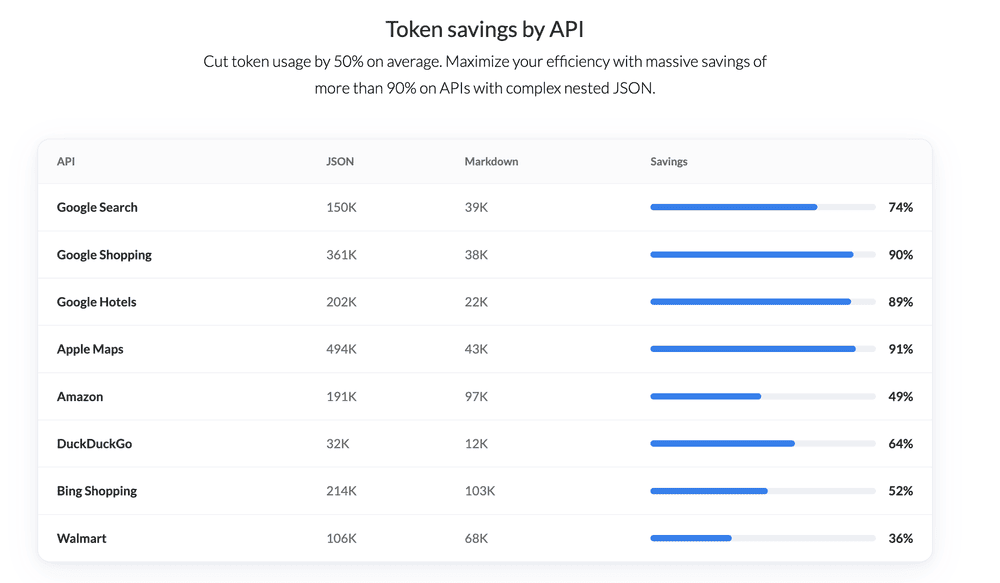
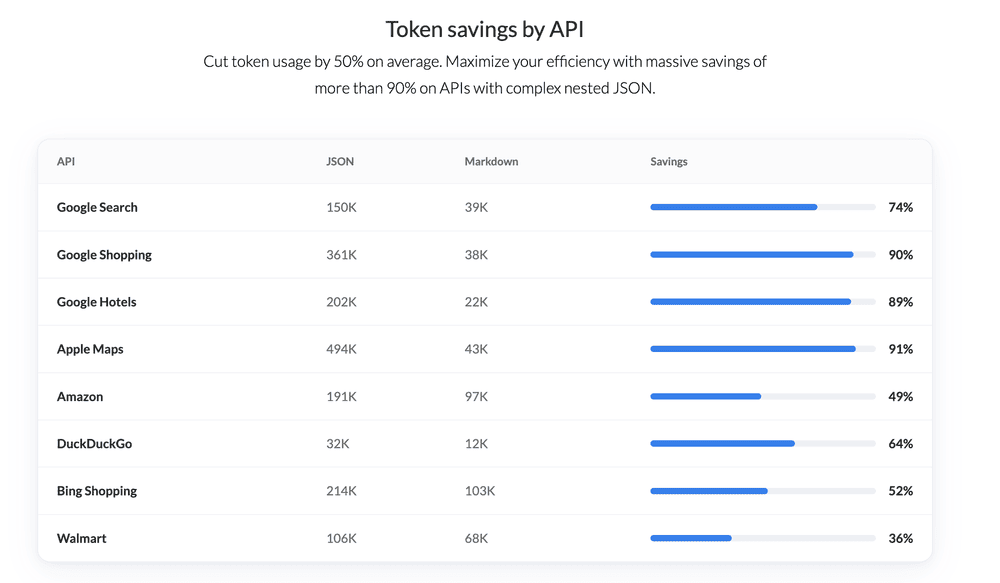
To combat this, the industry is witnessing a shift toward optimized data serialization formats. SerpApi, a leader in real-time search data, has introduced a Markdown-based output architecture designed specifically to strip away "token noise" while maintaining the structural integrity required for LLM reasoning. By transitioning from standard JSON to streamlined Markdown, developers are reporting token usage reductions of up to 74 percent, fundamentally changing the economics of building agentic systems.
The Anatomy of Token Waste in AI Workflows
The current standard for data exchange, JSON, was designed for interoperability between machines. It is precise, strictly typed, and structured for programmatic parsing. However, when an AI agent is tasked with a query—such as researching competitors or summarizing market trends—it consumes the entire JSON payload, including thousands of tokens dedicated to non-essential metadata.
For instance, a standard search query for "coffee shops" in a metropolitan area might return a response filled with nested objects, unique identifiers, internal tracking parameters, and repetitive UI-specific data. When an LLM processes this information, it must "read" every character of that JSON string. If the agent enters a recursive loop or performs multi-step reasoning, the cumulative token cost can reach tens of thousands of units per session. These tokens are not merely a minor overhead; they represent a direct drain on the model’s limited context window, potentially causing the model to lose track of early prompt instructions or triggering premature truncation of results.
A Chronology of the Shift Toward LLM-Optimized Data
The rise of LLM-native development has occurred in distinct phases over the last twenty-four months:
- Phase 1: The Raw Data Era (2022–2023): Developers utilized standard APIs exactly as they were built for web scraping and e-commerce platforms. The emphasis was on data accuracy, with little regard for the "token cost" of the data delivery mechanism.
- Phase 2: The Prompt Engineering Response (2023–Early 2024): As costs soared, developers began using aggressive system prompts to instruct models to "ignore the noise" in JSON responses. While this helped with reasoning, it did nothing to reduce the cost of the input tokens themselves, as the model still had to process the bloated JSON input before it could filter it.
- Phase 3: The Infrastructure Optimization Era (Mid-2024–Present): The focus has shifted to "server-side optimization." Rather than asking the model to ignore data, infrastructure providers like SerpApi have begun stripping unnecessary fields at the point of delivery. By outputting data in formats specifically tuned for linguistic processing—such as Markdown—the industry is effectively lowering the barrier to entry for complex, multi-agent AI systems.
Quantifying the Efficiency Gains
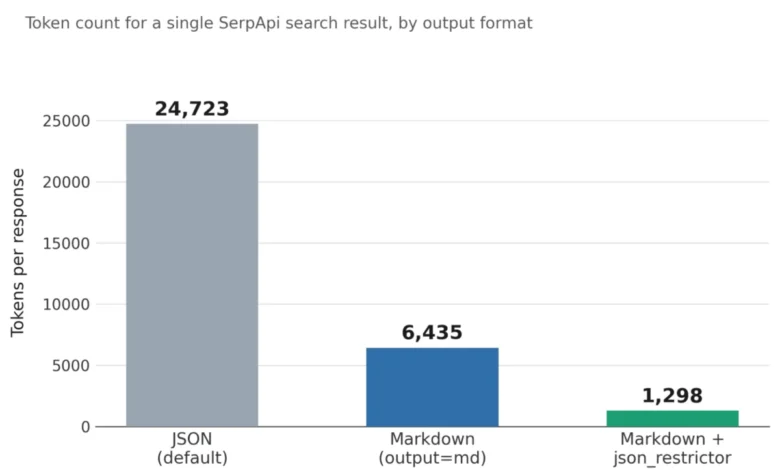
The economic argument for transitioning to Markdown is supported by significant empirical data. In controlled tests conducted by SerpApi, a standard search for a generic term like "coffee" yielded a JSON payload requiring 24,723 tokens. When the same query was executed with Markdown formatting enabled, the footprint dropped to 6,435 tokens—a 74 percent reduction. Even further optimization, involving restricted field sets, brought the footprint down to just 1,298 tokens.
These numbers carry profound implications for developers operating at scale. If an agent runs 1,000 queries a day, a 74 percent reduction in token count does not just equate to a faster response time; it signifies a massive decrease in the monthly expenditure on model inference. Furthermore, by occupying fewer slots in the model’s context window, these leaner payloads allow for more data to be included in a single prompt, effectively increasing the "intelligence" or breadth of knowledge the agent can handle without requiring expensive, high-capacity context models.
The Functional Divide: JSON vs. Markdown
While Markdown is increasingly the preferred format for AI agents, it is not a universal replacement for JSON. The utility of these formats depends entirely on the downstream application.
JSON remains the gold standard for backend systems that require strict data integrity. When an application is performing financial calculations, database injections, or programmatic data manipulation—such as extracting a price as a floating-point number or a date as a structured array—JSON’s rigid, typed nature is essential. For example, a retail pricing engine requires the precision of price, old_price, and coupon_price as distinct integers. In this context, stripping those into a Markdown table would be counterproductive, as the system would then require a secondary parsing layer to revert the text back into a machine-readable format.
Conversely, for an AI agent designed to perform summarization, sentiment analysis, or search-and-retrieval, the tabular format of Markdown is superior. Markdown’s structure—using headers, tables, and inline links—mimics the way humans read information, which is a format that current LLMs are highly optimized to process. By prioritizing "informational density" over "machine-parsing precision," developers can achieve the same level of agentic insight at a fraction of the cost.
Implementation and Operational Integration
Integrating these efficiencies into existing pipelines is designed to be low-friction. Providers like SerpApi have introduced simple toggles—often through query parameters or header modifications—that allow developers to request Markdown output across their entire API suite.
The technical implementation often involves:
- Request Parameter Modification: Appending
output=mdto API calls. - Server-Side Filtering: Using tools like
json_restrictoror CLI flags to prune unnecessary data fields before they leave the provider’s server. - YAML Frontmatter: Incorporating structured headers in the output to provide the agent with essential metadata without the bloat of a full JSON object.
This server-side approach is crucial. By reducing the payload size before it traverses the network, developers save not only on inference costs but also on latency, as the reduced data volume results in faster transmission times and lower bandwidth usage.
Broader Implications for the AI Ecosystem
The transition toward optimized data formats is a microcosm of a larger trend in the tech industry: the professionalization of the AI agent stack. As the "hype" phase of generative AI subsides, the focus has turned to the "engineering" phase—the systematic reduction of waste and the optimization of resource allocation.
For enterprises, this means that the viability of autonomous agents is no longer tied solely to the cost of the LLMs themselves, but to the entire data supply chain. A company that ignores the "token cost" of its data sources will find itself at a significant disadvantage compared to a competitor that utilizes lightweight, optimized data streams. The move toward Markdown is a clear signal that the AI industry is maturing, recognizing that the most efficient way to scale intelligent systems is to ensure that the data fed into them is as lean and relevant as possible.
As more providers adopt similar strategies, we can expect to see a new standard emerge for how search engines, databases, and APIs communicate with the next generation of AI agents. The era of blindly feeding bloated JSON into LLMs is likely coming to an end, replaced by a more nuanced, cost-conscious approach that treats every token as a valuable, finite resource. For developers, the message is clear: measure your current usage, test the impact of format changes, and prioritize the structure of your data as heavily as you prioritize the selection of your model.