The landscape of generative artificial intelligence is undergoing a significant architectural shift as researchers move beyond the traditional autoregressive paradigm that has defined the large language model (LLM) era. While models like GPT-4 and Claude have achieved remarkable fluency by predicting tokens one at a time, a new class of "diffusion language models" is emerging, promising to challenge the serial nature of current text generation. By utilizing iterative refinement rather than linear prediction, these models offer a fundamentally different approach to how machines translate thought into coherent text, potentially solving the long-standing bottlenecks associated with latency and parallel processing.
The Origins of Diffusion and the Textual Challenge
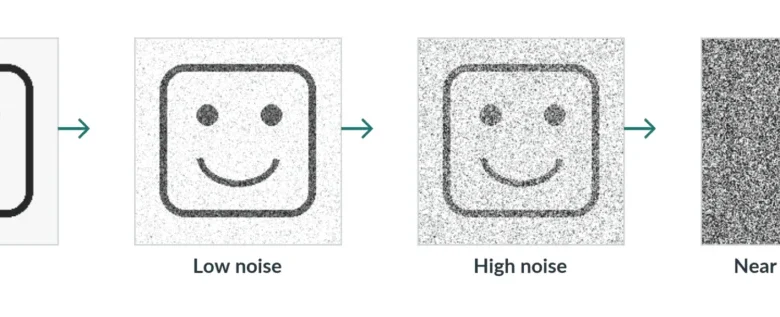
The concept of diffusion originated in the field of computer vision, most notably popularized by the 2020 paper Denoising Diffusion Probabilistic Models. These models operate by taking a clean data point, such as an image, and progressively adding Gaussian noise until the data becomes indistinguishable from random static. The model is then trained to reverse this process, learning to strip away the noise layer by layer to recover the original image.
Applying this to text has proven substantially more complex than applying it to images. Visual data exists on a continuous spectrum—a pixel’s intensity can be adjusted incrementally. In contrast, language is inherently discrete; it consists of specific, categorical token IDs. Adding "noise" to a word does not produce a slightly blurred version of that word; it simply results in a different, often nonsensical word. Consequently, researchers have had to adapt the diffusion framework to function in a discrete space, typically by replacing tokens with [MASK] placeholders rather than applying continuous Gaussian noise.
A Chronology of the Diffusion Shift
The push toward diffusion-based language generation gained significant momentum in early 2025. The field saw a rapid succession of technical milestones that shifted the research focus from theoretical curiosity to practical, high-performance implementations:
- February 2025: The introduction of LLaDA marked a pivotal moment, demonstrating that diffusion models could achieve competitive performance while bypassing the rigid left-to-right generation constraint.
- June 2025: The release of Mercury further refined the sampling techniques, proving that diffusion models could handle complex reasoning tasks with higher efficiency.
- Late 2025: DeepMind’s integration of diffusion techniques into the Gemini ecosystem highlighted the enterprise-level interest in these models, particularly for applications requiring high-throughput generation.
- 2026: Google’s launch of DiffusionGemma signaled that major AI laboratories were prioritizing the development of diffusion-based architectures as a viable alternative or complement to existing autoregressive infrastructures.
Autoregressive vs. Diffusion: Structural Mechanics
To understand why this shift matters, one must compare the fundamental mechanics of the two architectures. Traditional LLMs are autoregressive, meaning they operate on a strictly sequential basis. For a sequence $x = (x_1, dots, xN)$, the model calculates the probability of each word based entirely on the words that preceded it. Mathematically, this is expressed as $p(x) = prodi=1^N p(x_i mid x1, dots, xi-1)$. During inference, this creates a "serial dependency problem": the model cannot generate the fifth word until it has finished generating the fourth.
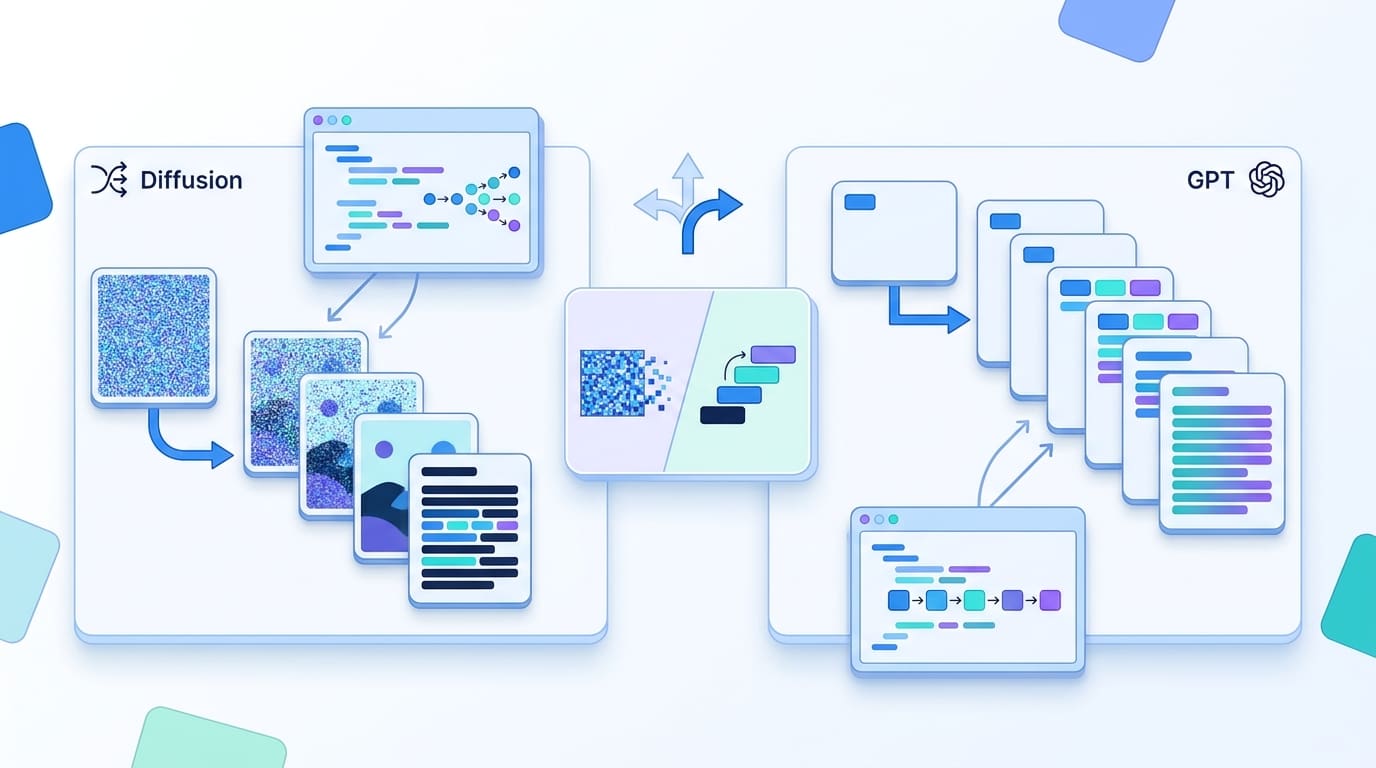
Diffusion language models break this dependency. By starting with a sequence composed entirely of masks, the model can predict the entire sentence—or large chunks of it—simultaneously. Through an iterative process of "denoising," the model fills in the gaps, gradually committing to specific tokens across the entire output canvas. While an autoregressive model extends a sequence linearly, a diffusion model refines the sequence globally.
Comparative Inference Performance
| Feature | Autoregressive (GPT-Style) | Masked Diffusion |
|---|---|---|
| Generation Path | Serial (Left-to-Right) | Parallel (Iterative Refinement) |
| Computational Efficiency | High latency for long outputs | Potentially lower latency via parallelization |
| Constraint Satisfaction | Difficult to revise past tokens | Naturally supports revision and global coherence |
| Training Objective | Next-token prediction | Recovery of masked sequences |
Implications for Future AI Infrastructure
The primary driver behind the adoption of diffusion models is the quest for faster inference. In a production environment, latency is a critical barrier to user adoption. Because autoregressive models must perform a full forward pass for every single token generated, they become significantly slower as the desired output length increases. Diffusion models, by contrast, can produce a draft of an entire document in a fixed number of steps, regardless of the output’s final length.
However, this transition is not without significant challenges. Critics and researchers note that diffusion models often struggle with the "order" of information. Because they generate tokens in a non-linear fashion, ensuring that a long-form essay maintains perfect logical flow can be more difficult than it is for models that "think" one step at a time. Furthermore, the sampling process—the mechanism by which the model decides which masks to fill and when—remains a highly active area of optimization. If the sampling logic is flawed, the model may produce incoherent or repetitive text.
Industry Perspective and Strategic Outlook
Major AI research organizations are currently testing hybrid approaches. Rather than viewing diffusion as an immediate replacement for GPT-style models, many developers are exploring ways to use diffusion to generate "skeletons" or "outlines" of responses, which are then refined by smaller, faster autoregressive models. This "cooperative generation" strategy could potentially offer the best of both worlds: the global coherence of long-range diffusion and the precise, granular control of autoregressive architectures.
The industry is also grappling with the massive investment in current GPU clusters designed for autoregressive workloads. Shifting to a diffusion-centric paradigm would require not only a change in algorithmic training but also a re-optimization of hardware utilization. Current tensor cores are heavily optimized for the matrix multiplications required by the transformer-based autoregressive process; diffusion-based sampling, which involves multiple passes and re-masking, will necessitate new software-level efficiencies to achieve a clear performance advantage.
Concluding Analysis
The transition toward diffusion language models represents a maturation of generative AI. We are moving away from the "mimicry" phase, where models simply try to predict the next logical word, into a "synthesis" phase, where models are tasked with constructing complete, coherent structures from a state of total uncertainty. While autoregressive models will likely remain the standard for chat-based assistants in the near term due to their proven reliability in conversation, the diffusion-based approach is increasingly viewed as the superior path for complex, structured, and long-form document generation.
As of 2026, the consensus among researchers is that diffusion will not necessarily replace the autoregressive architecture entirely, but rather force a diversification of the AI ecosystem. Future systems will likely employ a multi-modal, multi-architectural approach, utilizing diffusion for rapid, global drafting and autoregressive models for refined, turn-by-turn interaction. The core question for the next two years of development will be whether the gains in inference speed can be maintained while simultaneously improving the nuance and accuracy that users have come to expect from the current generation of large language models.