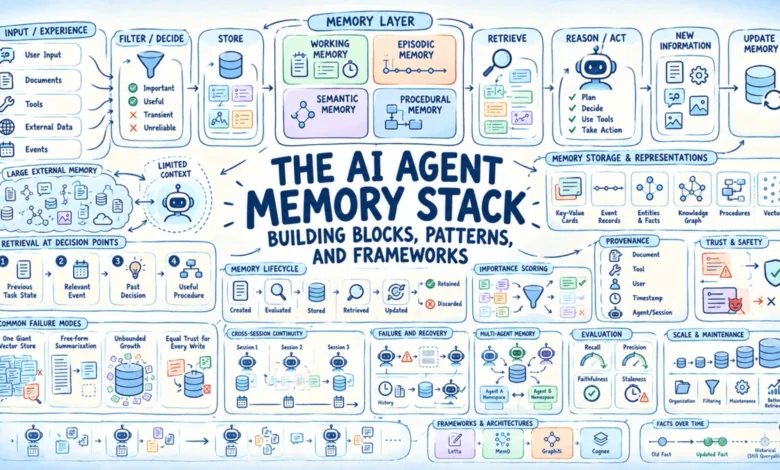
In the current landscape of artificial intelligence, a primary limitation of large language models (LLMs) is their inherent statelessness. By design, a standard LLM treats every incoming prompt as an isolated event, possessing no internal mechanism to recall previous user interactions or the outcomes of prior computational steps. While this architecture is sufficient for simple query-response tasks, it creates a significant bottleneck for AI agents tasked with complex, multi-stage workflows. To bridge this gap, developers are increasingly turning to sophisticated memory architectures that store information externally, allowing agents to maintain a sense of history, preference, and procedural knowledge.
The Evolution of Agent Persistence
The transition from stateless chatbots to stateful AI agents began in earnest as developers sought to automate workflows that required hours or days to complete. Without a persistent memory layer, an agent tasked with, for example, a multi-day market research project would be forced to "forget" its findings every time the context window reset. This forced reliance on manual re-inputting of data, which is both inefficient and prone to error.
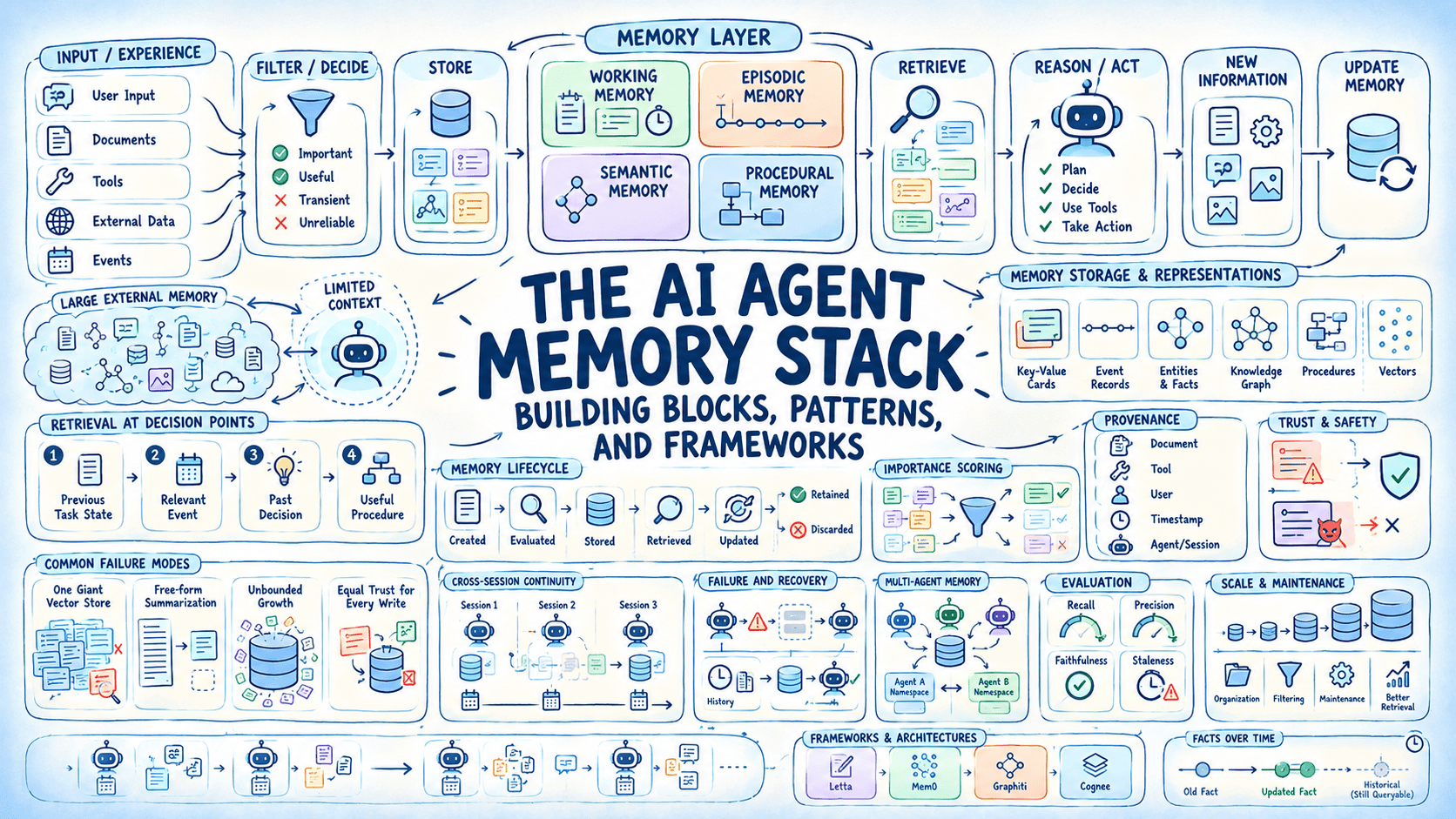
The current industry standard for solving this involves the implementation of a "Memory Stack." This stack acts as a middleware between the LLM and the storage layer, effectively managing how data is encoded, persisted, and retrieved. By decoupling the memory from the model’s context window, developers can provide agents with nearly infinite recall, limited only by the capacity of the underlying database.
Categorizing Agent Memory: A Functional Taxonomy
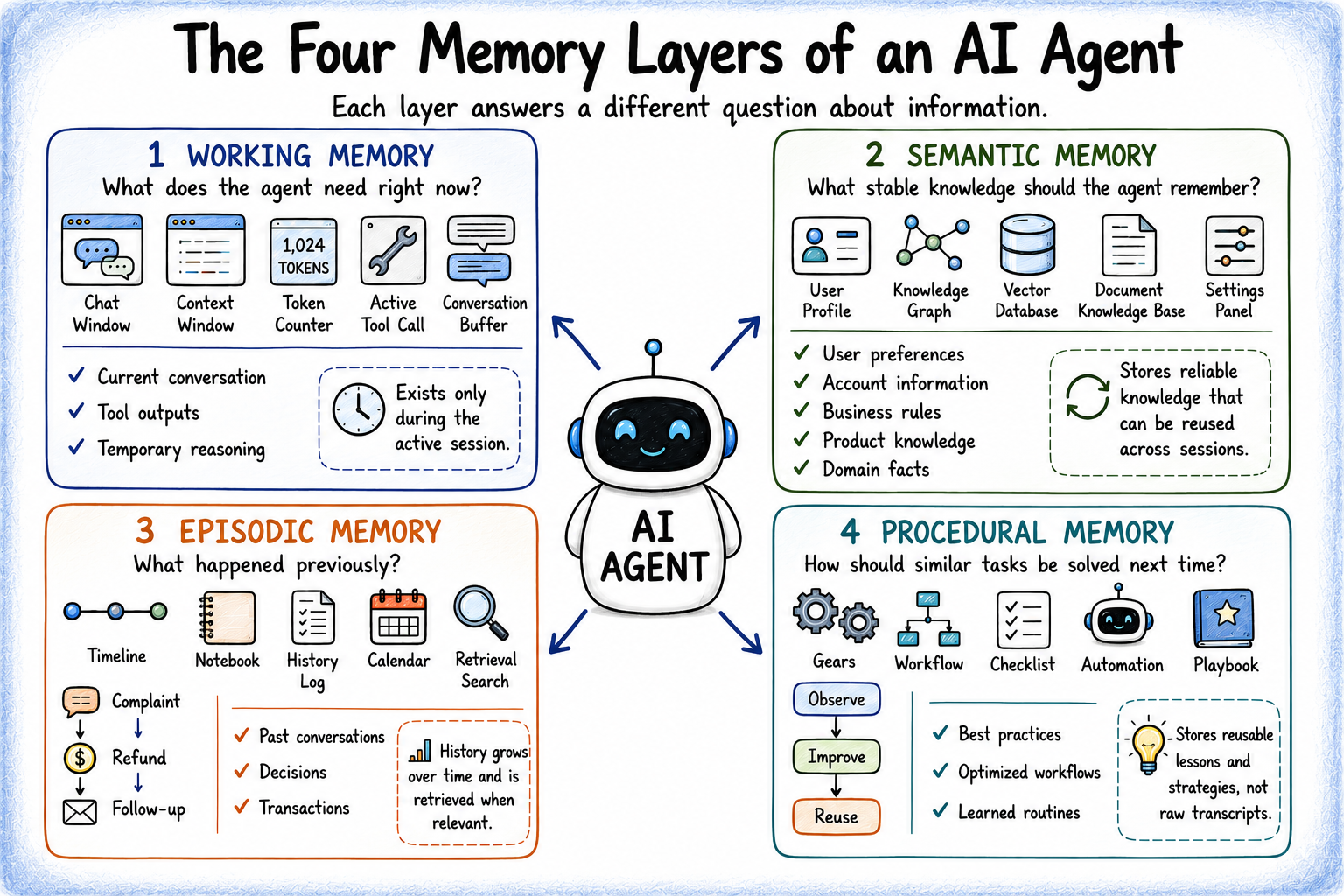
To effectively manage information at scale, researchers have categorized memory into four primary functional types. Each type requires a different storage strategy to optimize for speed, relevance, and accuracy.
- Working Memory: This is the volatile, short-term scratchpad used by an agent to track the immediate status of a task. It is characterized by high read/write speeds and is typically managed in an in-memory key-value store. It holds intermediate results that are vital for the current iteration but often discarded upon completion.
- Episodic Memory: This functions as a historical ledger of what the agent has previously experienced. It records past interactions, specific decisions made during a task, and the outcomes of tool usage. Often implemented via vector databases, this memory type relies on semantic similarity searches to retrieve relevant past experiences when a new, similar task arises.
- Semantic Memory: Unlike episodic memory, which focuses on chronological events, semantic memory stores facts, entities, and user preferences. It is the "knowledge base" of the agent. Updates to semantic memory are typically transformative rather than additive, ensuring that if a user changes a preference, the agent updates its internal knowledge rather than simply appending a conflicting entry.
- Procedural Memory: This represents the "how-to" knowledge of the agent. It includes successful action patterns, refined prompt templates, and documented failure modes. This memory is often baked into the agent’s system prompt or specialized fine-tuned layers, dictating the operational constraints the agent must follow.
The Engineering Challenges of Scale
As agentic systems move from pilot projects to enterprise-grade production environments, the design of memory systems has shifted toward managing complexity. A common pitfall for early-stage development is "memory bloating," where an agent is fed every interaction without a filter. This leads to increased latency and, more importantly, "retrieval noise," where the model becomes confused by an overabundance of irrelevant historical data.
Industry data suggests that the most successful implementations utilize a tiered retrieval strategy. Rather than searching the entire history, agents are programmed to perform "pruned" searches—querying working memory first, followed by a targeted search of semantic knowledge, and only accessing the expansive episodic logs when a high-level pattern is required.
Furthermore, memory poisoning remains a significant security concern. If an agent is allowed to write to its own memory without verification, adversarial actors can inject false information into the agent’s long-term history. To mitigate this, robust systems are now implementing "human-in-the-loop" verification and automated contradiction-checking protocols to ensure that stored information remains factual and consistent over time.
Frameworks Leading the Memory Revolution
The current ecosystem of memory frameworks offers varied approaches to these architectural challenges. Frameworks like Letta focus on self-editing text blocks, allowing the model to act as a database administrator for its own memory. Mem0 has gained traction by prioritizing entity-aware retrieval, ensuring that when a user mentions an entity (e.g., a specific client name), the agent retrieves all associated historical context immediately.
Graphiti and Cognee represent a more sophisticated approach: the knowledge graph. By mapping relationships between entities, these frameworks allow agents to perform complex, multi-hop reasoning. For example, if an agent knows "User X works for Company Y," and "Company Y is currently undergoing a merger," a graph-based memory allows the agent to infer that "User X may be affected by the merger," even if that specific sentence was never explicitly stored.
Chronology of Implementation: From Script to Agent
The progression of AI agent development can be viewed through three distinct phases:
- Phase 1 (The Stateless Era): Agents were primarily wrappers around LLMs, using zero persistent memory. Performance was capped by the size of the context window.
- Phase 2 (The Vector Search Era): Introduction of RAG (Retrieval-Augmented Generation) allowed agents to pull data from external documents. Memory was essentially read-only or append-only.
- Phase 3 (The Autonomous Memory Era): The current stage, where agents possess read/write/update capabilities. They can now refine their own memory, summarize past sessions, and delete obsolete information, effectively managing their own knowledge life cycle.
Implications and Future Outlook
The broader implication of these advancements is a shift in the nature of software development. We are moving toward "agentic engineering," where the primary task of the developer is not to write code for every contingency, but to design the memory architecture that allows an agent to learn and adapt autonomously.
Data from recent pilot studies indicates that agents equipped with well-structured memory architectures demonstrate a 40% increase in success rates for multi-step tasks compared to those with basic or no memory. However, this comes with increased operational costs, as maintaining complex vector and graph databases requires constant compute cycles.
As the industry matures, the focus is shifting toward "Memory Evaluation." Developers are beginning to ask, "How do we measure the quality of an agent’s memory?" This involves testing for consistency, recall accuracy, and the agent’s ability to resolve contradictions. Future developments are expected to focus on automated maintenance—agents that can "sleep" or perform background tasks to prune their own memory stores, reorganize information, and consolidate facts to maintain peak performance levels without human intervention.
Ultimately, the ability of an AI agent to function in the real world is inextricably linked to its ability to retain and synthesize information. By moving beyond simple text storage toward structured, graph-based, and self-managing architectures, the next generation of AI agents will be capable of sustaining long-term, goal-oriented behaviors that were previously the sole domain of human expertise. The technical foundation is being laid, but the challenge remains to balance the depth of memory with the speed and reliability required for real-time decision-making in high-stakes environments.