Federal Investigators Uncover Deep Ties Between Ransomware Negotiators and the Notorious ShinyHunters Hacking Syndicate

U.S. federal law enforcement agencies pursuing the prolific cyber extortion syndicate known as ShinyHunters have uncovered alarming alliances at the intersection of corporate cybersecurity and transnational crime. According to sources close to the investigation, federal investigators have identified executives at two separate ransomware negotiation firms who maintained uncommonly close operational relations with the hacking group. Most notably, one U.S.-based executive is alleged to have actively helped operate a public website used by ShinyHunters to pressure compromised organizations into paying multi-million-dollar extortions.
The unfolding investigation exposes a dark ecosystem within the cyber incident response industry, where certain entities purportedly hired to defend victims may instead be collaborating with threat actors. This systemic rot has drawn intense scrutiny from the U.S. Department of Justice (DOJ), the Federal Bureau of Investigation (FBI), and international law enforcement agencies operating across North America and Europe.
Anatomy of a Syndicated Extortion Campaign
Since emerging onto the cybercrime landscape in 2019—initially operated by French nationals who were subsequently arrested or jailed—the ShinyHunters brand has claimed responsibility for dozens of high-profile corporate data breaches. Control over the syndicate eventually shifted to a young Jordanian hacker known online as "Rey," identified by authorities as a teenager from Amman. According to estimates provided by the FBI, ShinyHunters has extorted more than $70 million from corporate and institutional victims globally over the course of a single year.
The group’s brazen tactics reached a critical inflection point in late September, when hackers aligned with ShinyHunters infiltrated the FBI recruitment portal, fbijobs.gov. The attackers taunted the federal law enforcement agency by threatening to leak deeply sensitive personnel files. The stolen data reportedly included Social Security numbers, home addresses, sensitive medical and psychological evaluations, and specific details regarding employee units and specializations.

This direct assault on federal infrastructure triggered an aggressive, rapid-response investigation by the FBI, leading to a cascade of international detentions, raids, and arrests aimed at unravelling the network supporting Rey and his associates.
Chronology of Key Arrests and Disclosures
The dismantling of the ShinyHunters support apparatus accelerated in mid-September 2026, marking a turning point in the international cybercrime probe:
- September 15, 2026: Dutch law enforcement authorities executed a high-risk tactical raid, utilizing flash-bang grenades to apprehend convicted hacker and ShinyHunters suspect Pepijn van der Stap in the Netherlands. Police caught Van der Stap actively logged into his Signal instant messaging accounts, allowing investigators immediate access to his real-time communications network.
- October 3, 2026: Reuters reported that "Rey," the primary administrator of ShinyHunters, had been detained by authorities in Jordan and was actively cooperating with the FBI.
- October 7, 2026: The DOJ charged MonsterCloud CEO Zohar Pinhasi with wire fraud and conspiracy for allegedly bypassing his clients’ instructions, secretly paying ransomware groups $8 million while billing victims $19 million for remediation.
- October 9, 2026: KrebsOnSecurity broke the news that the FBI had arrested Edward Dubrovsky, a 54-year-old Canadian cybersecurity executive and author of a recent book on handling cyber extortion, on federal charges of threatening to disclose hacked data and interfering with interstate commerce through extortion.
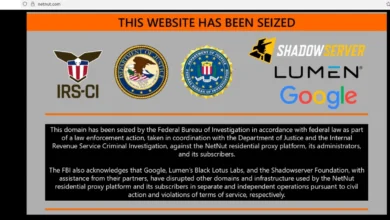
- October 16, 2026: The public-facing ShinyHunters extortion portal, known as "shinywire[.]com," went offline after operating for roughly five and a half months.
The Signal Chats and the Shadow of "Ghostbyte"
According to sources familiar with the federal probe, the extraction of data from Van der Stap’s Signal messaging application served as a Rosetta Stone for investigators. The chats revealed frequent, ongoing conversations between Van der Stap and high-ranking ransomware negotiators based in Canada and the United States.
Remarkably, these encrypted communications indicated that certain negotiation executives possessed precise details regarding newly breached ShinyHunters victims before the victim organizations themselves were even aware of the compromises. Furthermore, federal investigators discovered that Canadian cybersecurity executive Edward Dubrovsky was fully aware that ShinyHunters had stolen sensitive data from FBI servers. Despite this knowledge, Dubrovsky allegedly failed to notify federal authorities prior to the group’s public shaming campaign on social media.

Adding a chilling dimension to the Dutch suspect’s arrest, sources close to the investigation revealed that Van der Stap’s messaging logs contained discussions regarding a murder-for-hire plot directed at targets abroad. While there is no indication that the ordered hits were carried out, European media outlets reported that Van der Stap allegedly issued the directives.
The trail of evidence also reopened historical inquiries into the evolution of ransomware syndicates. Interviews with former colleagues of Daniel Tobok, the former chief executive of Toronto-based cybersecurity firm Cypfer, revealed that Tobok had historically been known to prolific ransomware affiliates under the alias "Ghostbyte." Digital forensics conducted by Constella Intelligence linked email addresses historically used by Tobok to online accounts registered under the "ghostbyte" moniker, including a Snapchat profile.
While Cypfer issued statements distancing the firm from Dubrovsky’s arrest and emphasizing that it does not facilitate ransomware payments, the overlapping corporate histories involving Cypfer, Cytelligence, and holding company Apros Group highlight the incestuous nature of the high-end cyber incident response market.
The "Shinywire" Portal and Operational Mechanics
Federal investigators believe that at least one executive at a prestigious U.S.-based consulting firm played an active operational role in maintaining "shinywire[.]com," a specialized extortion hub that cataloged nearly 100 corporate victims between May and October 2026.
The website functioned as a digital pressure cooker. When an organization was breached, its entry on Shinywire displayed samples of stolen corporate data paired with a strict countdown timer. Victims were given seven days to initiate negotiations and arrange ransom payments. If an organization ignored the demands, the syndicate published the entirety of the stolen data onto its Tor-based shaming blog.

Prominent victims listed on the defunct portal included American medical technology giant Intuitive Surgical, which suffered a credential compromise via targeted phishing in March 2026.
Industry Conflicts of Interest and Misaligned Incentives
The unfolding scandal brings to light inherent structural conflicts of interest within the multi-billion-dollar cyber extortion remediation industry. While paying ransoms to non-sanctioned actors like ShinyHunters is not strictly illegal under U.S. law, the fee structures utilized by certain negotiation and incident response firms create perverse financial incentives.
Mark Camillo, chief executive of cyber insurance consortium CyberAcuView, pointed out that many negotiation firms operate on a contingency model, charging a percentage of the final ransom payout rather than a flat retainer.
"This makes no sense if they are also the negotiator," Camillo observed. "There needs to be more transparency in the process as no one in the ecosystem should be profiting purely on the size of the ransomware transaction or payment itself."
When negotiation firms secure higher payouts, their own profit margins expand accordingly. Conversely, reputable incident response firms—such as Coveware and Unit 221B—consistently advise clients against paying ShinyHunters, warning that extortionists rarely delete stolen data and often use it to launch secondary shaming campaigns or extort downstream clients directly.

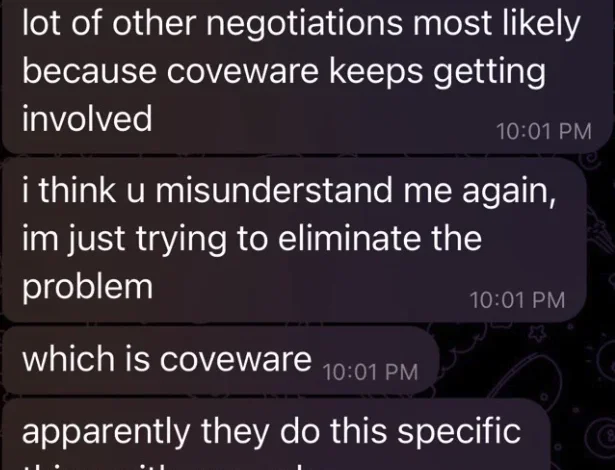
The frustration of ShinyHunters leadership over this principled advice was laid bare in intercepted Telegram chats from April and May 2026. In private conversations, the primary ShinyHunters administrator bitterly complained that Coveware was tanking their monetization rates, writing, "Go on my website, majority of those companies would’ve paid if it weren’t for Coveware giving them misinformation." The syndicate’s operators openly discussed attempting to "eliminate the problem" posed by security firms interfering with their extortion revenues.
Broader Implications for National Security and Corporate Governance
The arrest of senior negotiators and the active collusion allegations against U.S. consulting executives mark a watershed moment for cybersecurity regulation. For years, the private sector operated under an unwritten code of quiet negotiations, non-disclosure agreements, and discreet cryptocurrency payouts.
The integration of rogue negotiators into the operational apparatus of criminal cartels transforms traditional incident response firms from corporate defenders into active co-conspirators. As the Department of Justice broadens its dragnet—exemplified by recent prosecutions of executives like MonsterCloud CEO Zohar Pinhasi and the sentencing of facilitators like Angelo Martino—the corporate world faces a painful reckoning.
Organizations can no longer blindly trust third-party remediation firms recommended by insurance brokers or risk managers. The complicity of trusted intermediaries in feeding insider intelligence to extortionists, manipulating negotiation outcomes, and operating public shaming portals signals that the cybersecurity remediation industry requires rigorous federal oversight, transparent fee structures, and strict legal accountability.
As federal grand juries review sealed indictments and prosecutors comb through terabytes of decrypted Signal messages, the myth of the neutral cybersecurity intermediary has been irrevocably shattered.