Robust Serialization with JSON and Custom Types in Python Machine Learning Pipelines

In the high-stakes environment of machine learning operations (MLOps), the efficacy of a model is often determined long before the training phase begins. While the industry frequently emphasizes neural architecture search and hyperparameter optimization, seasoned machine learning engineers acknowledge that the vast majority of development time is consumed by data plumbing—the intricate process of cleaning, preprocessing, and orchestrating data flows. A critical, yet often overlooked, component of this pipeline is the serialization and deserialization of complex configuration objects. As data moves between files, distributed microservices, and specialized APIs, the inability of standard serialization formats like JSON to handle non-primitive Python types frequently becomes a bottleneck.
The limitation is inherent to the JSON specification, which natively supports only basic data types: strings, numbers, booleans, nulls, arrays, and objects. In contrast, modern Python pipelines rely heavily on rich, domain-specific types such as datetime objects, sets, pathlib paths, and enumerated constants. When a developer attempts to use the standard library’s json.dumps() method on a dictionary containing these types, the process terminates with a TypeError, signaling that the object is not JSON serializable. This failure, while simple in its mechanics, represents a significant point of fragility in production-grade systems, where configuration files must be exchanged reliably across different environments.
The Anatomy of Serialization Failures
The chronology of these errors typically begins during the transition from experimentation to deployment. In the early stages of a project, hardcoded configurations are common. However, as the pipeline matures into a production environment, these configurations must be stored as JSON files to ensure reproducibility. A typical experiment configuration might include an experiment_id (integer), a model_type (Enum), a set of features (set), a data_path (Path), and a timestamp (datetime).
When the standard Python json library encounters these types, it lacks the contextual intelligence to map them to valid JSON primitives. For example, a Python set is unordered and unique, whereas JSON only understands arrays. A Path object is a complex operating system abstraction, and a datetime is a temporal object. Without a custom serialization strategy, the pipeline is forced to manually convert these objects into strings or lists before every serialization event—a practice that is both error-prone and labor-intensive.
Engineering a Robust Custom Encoder
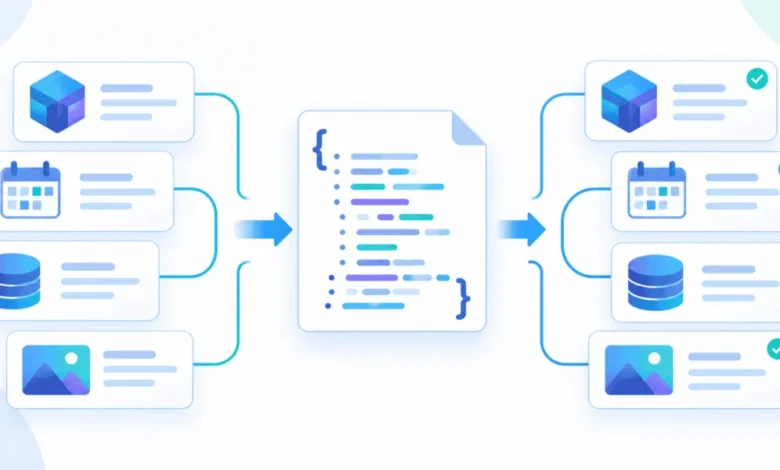
To move beyond these limitations, developers must implement a custom encoder by subclassing json.JSONEncoder. This approach allows the engineer to override the default() method, creating a centralized logic hub for handling data types. By defining a mapping that checks for the instance type of an object, the system can gracefully transform complex objects into a serializable dictionary format, often referred to as a "tagged" representation.
For instance, a datetime object can be transformed into a dictionary containing a __type__ key with the value datetime and a value key containing the ISO-formatted string. Similarly, a set can be converted into a list while retaining the metadata necessary for later reconstruction. This tagging mechanism is vital; it ensures that when the data is eventually parsed, the system knows exactly how to convert the primitive JSON back into the intended Python object.
The Role of the Object Hook in Deserialization
The inverse process, deserialization, requires a sophisticated approach known as an object_hook. By passing a custom decoding function to json.loads(), the pipeline gains the ability to inspect every dictionary encountered during the parsing process. If the decoder identifies the __type__ tag within a dictionary, it triggers the corresponding logic—such as using datetime.fromisoformat() or casting a list back into a set.
This mechanism provides a robust safety net for data integrity. By wrapping these transformations in a try-except block, engineers can handle cases where data may have been corrupted or improperly modified during transport. If a conversion fails, the system can log a warning and return the raw value, preventing the entire pipeline from crashing—a critical requirement for systems designed for high availability and automated retraining.
Addressing Schema Evolution and Migration
One of the most persistent challenges in MLOps is the evolution of schemas. As models mature, configuration requirements shift: new hyperparameters are introduced, old metrics are deprecated, and paths are restructured. A static configuration file created for a model six months ago will inevitably conflict with the codebase of today.
To address this, modern pipelines utilize factory functions that act as a validation layer during the loading process. Instead of directly using the deserialized dictionary, the pipeline passes the raw data through a migration function. This function uses the dict.get() method to provide default values for missing keys, effectively "patching" older configuration files to meet the requirements of the current schema. By explicitly defining defaults for parameters like learning_rate or optimizer_config, teams ensure that legacy experiments remain reproducible without manual code intervention.
Implications for Production Stability
The implementation of a custom, schema-aware serialization pipeline has profound implications for the stability of machine learning systems. Firstly, it reduces the "configuration drift" that often plagues projects where documentation and code are decoupled. By ensuring that every object in the configuration is validated against a schema during the loading phase, engineers can catch errors—such as missing parameters or type mismatches—at the start of the pipeline rather than mid-training.
Furthermore, this modular approach enhances the interoperability of microservices. In a distributed architecture, where one service might be responsible for data preprocessing and another for inference, having a standardized way to serialize custom Python types ensures that data remains consistent across service boundaries. The overhead of implementing these custom encoders and decoders is marginal compared to the cost of debugging a system-wide failure caused by a single unexpected TypeError in a production training job.
Conclusion and Best Practices
Building a robust serialization pipeline is a foundational exercise in professional machine learning engineering. By moving away from naive serialization and embracing custom encoders, object hooks, and schema-aware loading functions, developers can create systems that are resilient to the complexities of real-world data. These strategies not only simplify the management of experiment metadata but also serve as a crucial line of defense against the unpredictability of data evolution. As the field of MLOps continues to standardize, the ability to effectively manage the "data plumbing" remains a hallmark of high-quality, production-ready machine learning infrastructure. By treating configurations with the same rigor as model code, engineering teams can ensure that their pipelines remain performant, reproducible, and above all, reliable.