The Statue of Liberty Nebula, Captured by Astrophotographer Logan Carpenter, Illuminates the Cosmos as NASA’s Astronomy Picture of the Day

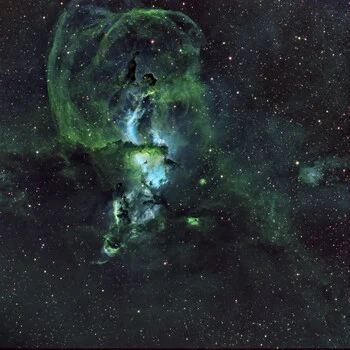
The universe, in its infinite grandeur, often reveals its most profound wonders through the keen eyes and dedicated efforts of amateur astronomers. Such is the case with the recent spotlight on the Statue of Liberty Nebula, a breathtaking celestial object brought to global attention by astrophotographer Logan Carpenter. NASA featured Carpenter’s stunning image as its Astronomy Picture of the Day (APOD) on July 20, 2026, offering millions a glimpse into a vibrant stellar nursery located approximately 9,000 light-years from Earth. This recognition not only celebrates a remarkable photographic achievement but also underscores the significant contributions of citizen scientists to our understanding of the cosmos.
A Celestial Icon Revealed: The Statue of Liberty Nebula
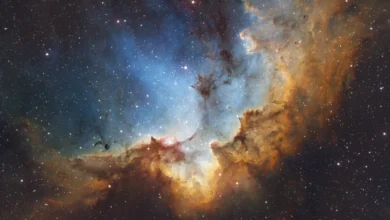
The nebula in question, scientifically designated NGC 3576, is a luminous emission nebula nestled within the southern constellation of Carina. Its evocative nickname, "Statue of Liberty Nebula," arises from a prominent, torch-like structure near its core, uncannily reminiscent of the iconic monument in New York Harbor. However, the visual allure extends far beyond this singular resemblance. Observers have also perceived in its swirling gas and dust clouds the silhouette of a soaring superhero or even a mournful angel, testament to the nebula’s complex and anthropomorphic forms.
This particular APOD image, presented as a "re-mapped color view," meticulously highlights the intricate tapestry of the nebula. It showcases dense clusters of shadowy interstellar dust, vast expanses of hydrogen gas energized by the intense radiation of newborn stars, and sweeping arcs of material expelled by stars in their dying throes. The nebula is part of a larger star-forming region known as RCW 57, a dynamic environment where the processes of stellar birth and death unfold in a perpetual cosmic ballet.
Scientific Significance: More Than Just a Pretty Picture
Beyond its aesthetic appeal, the Statue of Liberty Nebula holds considerable scientific importance. NASA’s accompanying description on the APOD page details that a thorough analysis of NGC 3576, which also bears the catalog designations NGC 3582 and NGC 3584, has revealed the presence of at least 33 massive stars in their advanced stages of formation. More remarkably, the nebula has been found to contain polycyclic aromatic hydrocarbons (PAHs), intricate carbon molecules believed to play a crucial role in the origins of life.
PAHs are thought to form within the cooling gas of stellar nurseries, environments analogous to the one that birthed our own Sun roughly five billion years ago. Their detection within NGC 3576 provides compelling evidence for similar chemical processes occurring in other star-forming regions across the galaxy. This discovery strengthens the hypothesis that the building blocks of life, carried on comets and asteroids, may have been seeded onto early Earth from such nebulae, linking the distant cosmic spectacle to our terrestrial existence. The Statue of Liberty Nebula, therefore, serves as both a celestial birthplace and a profound chemistry lesson, offering insights into the fundamental processes that led to life as we know it.
A Legacy of Discovery: From Herschel to Carpenter
The history of observing NGC 3576 stretches back nearly two centuries. It was first identified by the renowned astronomer John Frederick William Herschel on March 16, 1834. Located in the Sagittarius arm of the Milky Way, the nebula spans an impressive 100 light-years in diameter.
The popular "Statue of Liberty" moniker, however, is a relatively recent development in astronomical nomenclature. It was first proposed by Dr. Steve Mazlin of the Star Shadows Remote Observatory (SSRO), a collective dedicated to remote astronomical observations. This nickname highlights the evolving relationship between scientific discovery and public engagement, where evocative imagery can foster greater interest in the cosmos.
The dark, sculpted shapes within the nebula are identified as Bok globules, dense, opaque pockets of gas and dust that serve as cradles for nascent stars. These globules are progressively eroded by the intense ultraviolet radiation emitted by the massive, young stars forming in their vicinity, a process that sculpts the nebula’s intricate features and drives star formation.
The Art and Science of Astrophotography: Capturing the Cosmos
Logan Carpenter’s achievement underscores the sophistication and accessibility of modern amateur astrophotography. The practical implications of his success offer valuable insights for aspiring night-sky photographers. NGC 3576, being a southern-hemisphere object, is best captured using specialized techniques.
The APOD description’s reference to a "re-assigned color" image points to the use of narrowband filters, a standard practice in deep-sky imaging. These filters isolate specific wavelengths of light emitted by elements like hydrogen (H-alpha), oxygen (OIII), and sulfur (SII). By assigning these filtered emissions to red, green, and blue channels in post-processing, astrophotographers can reveal fine details and striking color contrasts that would be imperceptible to the naked eye or in broadband imaging. This technique is not a mere artistic embellishment but a legitimate scientific tool that enhances the visibility of celestial structures.
Carpenter’s technical prowess is well-documented. In a 2023 interview with ZWO, a prominent astrophotography equipment manufacturer, he detailed the meticulous process behind capturing faint celestial targets. This often involves combining hydrogen-alpha data with LRGB (Luminance, Red, Green, Blue) imaging and employing advanced software like PixInsight and Photoshop for processing. His commentary in that interview, expressing pleasant surprise at the results achievable with current amateur equipment, resonates deeply with the democratization of astronomy.
The Evolving Landscape of Amateur Astronomy
Carpenter’s APOD feature is more than just a personal triumph; it is a testament to the rapidly evolving capabilities available to amateur astronomers. The proliferation of remote telescope services and increasingly affordable, high-quality cooled cameras has significantly narrowed the gap between backyard imagers and professional observatory data. This accessibility has fostered a vibrant global community of astrophotographers, pushing the boundaries of what can be achieved from terrestrial vantage points.
Achieving an APOD feature is a highly competitive endeavor, signifying that an editor has judged an image’s composition, processing, and technical execution to be of exceptional quality among a vast pool of global submissions. For Carpenter, this recognition represents one of the most visible and prestigious rewards in the field of amateur astronomy, validating years of dedication, learning, and equipment investment. It serves as an inspiration to countless others who are captivated by the night sky and aspire to contribute their own unique perspectives to our collective cosmic knowledge.
A Timeline of Discovery and Recognition:
- March 16, 1834: John Frederick William Herschel first observes NGC 3576.
- Circa 2000s (estimated): Dr. Steve Mazlin of SSRO proposes the nickname "Statue of Liberty Nebula."
- 2023: Logan Carpenter is featured in a ZWO astrophotography interview, discussing his techniques and the quality of amateur equipment.
- July 20, 2026: NASA features Logan Carpenter’s photograph of the Statue of Liberty Nebula as Astronomy Picture of the Day.
Broader Implications for Scientific Engagement and Education
The selection of Carpenter’s image for APOD has far-reaching implications. It serves as a powerful educational tool, bringing complex astronomical concepts and the beauty of the universe to a wide audience. The story behind the image—the dedication of an amateur, the scientific significance of the nebula, and the underlying principles of astrophotography—provides a compelling narrative that can ignite curiosity in STEM fields among people of all ages.
The collaboration between amateur astronomers and institutions like NASA, even if indirect through the APOD platform, highlights a valuable synergy. Amateurs provide unique perspectives and often dedicate immense time to capturing specific celestial targets, while official platforms like APOD offer a crucial avenue for disseminating these findings and fostering broader scientific literacy. The Statue of Liberty Nebula, through this lens, becomes more than just a distant cloud of gas and dust; it becomes a symbol of human curiosity, technological advancement, and our enduring quest to understand our place in the universe.