Chasing Celestial History: Navigating the Desert to Samuelson’s Rocks for the Perseid Meteor Shower

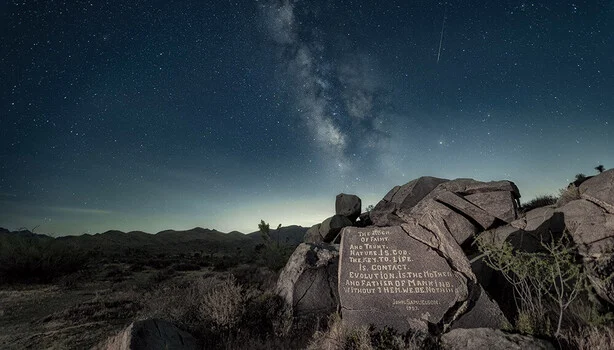
The pursuit of unique astrophotography often necessitates venturing far beyond the established trail systems of the American Southwest. Within the sprawling 795,000-acre expanse of Joshua Tree National Park, one such location—Samuelson’s Rocks—offers a convergence of historical intrigue and pristine dark-sky conditions. Comprising seven massive granite boulders inscribed with philosophical and political manifestos by a Swedish prospector in the 1920s, the site remains a challenging destination for photographers. During a recent expedition in August 2026, the intersection of the Perseid meteor shower and the Milky Way core provided a rare opportunity to document the intersection of human history and celestial movement in one of the darkest regions of Southern California.
Historical Context of the Inscriptions
The site derives its name from John Samuelson, an eccentric immigrant who arrived in the Mojave Desert during the mid-1920s. Historical records indicate that Samuelson sought employment with William F. Keys, a prominent desert pioneer who operated the Desert Queen Ranch. During his tenure, Samuelson carved eight distinct philosophical messages into seven large boulders near his remote homestead. These inscriptions, which have weathered a century of harsh desert elements, reflect the solitary, meditative lifestyle of the era’s prospectors.
Today, the rocks serve as a focal point for those interested in the cultural geography of the Mojave. However, because the National Park Service (NPS) does not maintain a formal trail to the location to protect the surrounding desert flora and sensitive biological soil crusts, the site remains isolated. This lack of infrastructure is a critical factor for prospective visitors, as the terrain is rugged, characterized by dense patches of cholla cacti and uneven sandy washes.
Chronology of the August 2026 Expedition
The expedition was scheduled to coincide with the lead-up to the Perseid meteor shower, a recurring astronomical event occurring when the Earth passes through the debris stream left by Comet 109P/Swift-Tuttle. While the peak of the shower typically falls between August 11 and 13, the weeks surrounding the peak often yield significant meteor activity.
- August 5, 2026 – 4:00 PM: Ambient temperatures reached 104°F (40°C). Preparations involved securing 1.5 gallons of water per person and verifying the functionality of offline GPS navigation systems.
- August 5, 2026 – 8:15 PM: Sunset occurred. The decision to depart post-sunset was a safety measure mandated by the extreme heat, which persists in the high desert well into the night.
- August 5, 2026 – 9:00 PM: Navigation commenced. Utilizing a combination of topographical alignment and digital offline maps, the 1.5-mile trek toward the coordinates began.
- August 5, 2026 – 9:42 PM: Arrival at the site. The total transit time was 42 minutes, accounting for terrain obstacles and hydration intervals.
- August 5, 2026 – 10:00 PM to 1:00 AM: The camera system was deployed on an intervalometer to record a continuous time-lapse sequence.
- August 6, 2026 – 2:00 AM: Moonrise, which effectively increased ambient light levels, terminated the optimal window for deep-sky photography.
Navigational Challenges and Safety Protocols
The absence of a marked path in a protected national park environment presents significant navigational challenges, particularly in low-light conditions. Standard GPS devices often experience latency, and cellular connectivity is virtually non-existent in the remote interior of Joshua Tree. Relying on the Garmin Explore application allowed for precise coordinate tracking without requiring a data signal.
Safety remains the primary concern for the National Park Service, which advises against hiking during peak summer heat. The primary hazards include hyperthermia and dehydration. For this mission, protective gear—specifically thick, tear-resistant trousers and durable footwear—was essential to mitigate the risk of injury from the Cylindropuntia (cholla) cacti, which are notorious for shedding barbed segments upon contact. Experts emphasize that in the event of an injury or heat-related illness, the lack of proximity to park roads can complicate search-and-rescue operations.
Technical Methodology in Astrophotography
Capturing a meteor alongside static historical landmarks requires a high degree of technical preparation. The camera equipment was mounted on a stable, heavy-duty tripod to withstand periodic desert wind gusts, which can reach significant speeds even in the absence of a storm.
To increase the probability of capturing a Perseid meteor, the photographer employed an intervalometer, a device that automates the shutter release to ensure a continuous stream of images. This technique serves two purposes: it maximizes the temporal coverage of the sky, increasing the odds of a meteor crossing the frame, and provides the raw materials for a time-lapse video. Following the data collection, post-processing via software such as Adobe Lightroom Classic allowed for the identification of a high-resolution frame containing both the Milky Way’s galactic core and a bright Perseid streak directly above the inscribed boulder.
Environmental and Conservation Implications
The increasing popularity of "dark sky" tourism has brought both economic benefits to regions like the Mojave and environmental challenges. Joshua Tree National Park was designated an International Dark Sky Park in 2017, a status that highlights the importance of preserving the night sky from light pollution. However, the surge in foot traffic to off-trail locations like Samuelson’s Rocks raises concerns regarding the degradation of the desert landscape.
The park’s "Leave No Trace" policy is strictly enforced. Visitors are urged to stick to established routes where possible and avoid disturbing the desert crust, which can take decades to recover from a single footprint. Furthermore, the use of bright white light is discouraged; the use of red-light flashlights is recommended to maintain both night vision and to minimize the disruption of nocturnal wildlife, such as the desert tortoise and various species of bats.
Broader Impact and Research
The documentation of such sites contributes to the growing body of work regarding the intersection of human history and astronomy. For the Yucca Brevifolia Magazine assignment, these photographs serve as more than aesthetic assets; they function as a record of the park’s enduring ability to inspire scientific and philosophical inquiry.
The successful capture of a meteor in the frame serves as a validation of the patience and preparation required for wilderness photography. According to celestial data, the Perseid shower in 2026 was particularly robust due to the relative positioning of the Earth and the comet’s debris trail. By combining historical documentation with modern astronomical imaging, the expedition highlights the importance of protecting both the cultural heritage of the Mojave and the integrity of its skies.
As climate change continues to increase the frequency of extreme heat events in the American Southwest, the window for such expeditions is narrowing. Future photographers will likely need to navigate not only the physical terrain but also the shifting meteorological patterns that make desert exploration increasingly hazardous. Despite these risks, the allure of capturing the "unreachable"—the fusion of a century-old message carved in stone and the transient light of a falling star—remains a compelling objective for those dedicated to the craft of wilderness documentation.