Travelers and hospitality providers face a renewed cyber threat as TA558 intensifies malicious reservation-themed campaigns


The global travel and hospitality industry, already reeling from the operational chaos of canceled flights, understaffing, and overbooked accommodations, is now confronting a sophisticated digital adversary. A well-documented threat actor known as TA558 has emerged from a period of relative dormancy, significantly ramping up its efforts to exploit the surge in post-pandemic travel. By weaponizing the mundane process of booking a hotel or airline ticket, these cybercriminals are successfully deploying a diverse array of malware payloads onto the systems of unsuspecting travelers and industry employees alike.
Security researchers at Proofpoint, who have been closely monitoring the group’s evolution, indicate that the threat actor has effectively revamped its tactics to bypass modern security defenses. The current campaign, which mirrors and expands upon strategies first observed in 2018, relies on sophisticated social engineering disguised as legitimate travel reservation confirmations. When recipients interact with these emails—often by clicking a link or opening an attachment—they inadvertently trigger a chain reaction that installs malicious software designed for espionage, data exfiltration, and financial theft.
A Strategic Shift in Delivery Mechanisms
The most notable evolution in the TA558 playbook is the transition away from traditional malicious Microsoft Office documents. In previous years, the group relied heavily on documents containing malicious macros—scripts designed to automate tasks within Word or Excel—to gain a foothold in target systems. However, Microsoft’s proactive decision in late 2021 and early 2022 to disable Visual Basic for Applications (VBA) and XL4 macros by default in Office products forced the group to pivot.
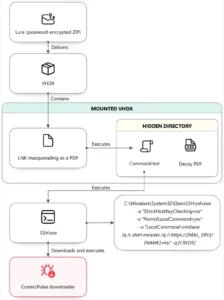
To circumvent these new security barriers, TA558 has moved toward the use of container files, specifically RAR archives and ISO disk images. These compressed formats allow the attackers to bypass email gateway filters that might otherwise flag suspicious executable files. Once an ISO or RAR file is downloaded and opened by a user, it decompresses to reveal a malicious batch (.BAT) file. The execution of this file triggers a PowerShell script, which acts as a bridge to download and install more potent payloads, such as the AsyncRAT (Remote Access Trojan).
This shift represents a significant increase in the complexity of the threat. In 2022 alone, the group launched 27 distinct campaigns utilizing URL-based delivery mechanisms, a stark contrast to the total of only five such campaigns conducted between 2018 and 2021. This acceleration in campaign tempo underscores the group’s determination to maintain its relevance in an increasingly hardened digital environment.
Chronology of a Persistent Threat
The activity of TA558 is not a recent phenomenon, but rather the result of a calculated, multi-year campaign of refinement. Since at least 2018, the group has carved out a niche by focusing on the travel and hospitality sectors, primarily targeting organizations within Latin America, though with expanding reach into North America and Western Europe.
- 2018: TA558 first enters the spotlight by leveraging vulnerabilities in the Microsoft Equation Editor, specifically CVE-2017-11882, to distribute Remote Access Trojans (RATs) such as Loda and Revenge RAT. Their lures were largely confined to Portuguese and Spanish-language emails referencing "reserva" (reservation).
- 2019: The group undergoes its first major expansion, incorporating macro-laced PowerPoint presentations into their attack arsenal. During this time, they also began experimenting with English-language phishing lures, signaling a shift toward a more global victim base.
- 2020: Marking their most prolific period, the group launched 25 campaigns in January alone. Throughout this year and into 2021, research from Cisco Talos and Uptycs highlighted the group’s continued reliance on template injections and document-based vulnerabilities to compromise hotel booking systems.
- 2022: Following a lull attributed to the global contraction of travel during the COVID-19 pandemic, TA558 returned with a revamped technical strategy. The move to ISO and RAR files became the defining characteristic of their operations, coupled with a higher frequency of campaigns.
The Anatomy of the Malware Payload
The primary goal of TA558, according to threat intelligence analysts, is financial gain. The malware payloads delivered during these campaigns—including Loda, Revenge RAT, and AsyncRAT—are designed to provide the attacker with persistent, unauthorized access to the victim’s machine.
Once a RAT is successfully installed, it can perform a variety of malicious activities:
- Reconnaissance: The attacker can map the victim’s network, identify connected peripherals, and monitor user activity.
- Data Theft: By capturing keystrokes, stealing browser credentials, and accessing saved login information, the group can harvest credit card details and personal identity information (PII).
- Lateral Movement: If a hotel employee’s workstation is compromised, the attacker may attempt to pivot into the company’s reservation database, potentially exposing the data of thousands of guests.
- Payload Distribution: The initial infection often serves as a "downloader" for secondary, more damaging malware, such as ransomware or banking trojans, which can be deployed once the attacker has established a firm foothold.
Implications for the Travel and Hospitality Industry
The implications of these campaigns extend far beyond the immediate victim. For hospitality organizations, a successful breach can lead to catastrophic reputational damage and severe regulatory fines under frameworks such as the GDPR or various state-level privacy laws. Furthermore, because these attacks target the booking process, they inherently erode consumer trust. If travelers believe that a legitimate reservation email could lead to a malware infection, the entire digital infrastructure of the travel industry risks being viewed as a liability rather than a convenience.
Sherrod DeGrippo, Vice President of Threat Research and Detection at Proofpoint, emphasized the severity of the threat in a recent briefing. "The group’s persistence and evolution suggest a high level of sophistication and a clear financial motivation," DeGrippo stated. "Organizations in the travel and hospitality sectors must assume that they are being targeted and implement robust defensive measures, including the blocking of suspicious file extensions at the email gateway and the implementation of multi-factor authentication (MFA) across all employee accounts."
Defensive Recommendations and Future Outlook
The rise of TA558 serves as a cautionary tale for any industry that relies on high-volume, document-heavy communication with the public. To mitigate these risks, security experts suggest a multi-layered approach to defense:
- User Awareness Training: Employees must be educated on the risks associated with unexpected emails, even those that appear to be routine booking confirmations. Specifically, staff should be trained to recognize the "red flags" of phishing, such as unexpected RAR or ISO attachments.
- Endpoint Security: Organizations should deploy endpoint detection and response (EDR) solutions capable of identifying and blocking malicious PowerShell scripts and suspicious file execution patterns.
- Gateway Filtering: Email security gateways should be configured to aggressively filter out container file formats like ISO and RAR, which are rarely necessary for standard business correspondence.
- Vulnerability Management: While TA558 has moved toward container files, they remain opportunists. Ensuring that all Office software is patched against known vulnerabilities, such as those related to remote code execution, remains a critical baseline for security.
As the travel industry continues to recover and expand, the incentive for cybercriminals to target this sector will only increase. TA558 has proven to be a resilient, adaptive, and highly motivated adversary. Their ability to pivot from macro-based attacks to containerized payloads demonstrates a clear understanding of the shifting security landscape. For the travel industry, the message is clear: the digital itinerary of the modern traveler is a primary target, and protecting it requires a constant, vigilant, and proactive security posture.
The battle between threat actors like TA558 and the cybersecurity community is an ongoing cycle of escalation. As organizations adopt new defenses, threat groups will inevitably seek new vulnerabilities. The history of TA558 is a testament to this reality, and the coming years will likely see further iterations in their delivery methods, requiring the industry to remain perpetually prepared for the next evolution in cyber-reservation fraud.
Related posts: