OnePlus Details November ColorOS 17 Rollout Schedule as OxygenOS Bows Out

The landscape of Android software development is undergoing a significant paradigm shift as BBK Electronics subsidiaries streamline their operating system strategies. OnePlus has officially outlined its comprehensive rollout schedule for the upcoming software cycle, which brings a definitive end to an era for the brand. For years, OxygenOS served as the hallmark software experience that distinguished OnePlus devices from their competitors, championed by tech enthusiasts for its stock-like interface and deep customization options. However, the release of Android 17 marks the final chapter for the independent identity of OxygenOS, as OnePlus transitions its entire supported hardware ecosystem to OPPO’s unified ColorOS platform.
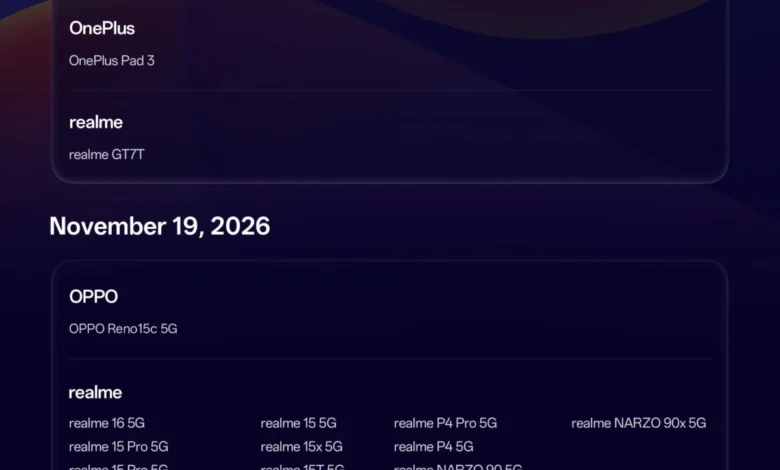
The transition, while anticipated by industry insiders given the shared codebase and engineering resources utilized by both brands over recent years, formalizes a convergence that has been years in the making. According to the official roadmap shared by the OPPO ColorOS Global account on social media platform X, the November deployment window encompasses a diverse array of smartphones and tablets. This strategic wave of upgrades aims to deliver modern interface refinements, enhanced system stability, and advanced artificial intelligence capabilities to millions of active users worldwide.
Comprehensive November Deployment Schedule
The phased rollout kicks off at the beginning of the month, establishing a rapid cadence for flagship and mid-range devices alike. Industry analysts note that this aggressive scheduling reflects a concerted effort by the manufacturer to minimize fragmentation across its active hardware portfolio.
Leading the charge is the OnePlus 13R, slated to receive the official ColorOS 17 update on November 5. As one of the brand’s premier performance-focused devices, the 13R will serve as an early benchmark for how the new software architecture performs on current-generation hardware. Following closely behind is the company’s previous-generation traditional flagship, the OnePlus 12, which is scheduled to receive the update on November 17.
Tablet users are also included in the initial wave. The OnePlus Pad 3 is locked in for a November 18 release, signaling the brand’s commitment to maintaining parity between its smartphone and tablet software ecosystems.
Perhaps one of the most anticipated deployments in the November batch involves the OnePlus Open, the company’s critically acclaimed foldable device. Scheduled for November 24, the update for the foldable will test OPPO’s ability to adapt its unified operating system to dual-screen and multitasking-heavy form factors. Rounding out the November schedule are the Nord 6 and the budget-conscious Nord CE 6, both of which are expected to begin receiving the over-the-air update on November 26.
Historical Context and the Death of OxygenOS
To understand the weight of this transition, one must examine the shared history of OnePlus and OPPO. Founded in 2013 as an independent startup focusing on enthusiast-grade hardware, OnePlus initially built its reputation on CyanogenMod and its proprietary OxygenOS—a lightweight, highly customizable user interface that eschewed the heavy bloatware common in contemporary Android skins.
Over the subsequent decade, as OnePlus integrated more deeply with its parent company, OPPO, the
lines between their software development teams blurred. By 2021, OnePlus officially announced a deeper integration with OPPO, merging their operating system codebases. Although the companies maintained distinct marketing skins—calling the global interface OxygenOS and the Chinese and select international variants ColorOS—under the hood, the underlying architecture, system apps, and frameworks became virtually identical.
With the advent of Android 17, OnePlus has elected to drop the OxygenOS moniker entirely in major markets, streamlining nomenclature and consolidating development under the ColorOS umbrella. Company representatives have defended the move as a necessary efficiency that will allow engineering teams to accelerate patch deployment, improve security protocols, and deliver cross-device continuity more effectively than maintaining two separate branches of the same underlying software.
What ColorOS 17 Brings to OnePlus Hardware
The transition to ColorOS 17 is not merely a branding exercise; it introduces a substantial suite of functional and aesthetic upgrades. Based on Google’s Android 17 operating system, ColorOS 17 emphasizes fluid animations, reduced system latency, and memory management optimizations designed to extend battery life and hardware longevity.
Key architectural improvements include enhanced rendering engines that take full advantage of modern high-refresh-rate displays. Furthermore, the update introduces a more robust implementation of on-device artificial intelligence features, aligning with industry trends toward generative AI assistants, intelligent photo editing tools, and predictive multitasking routines. OPPO’s proprietary system-level optimizations, such as Trinity Engine, are deeply integrated into the build, promising sustained performance even under heavy gaming or productivity workloads.
Beyond raw performance, ColorOS 17 focuses heavily on ecosystem integration. The software is engineered to facilitate seamless file sharing, clipboard syncing, and screen mirroring across OPPO, OnePlus, and selected personal computing hardware. For users deeply embedded in the broader ecosystem, this continuity aims to bridge the gap between mobile devices, tablets, and desktop environments.
December Rollout and 2027 Outlook
While the November schedule covers several key devices, it represents only the beginning of a much broader deployment strategy. Owners of older or secondary-tier devices will need to exercise patience as the engineering teams work through subsequent deployment waves.
According to preliminary internal roadmaps, the rollout will extend into December, targeting devices such as the OnePlus 11, the OnePlus 12R, and the Nord 5. Beyond December, a secondary tier comprising roughly 13 additional OnePlus devices—ranging from legacy flagships to older Nord-series mid-rangers—is scheduled to receive the update spanning from late December through the first quarter of 2027.
Industry experts caution that consumers should view these dates as initial deployment start windows rather than universal delivery guarantees. Major Android updates are traditionally distributed in controlled, phased batches to monitor for unforeseen bugs, server bottlenecks, and regional carrier restrictions. Consequently, an update designated for early November in one region may take several weeks to propagate globally.
Implications for the Consumer Market and Brand Identity
The phasing out of OxygenOS marks a poignant moment for longtime OnePlus loyalists. For a decade, the brand cultivated a distinct identity centered around community feedback, developer-friendly policies, and a clean user interface. The transition to ColorOS signifies the complete corporate and structural absorption of OnePlus into the broader OPPO ecosystem.
From a market perspective, however, analysts suggest that the move is pragmatically sound. Maintaining separate software teams for brands operating under the same corporate umbrella represents an unnecessary duplication of resources in an intensely competitive smartphone market. By unifying under ColorOS, OnePlus can leverage OPPO’s massive research and development budget, ensuring more rapid security updates and competitive feature parity with rival manufacturers like Samsung and Xiaomi.
Ultimately, consumer reception will likely hinge on the stability and user experience of ColorOS 17. If the unified operating system delivers on its promises of enhanced speed, robust AI functionality, and reliable battery management, most users may readily accept the name change. Conversely, any software instability or interface friction could alienate the purist demographic that originally put OnePlus on the map. As the November 5 kickoff approaches, all eyes will be on the OnePlus 13R to see how the new era of OnePlus software performs in the hands of the public.