Tesla Full Self-Driving v15 Rollout Targets Industry Weaknesses With Bold Safety Claims

Tesla has officially commenced the rollout of its long-anticipated Full Self-Driving (FSD) v15 software update, introducing a suite of targeted improvements directed at some of the autonomous driving system’s most persistent historical shortcomings. According to release notes and corporate communications published by the company, the latest iteration overhauls the end-to-end driving network, promising substantial upgrades in traffic sign detection, pothole avoidance, and speed management within sensitive areas such as school zones.
The deployment of FSD v15 represents a crucial milestone for the automaker’s artificial intelligence division. As Tesla faces mounting regulatory scrutiny and heightened consumer expectations regarding the safety of its driver-assistance technology, the company is attempting to demonstrate tangible progress toward achieving unsupervised autonomous operations. While the initial wave of updates is being rolled out to compatible vehicles equipped with the company’s AI4 hardware suite, industry analysts and safety advocates are closely examining the real-world performance of the new software to verify whether its ambitious technical claims translate into actual road safety improvements.
Targeted Improvements and Core Feature Additions
The release notes for FSD v15 reveal a deliberate focus on rectifying specific operational flaws that have plagued previous iterations of the software. Prominent among these improvements is enhanced sign detection and speed handling. Historically, FSD has drawn criticism—and raised regulatory flags—for its inability to consistently recognize varying speed limit signs, particularly in international markets and complex urban environments. By directly addressing this vulnerability, Tesla aims to curb instances of inadvertent speeding.
Furthermore, the update introduces localized navigation enhancements, rudimentary route learning at trip origins and destinations, and a specialized "Bike Rack Mode" designed to accommodate hitch-mounted accessories without disrupting the vehicle’s sensor suite. The software also incorporates logic to moderate vehicle speed around speed cameras, reflecting a pragmatic adjustment to common driving environments, although it simultaneously highlights ongoing debates regarding automated compliance with local traffic laws.
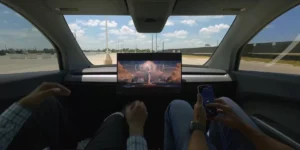
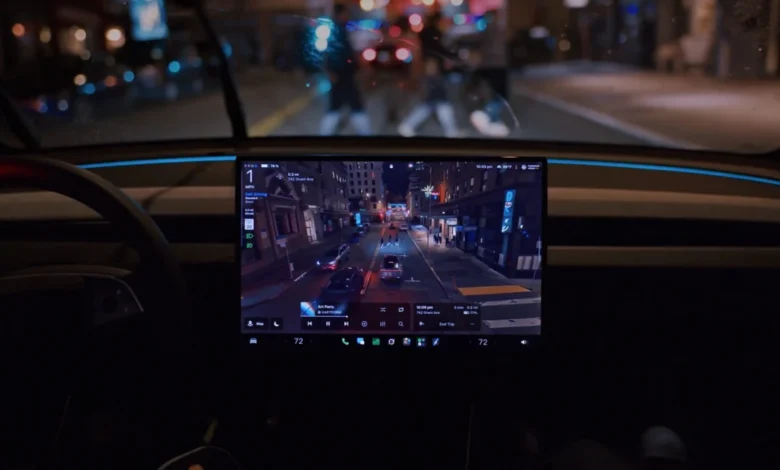
A significant visual and functional addition in v15 is the introduction of what Tesla terms the "Tesla Augmented Reality" or "Reality View" interface. This feature consolidates disparate neural network signals into a unified, high-fidelity live visualization displayed on the central touchscreen. By rendering a comprehensive representation of the vehicle’s immediate surroundings and intended trajectory, the system aims to provide drivers with greater transparency concerning the vehicle’s decision-making process. Tesla asserts that this streamlined architecture reduces computational overhead while empowering supervisors to better anticipate and oversee driving maneuvers.

Contextualizing the Safety Metrics and the 25x Multiplier
Central to Tesla’s promotional campaign for FSD v15 is the assertion that the new vision encoder achieves a "25x better handling of safety critical cases," specifically corresponding to a 25-fold improvement in the critical intervention rate. While this metric is theoretically aligned with the quantitative benchmarks required to transition from supervised to unsupervised autonomous driving, independent observers have noted a conspicuous absence of baseline empirical data.
Tesla has not publicly disclosed the exact frequency of critical interventions under previous software versions, making independent verification of the 25x multiplier challenging. Based on external industry estimates and crowdsourced fleet data from earlier iterations like v14—which reportedly achieved thousands of miles between critical disengagements—a twenty-fivefold enhancement could theoretically elevate reliability thresholds into tens of thousands of miles per intervention. However, safety researchers emphasize that statistical multipliers must be evaluated against rigorous, standardized third-party testing rather than proprietary corporate metrics.
The push for v15 also coincides with divergent regulatory and behavioral trends. Notably, the release notes indicate a reduction in the strictness of driver monitoring profiles when utilizing higher-speed settings. This adjustment occurs against a backdrop of increasing scrutiny from safety authorities, including the National Highway Traffic Safety Administration (NHTSA), which has opened inquiries into traffic-law compliance and active school zone navigation involving Tesla’s autonomous and semi-autonomous systems.
A Chronology of Iterative Development and Historical Precedents
To understand the current significance of FSD v15, it is necessary to examine the evolutionary trajectory of Tesla’s driver-assistance architecture. The development of the platform has historically been characterized by iterative, non-linear progress, frequently alternating between significant capability leaps and unexpected regressions.
In October 2025, the rollout of FSD v14 introduced advanced neural network architectures that initially struggled with behavioral anomalies such as phantom braking, trajectory hallucinations, and excessive acceleration. Subsequent point releases throughout early 2026 attempted to stabilize the software, with company executives frequently framing each incremental update as the definitive solution to remaining autonomy hurdles. Chief Executive Officer Elon Musk previously asserted that successive versions would exceed human safety levels across complex scenarios, setting high expectations that previous iterations frequently failed to consistently deliver across all operating domains.

The introduction of v15 follows statements made by Tesla representatives to financial analysts in mid-2026, wherein the software was described as a fundamental step-change utilizing core technologies deployed within the company’s regional robotaxi fleets. By transitioning these foundational elements to consumer-facing vehicles, Tesla is attempting to harmonize its commercial software offerings with its broader commercial autonomy roadmap.
Regulatory Scrutiny and Industry Implications
The commercial and technological stakes for FSD v15 extend far beyond consumer convenience, intersecting directly with regulatory compliance and the viability of autonomous ride-hailing services. Agencies such as the NHTSA continue to evaluate the operational safety of semi-autonomous systems, particularly regarding adherence to vulnerable infrastructure like school zones and pedestrian crossings. Recent independent evaluations in Europe and North America have underscored discrepancies between posted speed limits and vehicle behavior, prompting demands for greater algorithmic accountability.
The dual nature of the update—pairing advanced visualization tools and critical intervention improvements with loosened monitoring constraints in specific profiles—highlights the ongoing challenge of managing the transition phase of driver supervision. As drivers increasingly rely on advanced automation, ensuring attentive human oversight remains a paramount concern for traffic safety experts.
Fact-Based Implications for the Autonomous Vehicle Market
The release of FSD v15 carries several direct implications for the broader automotive and technology sectors:
- Verification Challenges: The reliance on proprietary performance multipliers without accompanying baseline datasets underscores the persistent need for standardized, transparent benchmarking across the autonomous vehicle industry.
- Consumer Trust and Usability: Features like Reality View may enhance user comprehension and reduce cognitive load during supervision, potentially mitigating the risks associated with driver complacency.
- Regulatory Alignment: By specifically targeting historical weaknesses such as sign recognition and school zone speeds, Tesla is directly addressing the primary pain points cited by safety regulators and municipal authorities.
- Autonomous Fleet Scalability: If the operational reliability improvements implied by the critical intervention metrics prove robust in diverse real-world conditions, it could accelerate the deployment timeline for unconstrained robotaxi services.
Ultimately, the success of FSD v15 will not be determined by marketing claims or interface aesthetics, but by its sustained, predictable performance across millions of miles of diverse public roadway driving. As fleets update to the new software, comprehensive empirical analysis will reveal whether v15 successfully resolves the systemic vulnerabilities that have historically constrained the widespread adoption of automated driving technologies.
Related posts: