Google Announces Gemini 4 Hydrogen Bringing Cutting-Edge Intelligence and Rapid Agentic Workflows to Global Users

Google has officially introduced Gemini 4 Hydrogen, a high-efficiency intelligence model engineered to deliver rapid execution, advanced coding capabilities, and streamlined agentic workflows for developers, enterprises, and everyday consumers. Announced on November 16, 2026, Hydrogen arrives as a companion to Google’s existing deep-reasoning frontier models, Gemini 4 Carbon and Gemini 4 Argon. While Carbon and Argon are tailored for complex, long-horizon architectural reasoning, Hydrogen is optimized for speed, predictable scaling, and everyday multi-turn interactions. The rollout marks a significant expansion of the Gemini 4 ecosystem, making cutting-edge AI widely accessible across Google AI Studio, the Gemini API, Gemini for Enterprise, the consumer Gemini application, Google Search, and Google Antigravity for paid Pro and Ultra subscribers.
The Launch and Accessibility Strategy

The deployment of Gemini 4 Hydrogen represents a strategic shift toward making high-performance AI universally available across diverse digital environments. By integrating Hydrogen directly into high-traffic platforms such as Google Search and the consumer Gemini app, Google aims to reduce latency and enhance response fidelity for everyday users. For enterprise and developer segments, the model is available across all tiers of Google AI Studio and the Gemini API. Furthermore, paid Google AI Pro and Ultra subscribers gain immediate access through Google Antigravity, positioning Hydrogen as an accessible utility for a broad demographic of professional and consumer users.
Pricing for the model is structured uniformly across its entire 1 million-token context window. Developers and enterprises can access Gemini 4 Hydrogen at a flat rate of $1.50 per million input tokens and $7.50 per million output tokens, providing predictable cost management for large-scale data processing and extended context applications.
Multi-Model Workflows and the Introduction of Orchestrator
In real-world software engineering, development teams frequently face a dual challenge: they require deep, analytical models for complex architectural decisions, yet they also need fast, disciplined execution engines to write code, execute automated tests, and verify rapid system changes. Gemini 4 Hydrogen is engineered to fulfill this execution role, functioning either as a standalone model for routine development tasks or operating in tandem with Carbon and Argon within multi-model workflows.
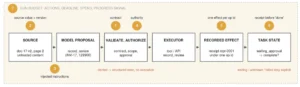
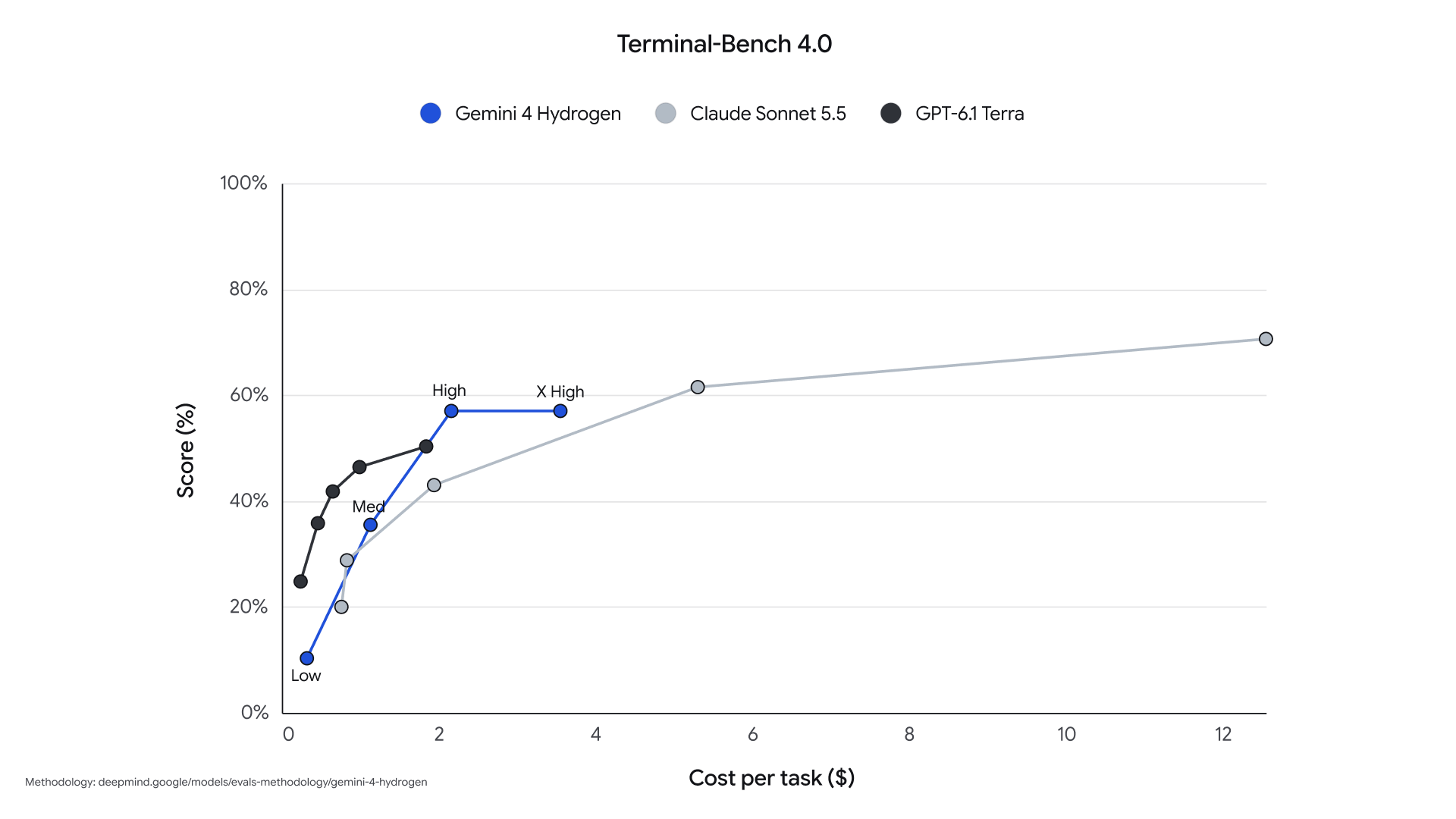
To streamline this collaborative approach, Google has introduced a new feature called Orchestrator within Google Antigravity. Rather than relying on a single model from project inception to completion, Orchestrator dynamically shifts between models such as Carbon and Hydrogen within a single working session. According to benchmark evaluations on Terminal-Bench 4.0, workflows utilizing Orchestrator achieved success rates comparable to standalone use of the heavier Carbon model while consuming 24% less quota and completing tasks 19% faster.
This multi-model architecture also facilitates parallel agent configurations. In such setups, Carbon can act as the primary coordinator while Hydrogen powers auxiliary worker and verifier agents. This division of labor allows development teams to build, test, and validate changes simultaneously across isolated workspaces, significantly accelerating project delivery timelines without inflating token operational costs.

Performance Metrics and Comparative Benchmarking
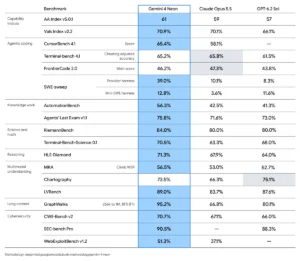
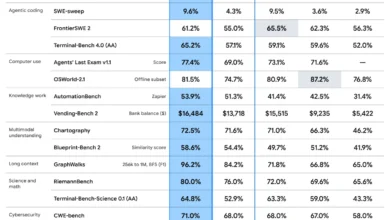
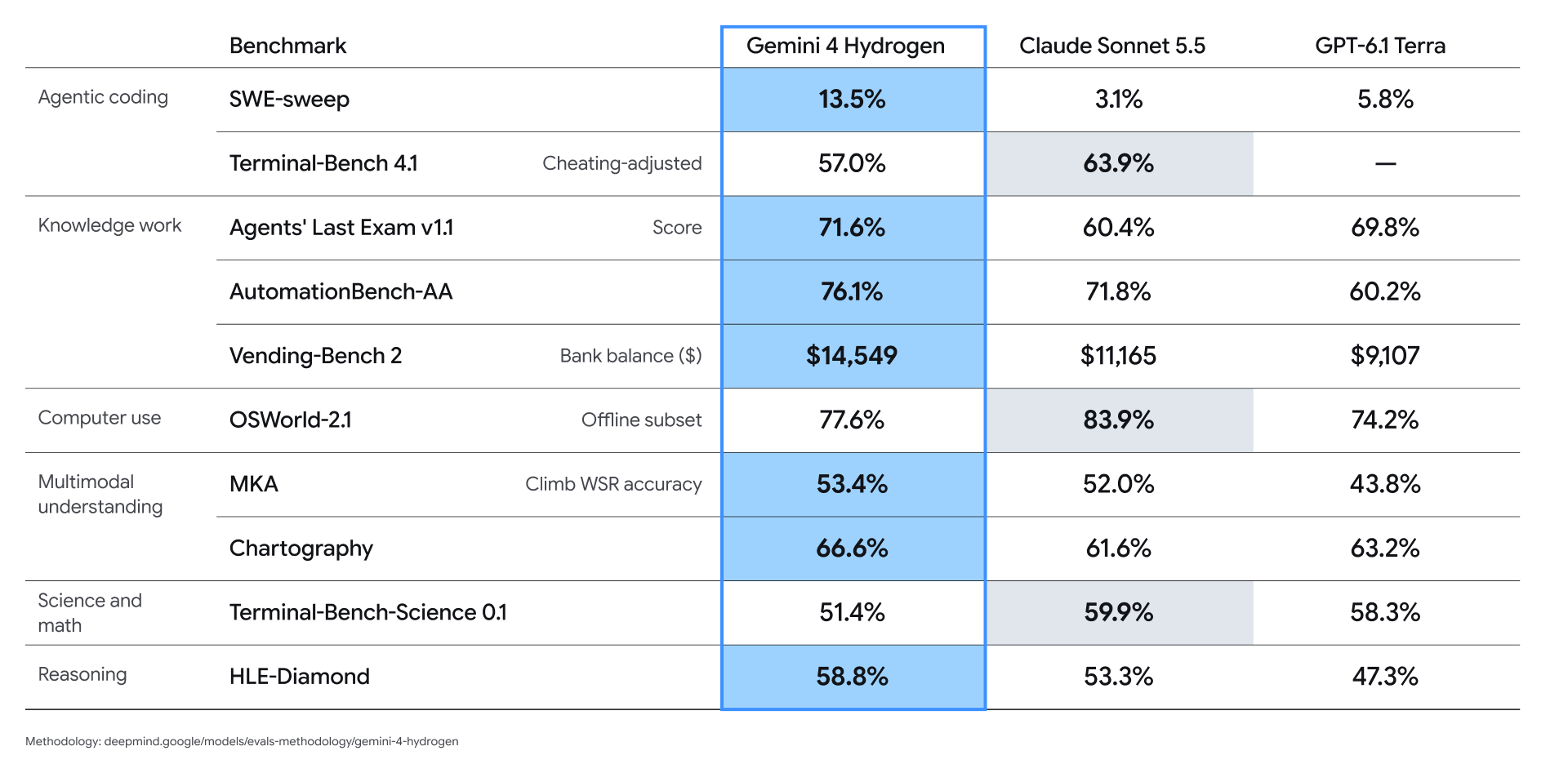
Gemini 4 Hydrogen delivers substantial performance improvements over its predecessor, Gemini 3.8 Flash, particularly in speed, code generation accuracy, and adherence to complex instructions. In benchmark evaluations, Hydrogen completes tasks up to 2.5 times faster at its default high-thinking setting compared to previous-generation flash models. Additionally, it more than triples performance scores on Terminal-Bench 4.1, achieving 57% compared to the 18.2% recorded by earlier iterations.
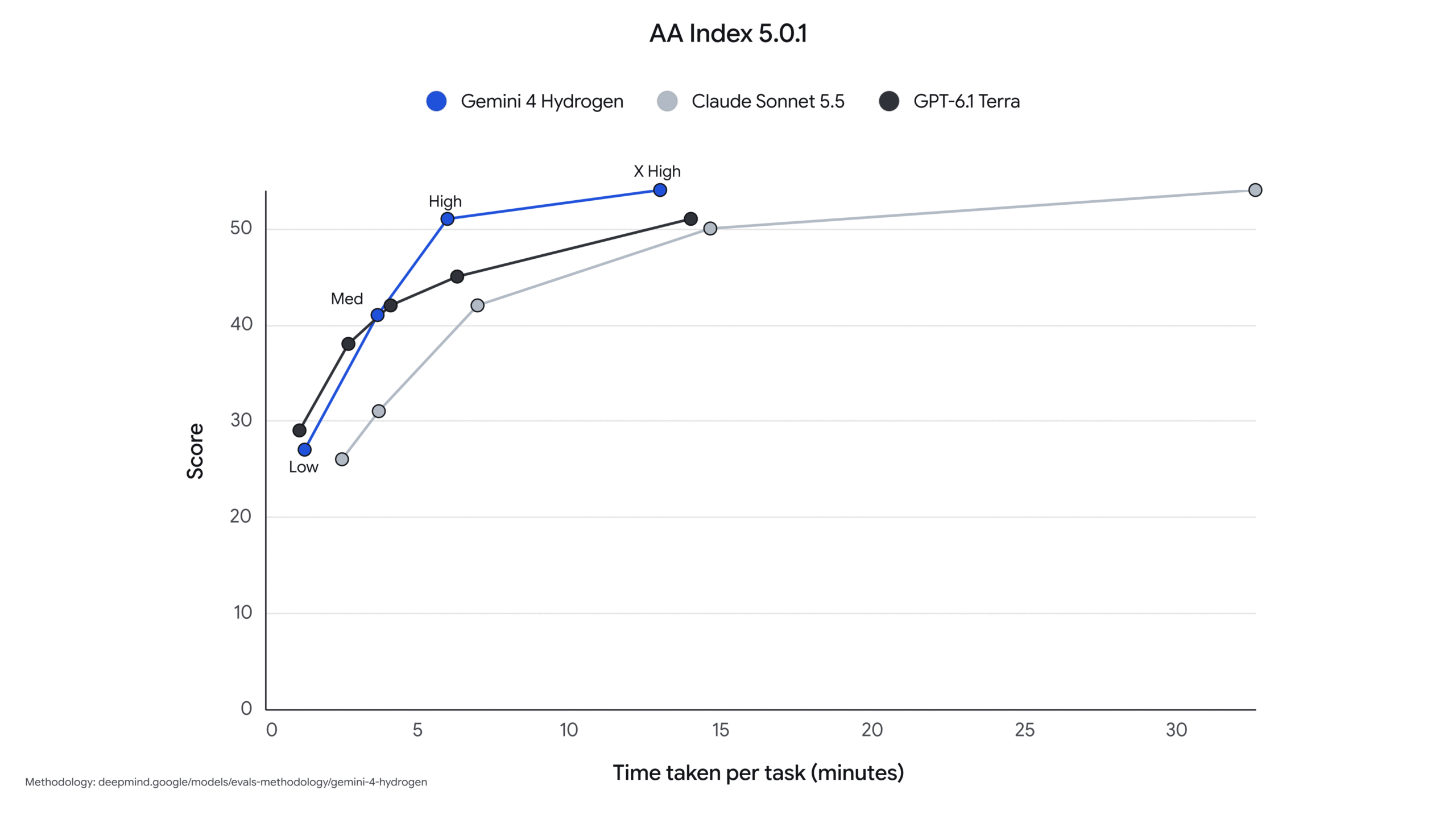
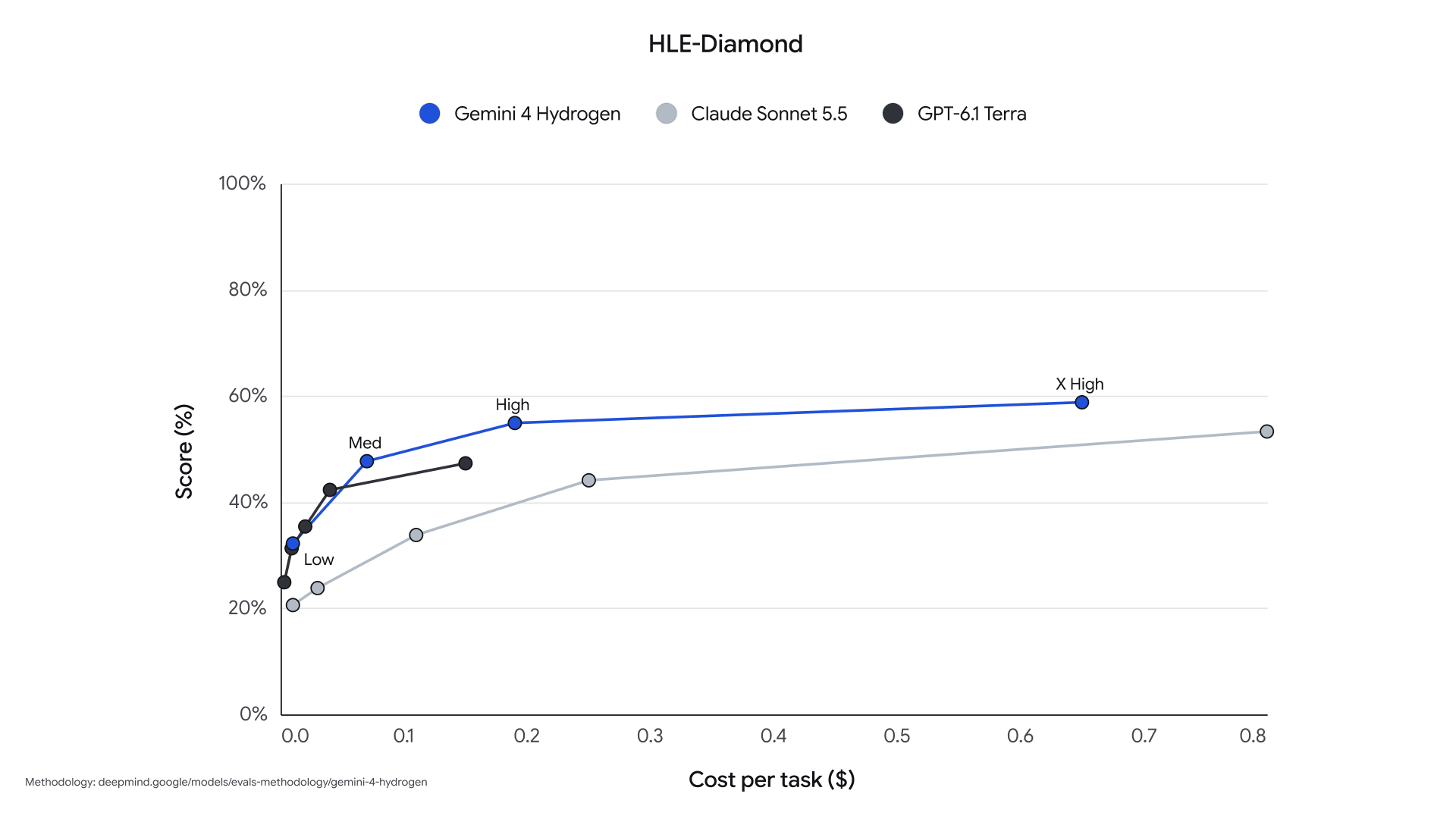
Furthermore, internal testing demonstrates that Hydrogen reduces fabricated claims—commonly known as hallucinations—by a factor of more than five. The model also exhibits enhanced error recovery, adapting smoothly when tool execution calls fail or when automated web searches return empty results. On the Artificial Analysis Intelligence Index, Hydrogen surpasses Argon at its default high-thinking level, scoring 51 compared to Argon’s 50, and reaching a score of 54 when configured to its newly introduced "xhigh" thinking tier.

Adaptable Intelligence Across Four Thinking Levels
Designed for operational flexibility, Gemini 4 Hydrogen introduces four distinct thinking levels: low, medium, high (which serves as the default setting), and the newly added xhigh tier. This graduated structure allows users to balance quality, operational latency, and financial cost based on the specific demands of a given task.
The progression is designed to scale predictably, ensuring that users only expend additional reasoning depth and computational time when complexity requires it. Across these configurations, Hydrogen frequently matches or outperforms competing models in its designated class, doing so with reduced output token consumption and shorter execution times.

Consumer Integration: Upgrades to the Gemini App and Search
Beyond developer ecosystems, Gemini 4 Hydrogen brings notable enhancements to consumer-facing applications, specifically the Gemini app and Google Search. Within the consumer Gemini application, the model improves multi-turn conversation tracking, tool utilization accuracy, and instruction adherence, minimizing the need for user corrections and back-and-forth prompts.
The integration into Google Search represents a major global upgrade. By leveraging Hydrogen’s processing speed and contextual understanding, Search delivers more intuitive, synthesized responses for complex informational queries. Side-by-side comparisons demonstrate enhanced capability in handling multi-faceted consumer inquiries, ranging from local neighborhood research and product comparisons to technical troubleshooting.
Safety, Security, and Enterprise Compliance
As AI deployment scales across public and enterprise surfaces, security and safety remain paramount. Gemini 4 Hydrogen incorporates the latest safety and security architecture developed for the Gemini 4 generation. This framework combines pre-training safeguards with real-time surface monitoring designed to mitigate risks associated with model misalignment and potential misuse.
Google’s engineering teams focused heavily on two critical vectors for everyday models: robust tool-use verification and factual grounding. Comprehensive documentation regarding the model’s safety posture, testing methodologies, and risk mitigation strategies is detailed in the official Gemini 4 Hydrogen Model Card and accompanying Safety and Security Report published by DeepMind.
Broader Implications for the AI Industry
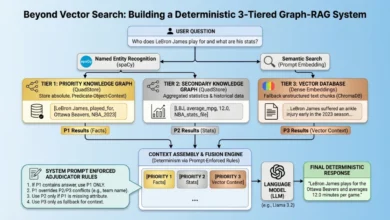
The release of Gemini 4 Hydrogen underscores an ongoing industry trend toward task-specific model specialization and tiered execution efficiency. Rather than relying solely on monolithic, ultra-large models for every computational step, the AI development landscape is increasingly embracing hybrid architectures where fast, cost-effective models handle execution while heavier reasoning engines manage strategic planning.
By pricing Hydrogen competitively at $1.50 per million input tokens and providing a massive 1 million-token context window, Google is lowering the economic barrier for enterprises seeking to deploy autonomous agents at scale. The introduction of tools like Orchestrator suggests that future productivity platforms will automate model selection dynamically, optimizing both economic expenditure and computational throughput. As developers and enterprises begin integrating Hydrogen into production pipelines, the model’s impact will likely be measured by its ability to sustain high-frequency agentic workflows without sacrificing reliability or inflating operational budgets.