GoSun Unveils Solar-Chargeable Electric Tractor to Disrupt Small-Scale Agriculture

The transition toward sustainable agricultural machinery has long faced a persistent hurdle: balancing the heavy energy demands of daily farming operations with the limited battery endurance of electric alternatives. While the automotive sector has rapidly embraced electrification, the agricultural utility vehicle market has struggled to achieve widespread commercial success due to high upfront costs, range anxiety, and a lack of reliable rural charging infrastructure. Addressing these challenges head-on, Ohio-based clean technology developer GoSun has introduced an innovative solution aimed at reshaping small-scale farming and property management. Co-developed in partnership with renowned Indian agricultural machinery brand Moonrider, the newly unveiled Moonrider 27 All-Electric Solar Tractor combines robust performance capabilities with integrated solar-charging technology, presenting a compelling alternative to traditional diesel-powered utility vehicles.
Main Facts of the Moonrider 27 System
At the heart of the Moonrider 27 is a robust 20 kW electric motor—equivalent to approximately 27 horsepower—engineered to deliver instantaneous torque across all four wheels. This four-wheel-drive configuration ensures maximum traction, stability, and pulling power, enabling the vehicle to navigate diverse terrains ranging from muddy pastures to uneven orchard floors. Unlike many experimental electric utility vehicles that struggle with hardware compatibility, the GoSun tractor features a standard 540 rpm mechanical power take-off (PTO) located at the rear. This crucial integration allows operators to seamlessly utilize a wide array of existing farm implements, including rotary mowers, tillers, and post-hole diggers, without requiring costly equipment replacements.

Powering the propulsion system and auxiliary tools is a 24 kWh Lithium Iron Phosphate (LFP) battery pack. LFP chemistry was selected for its exceptional thermal stability, safety profile, and longevity, ensuring that the tractor can endure the rigorous demands of agricultural life. According to GoSun’s preliminary performance specifications, a fully charged battery pack provides up to five hours of continuous operation under typical working conditions. For many hobby farms, vineyards, orchards, and municipal property management teams, this operational window easily covers a full day of routine maintenance and chores.
Background Context and Industry Evolution
The introduction of the Moonrider 27 arrives at a critical juncture for the agricultural sector. For decades, small-scale farmers and property managers have depended almost exclusively on diesel-powered utility tractors. While reliable, these internal combustion engine vehicles are major contributors to on-site carbon emissions, generate high levels of noise pollution, and impose continuous financial burdens through volatile fuel prices and frequent maintenance requirements, such as oil changes and emissions system upkeep.
In recent years, major agricultural equipment manufacturers have introduced heavy-duty electric tractors aimed at commercial-scale operations. However, these machines often come with prohibitive price tags that place them out of reach for smallholders, landscapers, and municipal parks departments. Furthermore, rural properties frequently lack the high-capacity electrical grid infrastructure required to support rapid-charging stations for commercial electric fleets. By integrating an onboard solar charging system, GoSun’s latest venture directly targets these infrastructural and economic bottlenecks, offering a decentralized energy solution tailored specifically to the realities of rural land management.
Chronology and Development Timeline
The genesis of the Moonrider 27 is the result of a strategic collaboration between GoSun, a company widely recognized for its portable solar appliances and consumer solar innovations, and Moonrider, a trusted name in tractor manufacturing. The partnership was formed to bridge the gap between heavy agricultural engineering and consumer-accessible solar technology.
Over the past two years, engineering teams from both companies worked to integrate photovoltaic capabilities into a heavy utility platform without compromising the structural integrity or utility of the tractor. The design process focused heavily on optimizing energy efficiency, enhancing battery durability under extreme weather conditions, and ensuring compatibility with legacy tractor attachments. Following rigorous prototyping and field testing phases throughout late 2025 and early 2026, the vehicle made its official public debut in September 2026, positioning itself as a vanguard for autonomous and renewable-powered agricultural machinery.
Power Generation and Flexible Charging Infrastructure

What truly distinguishes the Moonrider 27 from competing electric tractors is its multifaceted approach to refueling. While the vehicle can be conventionally charged using a standard 220/240V AC Level 2 electrical outlet—making overnight charging simple and cost-effective—its defining feature is the optional 1.1 kW integrated solar array.
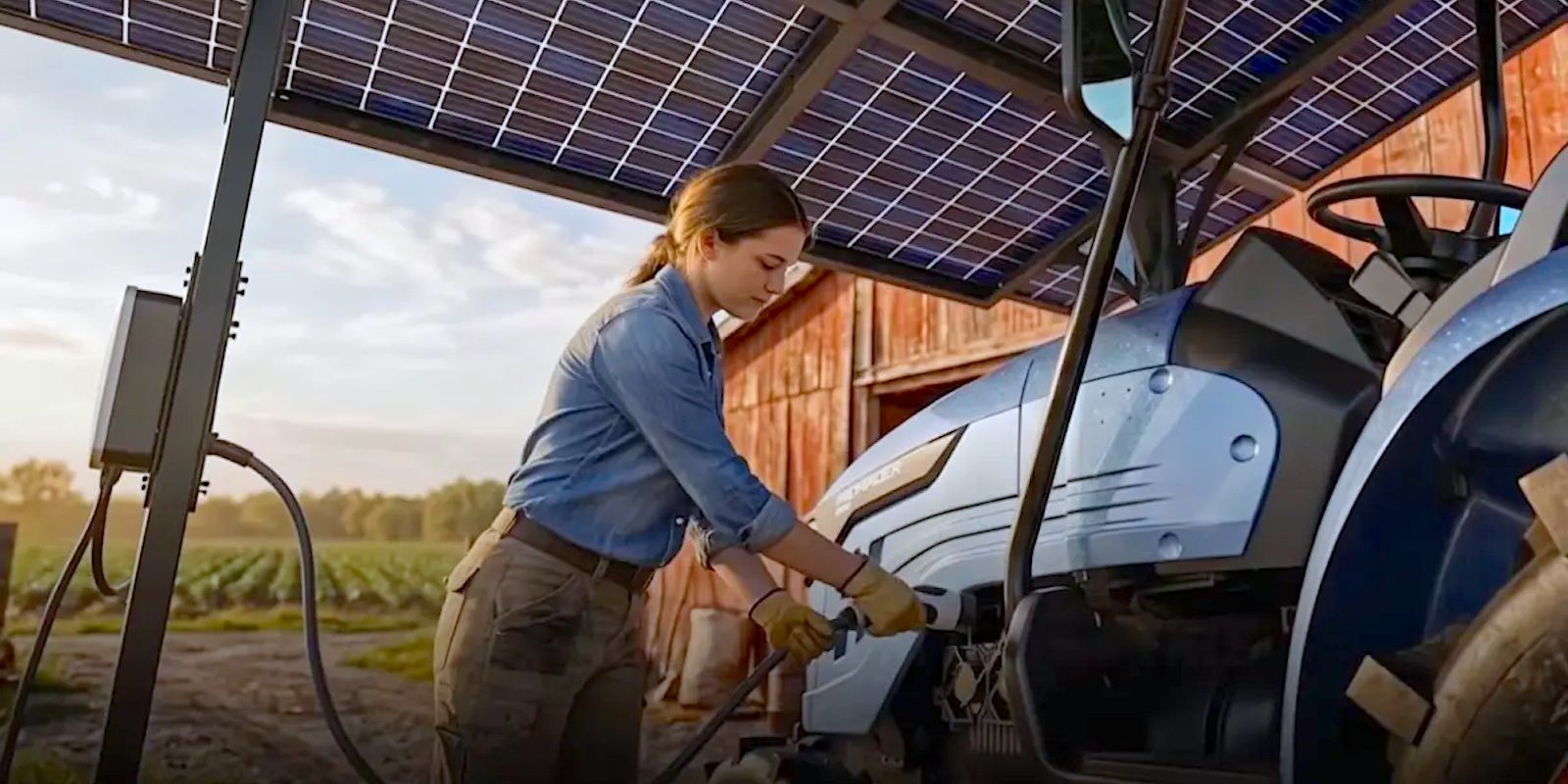
Designed to mount above the operator station, this photovoltaic canopy continuously harvests ambient sunlight during daylight hours. During peak solar production periods in favorable weather conditions, the array can generate approximately 1.5 hours of additional runtime equivalent per day. For operators whose daily workloads do not require draining the battery to its minimum threshold, the solar canopy introduces the possibility of extended periods—ranging from days to weeks—where the tractor operates entirely off-grid without ever needing to be plugged into a physical power source.
This autonomous energy generation fundamentally alters the operational economics of small-scale farming. Property owners can eliminate fuel storage tanks, reduce their reliance on grid electricity, and perform daily maintenance routines with zero direct energy expenditures beyond the initial purchase of the equipment.
Statements and Industry Reactions

The launch of the Moonrider 27 has elicited significant commentary from industry analysts, environmental advocates, and agricultural technology experts. Patrick Sherwin, founder and chief executive officer of GoSun, emphasized the transformative potential of the new vehicle during the official product launch.
"Small-scale farming and property management have relied on noisy, costly diesel utility vehicles for far too long," Sherwin stated. "With our new All-Electric Tractor, we are empowering farmers and land managers to literally work in the sunshine—reducing operational costs while protecting the soil and air."
Agricultural economists note that while the upfront investment in electric machinery remains a consideration for buyers, the total cost of ownership over the lifespan of a solar-augmented electric tractor is expected to be substantially lower than that of diesel equivalents. The elimination of diesel fuel purchases, combined with the drastically reduced moving parts in an electric motor compared to an internal combustion engine, translates to minimal routine maintenance and lower long-term overhead costs.
Broader Impact and Market Implications

The entry of the GoSun Moonrider 27 into the North American and global agricultural markets carries notable implications for the broader clean technology landscape. By proving that small utility tractors can achieve energy self-sufficiency through integrated solar generation, the collaboration sets a new benchmark for sustainable off-road vehicle design.
If the Moonrider 27 successfully gains traction among hobby farmers, vineyard operators, and municipal land management agencies, it could pave the way for wider adoption of renewable energy micro-grids in rural communities. Farmers who adopt solar-charged equipment may increasingly look toward solar-powered irrigation pumps, barn lighting, and battery storage systems, creating fully self-sustaining agricultural ecosystems.
As the agricultural sector faces mounting regulatory pressures to reduce carbon emissions alongside persistent economic pressures from fluctuating fossil fuel markets, innovative solutions like the Moonrider 27 offer a pragmatic roadmap forward. By harmonizing traditional mechanical utility with decentralized solar energy, GoSun and Moonrider have demonstrated that the future of farming may not only be electric, but entirely self-reliant.