The deployment of Large Language Models (LLMs) has transformed the landscape of artificial intelligence, yet the technology remains tethered to a significant operational bottleneck: the autoregressive nature of token generation. As organizations race to integrate these models into latency-sensitive applications such as real-time customer service agents, automated coding assistants, and interactive diagnostic tools, the "one-token-at-a-time" generation constraint has emerged as a critical barrier to scalability. Speculative decoding, an advanced inference optimization technique, has surfaced as the industry standard for bypassing this hardware-bound limitation, enabling performance improvements of up to 3x without sacrificing output quality or requiring model retraining.
The Architectural Bottleneck of Autoregressive Inference
To understand why speculative decoding is transformative, one must first examine the physical limitations of modern GPU architectures. Current LLMs, characterized by their massive parameter counts—often ranging from 7 billion to over 1 trillion—operate on an autoregressive basis. For every single token produced, the model must read its entire weight set from GPU memory (VRAM) into the compute units.
In technical parlance, these systems are "memory-bandwidth bound." While modern accelerators like the NVIDIA H100 possess immense floating-point operation (FLOP) capacity, this compute power remains underutilized because the system spends the majority of its cycle time waiting for data to move from memory to the processor. Consequently, the latency of a single token generation is dictated not by the complexity of the math, but by the speed of the memory bus. When a user queries an LLM, the model performs a full forward pass through its billions of parameters for every single word generated, a process that is inherently inefficient for high-speed, low-latency requirements.
The Evolution of Speculative Decoding
The origins of speculative decoding can be traced back to research papers published around 2022-2023, most notably works by teams at Google and DeepMind, as well as independent researchers. The primary goal was to find a way to maintain the mathematical integrity of the target model while parallelizing the work.
Before the widespread adoption of speculative decoding, engineers often relied on model quantization—reducing the precision of model weights from 16-bit to 4-bit or 8-bit—to speed up inference. While effective, quantization often comes with a marginal decrease in accuracy. Speculative decoding changed the paradigm by keeping the "source of truth" (the target model) intact, using a secondary, smaller "draft model" as an anticipatory engine.
How the Speculative Loop Functions
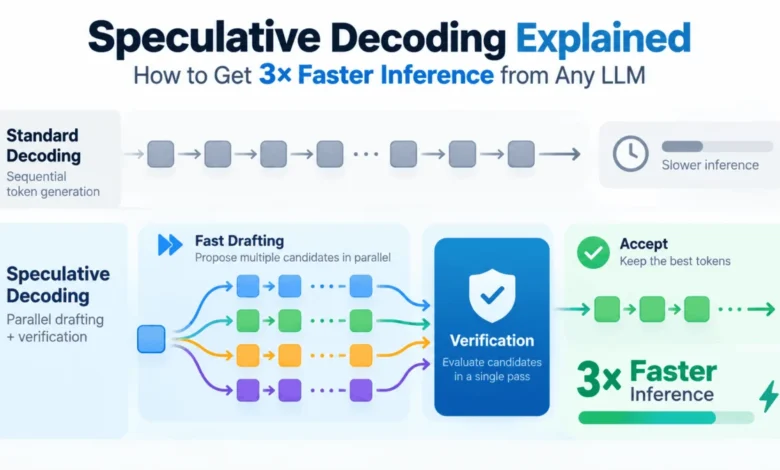
The mechanism operates through a sophisticated two-step interaction between a small draft model and a large target model.
- The Drafting Phase: A miniature model, which can reside comfortably in the cache or memory of the GPU, generates a sequence of 4 to 8 tokens in rapid succession. Because the draft model has significantly fewer parameters, it can execute these tokens at a fraction of the time required by the larger model.
- The Verification Phase: These candidate tokens are then fed into the large target model as a single batch. Because modern GPU architecture is optimized for matrix multiplication, the target model can evaluate all 8 tokens in a single forward pass.
- The Statistical Check: The target model compares the draft tokens against its own probability distribution. If the target model’s confidence in a candidate token meets a specific threshold, the token is accepted. If not, the target model rejects the incorrect tokens and provides a corrected output.
Crucially, this process relies on a statistical method known as Rejection Sampling. By adjusting the probability distributions during the verification stage, the final output is mathematically guaranteed to be identical to what the target model would have produced had it been running in standard, single-token mode. There is no "approximation" involved; the output remains pristine.
Data and Performance Metrics
Industry benchmarks and internal performance reports from companies like NVIDIA and various open-source contributors indicate that the efficacy of speculative decoding is highly dependent on the "acceptance rate"—the percentage of tokens predicted by the draft model that are confirmed by the target model.
- Standard Inference: Typically yields 20 to 40 tokens per second (TPS) on high-end hardware, depending on the model size.
- Speculative Decoding: Can boost throughput to 80–120 TPS.
- Optimal Conditions: In tasks involving repetitive text or structured code, acceptance rates often climb above 70%. In these scenarios, the computational cost per token drops significantly, as the target model effectively "verifies" multiple tokens for the price of one single forward pass.
However, data also suggests diminishing returns. In scenarios with high concurrency—where a single GPU is serving dozens of users simultaneously—the overhead of running the draft model can actually consume precious VRAM, leading to a net decrease in total system throughput. Therefore, industry consensus currently suggests that speculative decoding is best suited for single-user or low-concurrency, high-latency-sensitivity environments.
Modern Implementations and Innovations
The field has rapidly evolved beyond the simple two-model setup. Several innovative approaches are currently being deployed in production environments:
- Medusa: Developed to eliminate the need for a separate draft model, Medusa adds "heads" to the existing architecture of the target model. These heads predict multiple future tokens simultaneously, allowing the model to draft its own candidates. This reduces the memory overhead of maintaining two separate model files.
- Eagle: A refinement of the Medusa concept, Eagle uses the hidden states of the target model to generate candidates. By utilizing the deeper internal context, Eagle achieves higher acceptance rates, particularly in complex reasoning tasks where simple token prediction is insufficient.
- Prompt Lookup Decoding: This is perhaps the most efficient method for document-heavy tasks. It does not use a draft model at all. Instead, it scans the user’s prompt for recurring phrases. When the model encounters a prompt that contains familiar technical jargon or legal boilerplate, it "guesses" the next few tokens based on the existing text in the prompt. This method has shown exceptional results in code editing, where functions and variable names are frequently repeated.
Industry Reactions and Future Implications
Major inference frameworks, including Hugging Face’s text-generation-inference (TGI), vLLM, and llama.cpp, have integrated speculative decoding as a first-class feature. System architects report that for organizations providing real-time AI agents, the implementation of these techniques is no longer optional.
"We are moving toward a world where latency is the primary differentiator for AI services," noted an industry analyst during a recent AI infrastructure summit. "If you can provide a response in 100 milliseconds instead of 300, you win the customer. Speculative decoding is the most cost-effective way to achieve that speed without buying more hardware."
The broader implication of this technology is a shift in how we perceive model efficiency. For years, the industry focused almost exclusively on shrinking the models themselves. Now, the focus is on optimizing the interaction between models and hardware. As researchers continue to refine speculative methods, we can expect to see even more efficient draft models—perhaps ones that are distilled from the target model itself—further narrowing the gap between human reading speeds and AI generation speeds.
Conclusion: The New Standard in Inference
Speculative decoding represents a pivotal moment in the maturity of generative AI. By recognizing that the primary obstacle to LLM performance is not computational capacity but data movement, engineers have successfully unlocked significant performance gains through clever algorithmic design. As these techniques become standard, they effectively raise the ceiling for what is possible in interactive AI. From seamless coding copilots that feel like an extension of the developer’s own thoughts to customer service agents that respond with near-zero latency, the impact of these optimizations will continue to define the next generation of AI-driven applications. For those looking to deploy large language models at scale, the question is no longer whether to use speculative decoding, but rather which variant best suits the specific workload of their application.