Iterators and Generators for Memory-Efficient Processing: A Guide to Scalable Data Engineering

The increasing volume of log data generated by modern distributed systems has pushed traditional, memory-bound processing techniques to their breaking point. For years, developers relied on standard Python list-based processing, which involves reading entire datasets into RAM. However, as log rotation policies shift and single files grow from a few megabytes to multi-gigabyte files, these scripts often fail, triggering fatal MemoryError exceptions. This transition in data handling necessitates a fundamental shift toward lazy evaluation patterns, specifically utilizing Python’s iterator and generator protocols to handle high-volume data streams without exhausting system resources.
The Anatomy of a Memory Crisis
The reliance on list comprehensions and eager loading is a common architectural choice in early-stage software development. When a system processes small logs, a script that reads a file, parses records, filters for errors, and calculates latency averages into memory-resident lists will function perfectly. However, the logic remains fragile. When a log file exceeds available physical memory—a scenario increasingly common in cloud-native environments where traffic bursts can create 9 GB or 10 GB logs overnight—the script collapses.
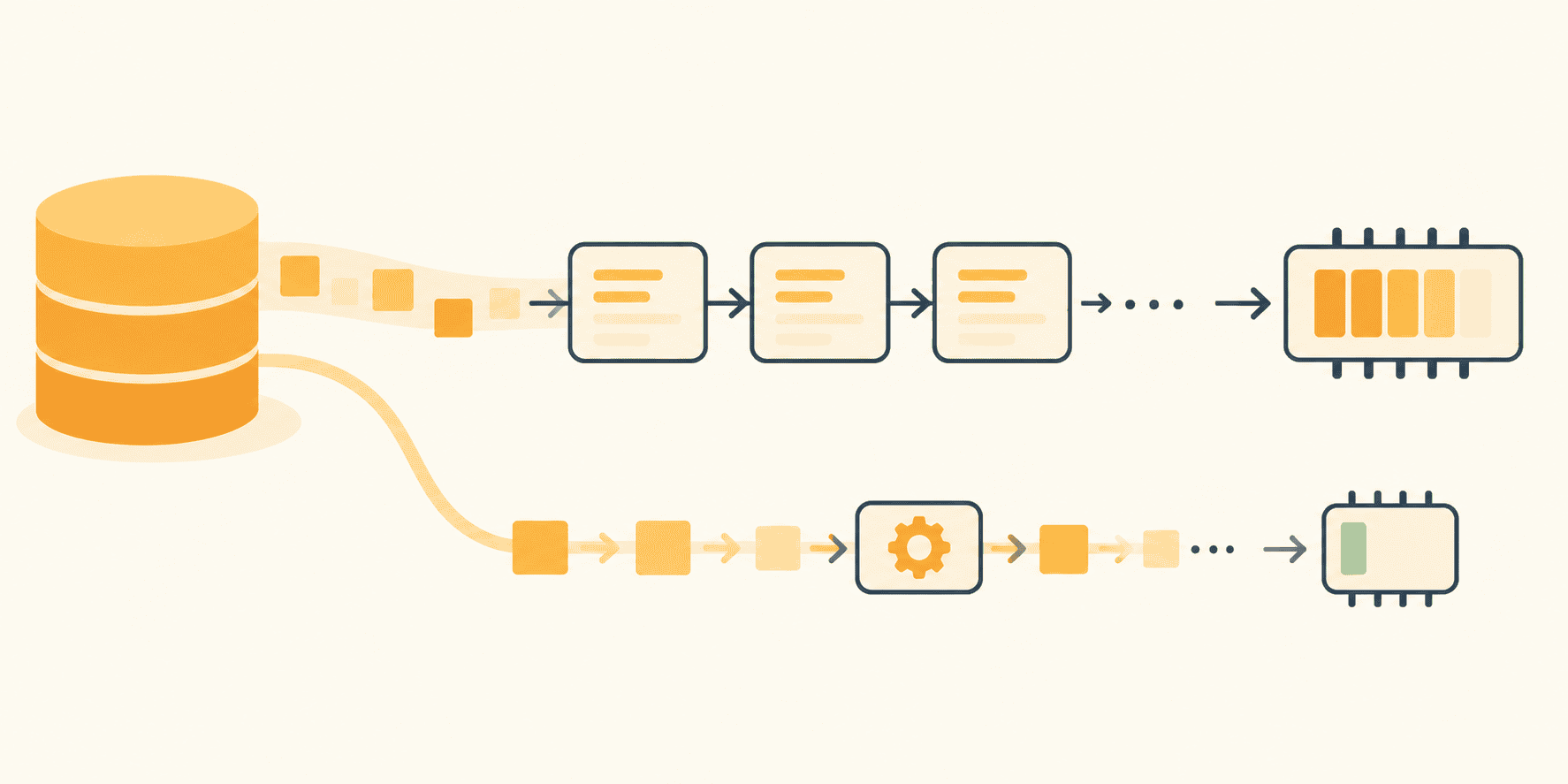
The core issue is "eager execution." In an eager pipeline, each step creates a new list, duplicating the data and consuming memory exponentially. By contrast, a streaming pipeline treats data as a continuous flow. The objective is to ensure that at any given moment, only a single record—or a small, defined batch—occupies memory, with the operating system discarding processed lines as the iterator moves forward.
Chronology of the Iterator Protocol
Python’s capability for streaming has been a core feature of the language for over two decades, rooted in the iterator protocol. Understanding this protocol is essential for any engineer tasked with building resilient data pipelines. An iterable, such as a file object or a list, provides an iterator through the iter() function. This iterator maintains a cursor, allowing the program to traverse the data using the next() method.
The protocol operates on a simple contract: __iter__() returns the iterator, and __next__() yields the subsequent element or raises StopIteration upon completion. This mechanism is the bedrock of memory-efficient processing. When a program loops over an open file object using for line in f, Python does not read the file into memory. Instead, it reads a small buffer and yields lines one at a time. This "forward-only" motion is the reason why streaming is possible: the system does not need to store the past, only the current item.
The Shift to Generator Functions
Transitioning from monolithic loop bodies to modular, generator-based functions allows for cleaner code and more testable architecture. A generator function, defined by the use of the yield keyword, suspends execution while retaining the function’s local state. Unlike a standard function that returns a value and loses its context, a generator remains "paused" until the caller requests the next item.
This suspension mechanism is highly advantageous for complex parsing tasks. For instance, a pipeline can be constructed in distinct stages:
- The Source Stage: A generator function iterates through a list of file paths, yielding individual lines.
- The Parsing Stage: A function receives these lines, uses regular expressions to convert raw strings into dictionaries, and yields the structured records.
- The Filtering Stage: A function accepts these records and yields only those matching specific criteria, such as "ERROR" status or high latency.
By decoupling these steps, developers can test each generator independently. A unit test can pass a small, mocked list of three lines into the parser to verify its regex logic, far more efficiently than attempting to debug a massive, nested script against production data.
Architectural Implications of Lazy Pipelines
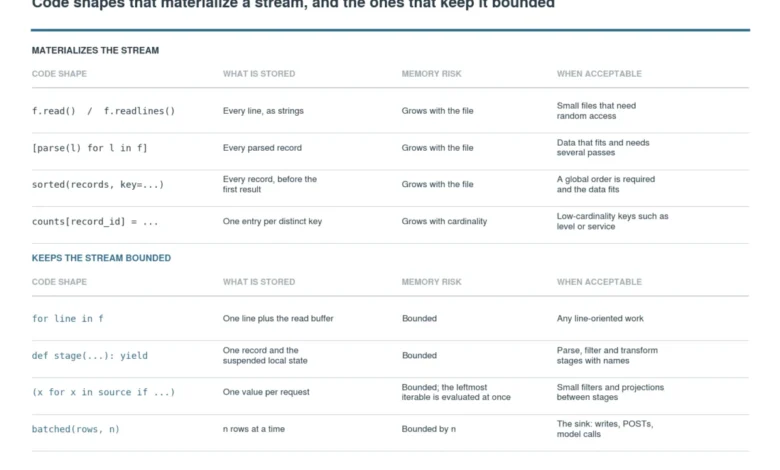
The efficacy of these pipelines depends on maintaining "laziness" throughout the entire path. A common pitfall is the accidental introduction of an eager step, such as calling list() or sorted() in the middle of a chain. Because sorted() requires knowledge of the entire dataset to determine the relative order of elements, it forces the entire stream into memory, effectively re-introducing the memory bug the generator was intended to solve.
To maintain efficiency, developers should utilize the itertools module, which provides tools designed for streaming. Functions such as islice, chain, and takewhile are designed to operate on iterators without forcing materialization. For example, islice allows developers to sample the first few rows of a massive dataset to verify formatting without touching the remainder of the file.
Industry Standards for Batching
While processing data one record at a time is memory-efficient, many downstream systems—such as databases or API endpoints—require data in batches. The introduction of itertools.batched() in Python 3.12 provides a standardized, high-performance way to handle this. By pulling exactly the number of records required for a batch and releasing them, developers can control their memory footprint with precision.

The rule of thumb for modern data engineering is "batch only at the boundary." This means the pipeline remains a pure stream until it reaches the final consumer (a database sink, a file writer, or an API client). By explicitly naming these boundary functions—such as write_batches()—the code becomes self-documenting, signaling to future maintainers exactly where the stream is intentionally terminated.
Measuring Success: Tracemalloc and Beyond
Validation is a critical component of any memory-conscious development cycle. Developers should not rely on intuition; they should use the tracemalloc library to measure peak memory consumption. Comparing an eager script to a streaming equivalent often reveals dramatic results: while an eager script might peak at several hundred megabytes for a moderate log file, a streaming version often maintains a peak usage of less than one megabyte, regardless of whether the input file is 100 MB or 100 GB.
It is important to note, however, that tracemalloc tracks only Python-level allocations. External factors, such as C-extension buffers, operating system file caching, and background processes, remain outside this view. Consequently, observing resident set size (RSS) via system tools like top or htop provides a necessary holistic perspective.
Broader Implications for Data Science and Machine Learning
The transition to streaming architectures is particularly relevant to the field of machine learning, where the "dataset doesn’t fit" problem is a frequent barrier to entry. Many preprocessing workflows for Large Language Model (LLM) fine-tuning or feature engineering involve processing massive JSONL or CSV files.
By applying these principles, developers can build robust pipelines that scale horizontally. Whether the objective is an event log analysis, a massive CSV export, or data ingestion for model training, the streaming pattern remains constant: read, parse, filter, and batch. This approach not only solves the immediate memory constraints of modern infrastructure but also leads to more modular, readable, and maintainable software. As data volumes continue to climb, the ability to process information without holding it in its entirety is no longer an advanced optimization; it is a fundamental requirement of professional software engineering. By ensuring that laziness is maintained throughout the entire data path, developers can build systems that remain stable under the pressure of production-scale traffic, ensuring that the next log rotation does not lead to the next system outage.