Multilingual Text Classification with Scikit-LLM and Multilingual Embeddings

The Evolution of Multilingual NLP
Historically, the machine learning community relied on machine translation (MT) as a preprocessing step to normalize multilingual data into a single, dominant language—usually English—before feeding it into a classification model. While this ensured compatibility, it introduced two major drawbacks: latency and information loss. Every translation pass added significant computational overhead, and the nuances of the original language—idioms, cultural context, and tone—were often stripped away, leading to a degradation in classification accuracy.
Alternatively, companies often opted to train individual models for every language supported by their services. While this preserved linguistic integrity, it created a scaling nightmare. A business operating in 20 languages would require the lifecycle management of 20 distinct models, each requiring its own training data, fine-tuning, monitoring, and version control.
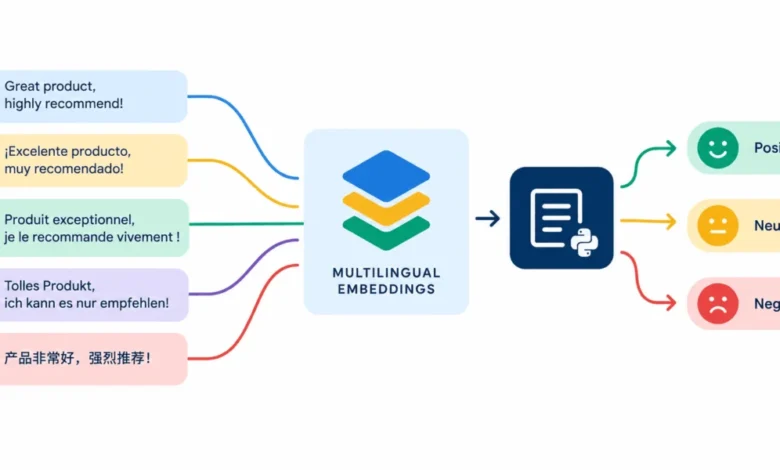
The emergence of multilingual embedding models marks a paradigm shift. These models act as sophisticated translators that do not convert text from one language to another; instead, they project all input text into a high-dimensional mathematical space. In this space, the semantic meaning of a sentence is preserved regardless of the syntax or vocabulary used. Consequently, a review stating "This product is fantastic" in English and its Spanish counterpart "¡Este producto es fantástico!" are mapped to nearly identical coordinate points.
Setting the Foundation: The Technical Stack
To implement a scalable multilingual pipeline, engineers are increasingly turning to open-source frameworks like Scikit-LLM, which bridges the gap between high-level LLM capabilities and the industry-standard scikit-learn ecosystem. By utilizing a local Ollama distribution, developers can bypass the cost and privacy concerns associated with proprietary API-based models.
The choice of the BGE-M3 (BAAI General Embedding) model is particularly notable in this architecture. BGE-M3 is specifically engineered to handle multi-linguality, multi-granularity, and multi-functionality. Unlike standard embedding models, it has been trained on massive datasets spanning over 100 languages, allowing it to capture subtle cross-lingual semantic relationships. By configuring Scikit-LLM to route through a local Ollama instance, developers can generate these high-quality vector representations locally, ensuring that sensitive user data never leaves the secure, private environment of the infrastructure.
Building the Pipeline: A Step-by-Step Implementation
The implementation process involves three primary phases: environment initialization, data orchestration, and pipeline assembly.
1. Infrastructure Configuration
The first step involves installing the necessary Python dependencies, including scikit-llm and the datasets library. Developers must ensure the system has access to the Ollama distribution, which serves as the local engine for model inference. By executing the ollama pull bge-m3 command, the system downloads the necessary weights to perform embedding generation locally.
2. Data Curation and Preprocessing
For the purposes of a robust classification system, the Amazon Multi-language Reviews dataset serves as a gold-standard benchmark. This dataset contains millions of customer reviews labeled on a 5-star scale. To prepare for training, developers should load a balanced subset of data. For instance, selecting 1,000 samples from both English and Spanish subsets ensures the model is exposed to an equitable distribution of linguistic inputs. Once loaded, the data must be shuffled randomly to ensure that the model does not learn language-specific patterns in isolation, but rather develops a generalized understanding of sentiment across the entire corpus.
3. The Scikit-Learn Integration
The pipeline is defined by a two-stage process. The first stage, the GPTVectorizer, transforms raw text into numerical embeddings using the BGE-M3 model. The second stage, a LogisticRegression classifier, takes these embeddings as input features to predict the corresponding star rating. This architecture is elegant in its simplicity: the heavy lifting of linguistic understanding is offloaded to the embedding model, while the classification itself is performed by a lightweight, high-performance algorithm.
Analysis of Performance and Results
Initial tests using this pipeline reveal an intriguing landscape. While the overall accuracy of such models is competitive, there is a distinct trend in the performance metrics. The model consistently demonstrates higher precision and recall for extreme ratings—specifically 1-star (0) and 5-star (4) reviews—compared to intermediate ratings (2 or 3 stars).
This phenomenon can be attributed to two primary factors. First, extreme ratings are often characterized by highly polarized vocabulary, which is easier for an embedding model to distinguish. Second, intermediate reviews often contain nuanced, ambiguous, or mixed sentiment (e.g., "The product arrived on time, but it was slightly smaller than expected"), which requires a more granular level of semantic understanding than a basic linear classifier might provide.
However, the implications of these results are profound. With an accuracy score of roughly 57% on a 5-class problem, the model is performing significantly better than a random baseline. More importantly, this performance is achieved without a single line of language-specific code. As the field matures, fine-tuning the downstream classifier or using more sophisticated models like Gradient Boosting or Random Forests—instead of Logistic Regression—is expected to push these metrics higher.
Broader Implications for Global Businesses
The transition to multilingual embedding-based pipelines has several critical implications for modern enterprises:
- Operational Efficiency: The ability to maintain a single model for all languages reduces the "model tax" on engineering teams. This allows businesses to expand into new markets without the need to hire local language experts for every new classification task.
- Data Privacy: By utilizing local LLM providers like Ollama, companies can maintain strict data sovereignty. There is no need to send customer feedback to third-party cloud APIs, mitigating risks associated with data leakage or compliance failures under regulations like the GDPR.
- Agility: A single-pipeline architecture allows for rapid iteration. An improvement in the embedding model—such as a transition from BGE-M3 to a more advanced iteration—automatically propagates across all supported languages, ensuring that the model remains cutting-edge without requiring a total rebuild of the application.
- Semantic Consistency: Because the model learns to associate meanings rather than words, it can handle variations in dialect, slang, and evolving terminology more gracefully than traditional keyword-based or translation-based systems.
Future Trajectories
The current methodology represents only the beginning of what is possible. As researchers continue to optimize the efficiency of LLMs, we expect to see smaller, faster, and more accurate models capable of running on edge devices. Furthermore, the integration of "few-shot learning" into these pipelines could allow for even higher performance with smaller, curated training sets.
In conclusion, the combination of multilingual LLM embeddings and the scikit-learn framework is a powerful tool for any organization seeking to understand their global user base. By moving away from language-specific silos and toward a unified, semantic-based approach, companies can build more resilient, scalable, and efficient AI systems. As the technology continues to evolve, the barrier to entry for multilingual NLP will continue to fall, democratizing the ability to analyze global data and derive actionable insights from a world that speaks in thousands of voices.