Google Rolls Out Immersive Explorations for Gemini Student Hub Giving Users a New Way of Exploring Topics Layer-by-Layer Through Interactive Visuals

Google has officially introduced a major visual and interactive learning feature to its artificial intelligence ecosystem, rolling out "Immersive Explorations" within the Gemini student hub. Designed to transform how students and lifelong learners engage with complex educational material, the new library replaces traditional, text-heavy reading formats with multi-layered, interactive graphics. By allowing users to click through distinct components of a complex subject—ranging from astronomical phenomena to cellular structures—Google aims to make abstract concepts more intuitive, accessible, and engaging for global learners.
The rollout follows an expanding series of educational updates from the technology giant, which has increasingly focused its Gemini AI infrastructure on addressing classroom challenges, personalized tutoring, and interactive digital pedagogy. As digital learning tools become standard fixtures in modern classrooms, features like Immersive Explorations represent a significant shift from static digital textbooks toward dynamic, AI-assisted visual discovery.
Transforming Education Through Layered Visual Learning
For decades, digital education tools have relied heavily on digitized textbooks, PDF documents, and web articles that require students to sift through dense walls of text to find conceptual explanations. Google’s newly launched Immersive Explorations addresses this friction by prioritizing visual hierarchy and interactive exploration.
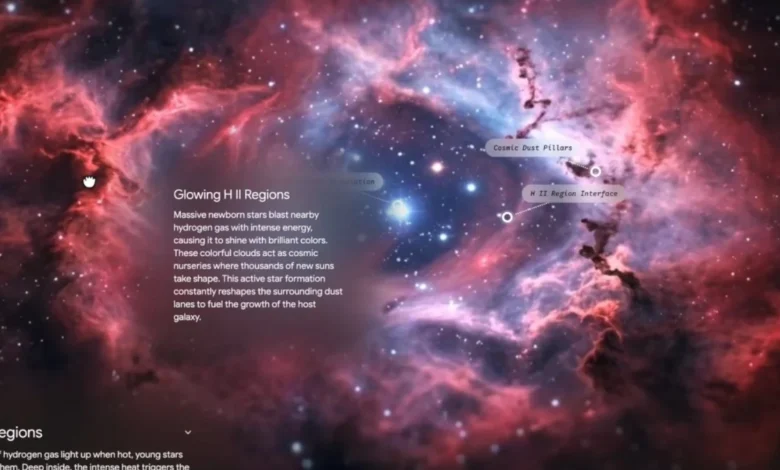
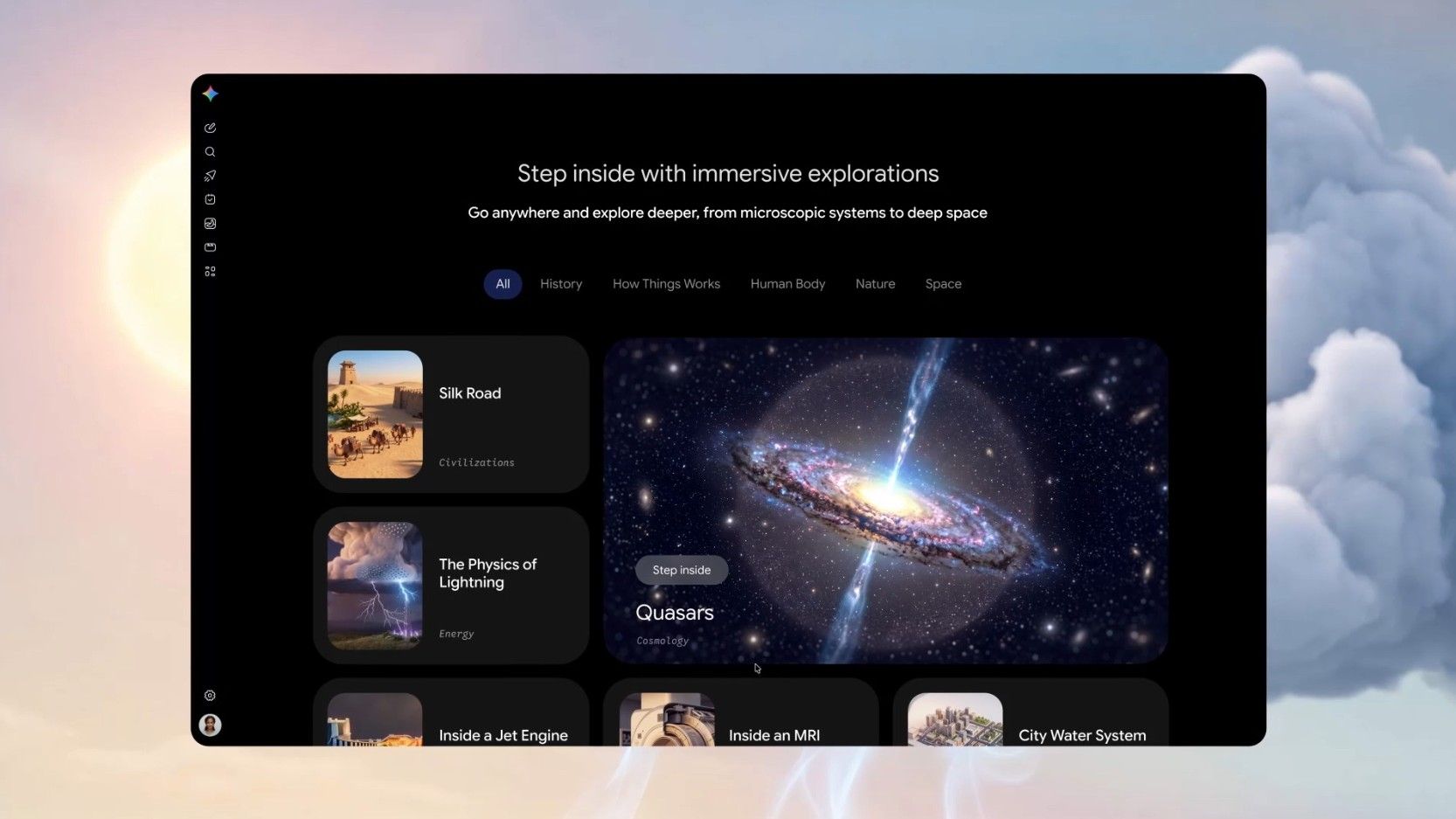
Within the Gemini student hub, users can access complex digital models that break down multifaceted subjects into individual, digestible layers. For instance, when studying astrophysics, a student examining a quasar is not merely presented with an image and a descriptive paragraph. Instead, they can zoom into specific features such as host galaxies or interstellar dust lanes. By clicking on individual segments of the visual rendering, users unlock targeted contextual information, allowing them to comprehend both the macro-level composition and the micro-level details of the subject matter.
This methodology extends across multiple academic disciplines available in the hub. Students can investigate the mechanics behind the physics of lightning, inspect the intricate molecular structures of plants, or explore prehistoric environments and dinosaurs. Each interactive graphic is accompanied by concise explanatory text, ensuring that visual engagement is directly reinforced by factual data.
Chronology and Deployment of Google’s Educational AI Suite
The launch of Immersive Explorations is part of a broader, sustained push by Google to integrate artificial intelligence deeply into the educational sector. Over the past few years, the company has methodically deployed specialized tools designed to assist both students and educators across various platforms.
The groundwork for these innovations was laid when Google introduced Gemini for teens using school-managed accounts. Recognizing the unique responsibilities required when deploying AI to minors, Google rolled out these accounts with strict safety guardrails, content filters, and integrated fact-checking capabilities to minimize hallucinations and ensure accuracy. This deployment spanned over 100 countries and was paired with the release of "Coach," a step-by-step interactive tool designed to reinforce student knowledge through quizzes and guided learning games.
Concurrently, Google turned its attention to educators via the Google Classroom ecosystem and NotebookLM (recently rebranded as Gemini Notebook). This integration allowed teachers to leverage AI to streamline administrative tasks, generate custom rubrics, and design tailored quizzes derived directly from their unique curricula. Furthermore, educators gained the ability to create specialized AI "experts"—customized chatbots trained on specific subject matter to provide targeted assistance to students who might be struggling with difficult concepts outside of regular classroom hours.
The debut of Immersive Explorations serves as the latest milestone in this timeline, shifting the focus from text-based tutoring and administrative assistance toward immersive, graphical comprehension.
Global Accessibility and Language Support
Recognizing the global demand for advanced educational technology, Google has made Immersive Explorations available immediately within the Gemini app and dedicated student web portal. However, the initial rollout includes specific geographic and linguistic parameters designed to ensure system stability and performance quality.
At launch, the feature is fully optimized and available in six primary languages: English, Indonesian, Hindi, Brazilian Portuguese, French, and Simplified Chinese. For users operating the Gemini platform in languages not currently supported in this initial wave, the system defaults to English until localized support and translated datasets can be integrated in subsequent software updates. This phased rollout strategy mirrors Google’s standard deployment practices for complex generative AI features, ensuring that localized educational standards and linguistic nuances are accurately addressed before broad international release.
Industry Implications and the Future of AI in Classrooms
The introduction of multi-layered, interactive AI tools carries significant implications for the future of digital pedagogy and textbook publishing. Traditional educational publishing houses have long dominated the creation of visual diagrams and anatomical models; however, generative AI-driven tools like Immersive Explorations introduce a level of on-demand customization and interactivity that static media cannot match.
Industry analysts note that as generative AI matures, the competitive advantage in educational technology is shifting from raw text generation to multimodal comprehension. By combining text, interactive 3D-style graphics, and guided step-by-step learning pathways, tech companies are attempting to address declining attention spans and diverse learning styles among modern students. Visual learners, who often struggle to retain information from linear text sources, stand to benefit significantly from spatial and layered breakdowns of complex data.
Nevertheless, the rapid integration of AI into education continues to prompt vital discussions among educators, policymakers, and technologists. Questions regarding data privacy, equitable access to high-speed internet-connected devices, and the necessity of maintaining critical thinking skills in an era of automated answers remain central to the ongoing debate. Google’s inclusion of guardrails, fact-checking mechanisms, and teacher-centric controls in its broader Gemini ecosystem reflects an institutional awareness of these concerns.
As Immersive Explorations gains traction among students and educators worldwide, its long-term success will likely be measured by its adoption rates in formal academic settings and its demonstrated impact on student comprehension and retention metrics. For now, Google has signaled a clear direction for the future of digital learning: one where complex scientific and historical concepts are no longer locked behind static pages, but are instead open to be unpacked, layer by interactive layer.