Sandboxing AI Agent Code Execution in Python: Containers, MicroVMs and Beyond

The rapid integration of Large Language Models (LLMs) into autonomous agent frameworks has fundamentally shifted the requirements for secure computing environments. As developers increasingly grant AI agents the capability to write and execute arbitrary code—ranging from data analysis scripts to complex system utilities—the risk surface has expanded significantly. Protecting the host infrastructure from malicious or errant code generated by an AI requires a robust, layered approach to sandboxing. By examining three distinct isolation tiers—limited subprocesses, hardened Docker containers, and Firecracker microVMs—developers can balance the competing demands of performance, portability, and security.
The Evolution of Agentic Security
The necessity for robust sandboxing is driven by the nature of modern agentic workflows. An AI agent, when equipped with a "code interpreter" tool, essentially acts as an automated software engineer. Without strict boundaries, a model hallucinating a library import or intentionally executing a malicious payload could potentially access local environment variables, sensitive API keys, or private filesystem data.
The industry has historically relied on virtualization and containerization to solve isolation challenges. However, the unique demands of AI agents—which often require short-lived, ephemeral, and frequently recycled environments—have necessitated a new architectural focus. According to recent technical audits from the Cloud Native Computing Foundation (CNCF), container breakout vulnerabilities, such as those identified in the runc ecosystem in late 2025, underscored the risks of sharing a host kernel across multiple execution instances. These events pushed the industry toward hardware-level isolation provided by microVMs.
Tier 1: The Subprocess Approach
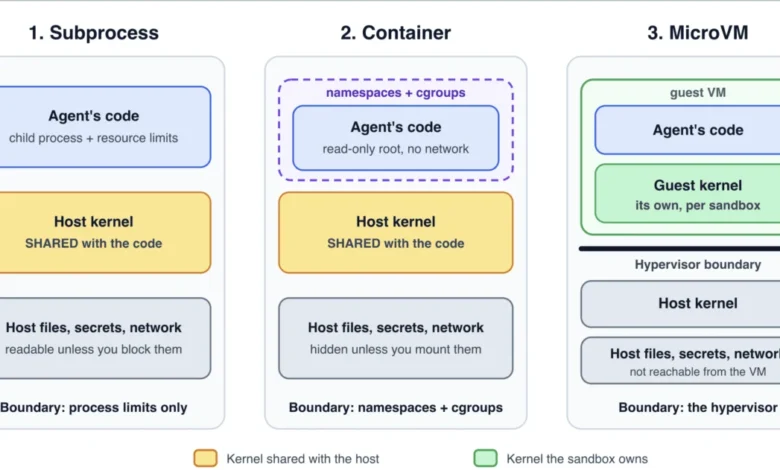
At the lowest level of isolation is the limited subprocess. This method involves spawning a child process from the host Python environment and applying constraints using Linux kernel features like cgroups and unshare.
This tier is characterized by its high performance. Because there is no overhead from a virtual machine or container runtime, startup latency is typically measured in single-digit milliseconds. However, its security profile is relatively weak. The subprocess continues to share the host’s kernel and, by default, its filesystem. Even with strict resource limits applied to CPU and memory, the shared kernel remains a single point of failure. This tier is strictly recommended for local development and testing of trusted, deterministic code rather than for production environments handling untrusted inputs.
Tier 2: Hardened Docker Containers
Docker containers provide a mid-tier solution by leveraging Linux namespaces and control groups to isolate processes. To make a container "agent-ready," developers must go beyond standard defaults. A hardened container configuration includes:
- Network Isolation: Setting the network mode to ‘none’ to prevent the agent from communicating with external Command and Control (C2) servers.
- Filesystem Restrictions: Running the container with a read-only root filesystem and mounting a small, volatile tmpfs for workspace operations.
- Capability Stripping: Dropping all Linux capabilities and enabling ‘no-new-privileges’ to prevent privilege escalation.
While these measures significantly reduce the attack surface, the fundamental limitation remains the shared kernel. A vulnerability in the host’s kernel can potentially be exploited to gain unauthorized access from the container. Despite this, containers offer a balance of security and portability that is sufficient for many enterprise applications where the host infrastructure is already hardened and strictly managed.
Tier 3: Firecracker MicroVMs
The current gold standard for agentic security is the microVM, specifically implementations using the Firecracker Virtual Machine Monitor (VMM). Firecracker, originally developed by AWS for Lambda and Fargate, allows for the creation of lightweight, fast-booting virtual machines that each run their own guest kernel.
The primary advantage of the microVM approach is the hardware-level boundary. Because the guest kernel is entirely separate from the host kernel, a compromised agent is trapped within a dedicated virtualized environment. Even in the event of a critical kernel exploit, the attacker remains confined to the virtual machine instance. Providers like E2B have built SDKs that wrap this technology, allowing developers to treat a full microVM as a simple, ephemeral Python object. While there is a slight performance penalty—usually adding between 100ms and 300ms to the startup time compared to a raw subprocess—the security gains are substantial.
Comparative Analysis of Performance and Security
To determine the optimal configuration, developers must evaluate the "Safety-Latency Trade-off." Empirical tests indicate that while subprocesses are nearly instantaneous (often under 10ms), they fail to stop sophisticated attacks like fork-bombing or unauthorized file access.
Hardened containers provide a "middle ground," blocking most standard exploits while maintaining startup times in the 50-100ms range, depending on image caching. MicroVMs, while the slowest to initialize, offer the most comprehensive protection. Recent data suggests that as hardware-assisted virtualization becomes more efficient, the latency gap between containers and microVMs is narrowing, making the latter an increasingly attractive choice for production-grade agentic platforms.
Strategic Implications for Infrastructure
The broader industry trend is moving toward the "Infrastructure-as-Policy" model. Leading cloud providers and container platforms have begun integrating microVMs directly into their services. In April 2026, Docker introduced integrated support for microVM-backed sandboxes, signaling a paradigm shift where the container runtime manages the virtualization layer automatically.
For organizations building AI agents, the implications are clear: security policies should be defined at the infrastructure level rather than relying on the model to "behave." An agent should never have the inherent permission to alter its own execution environment. By offloading the security boundary to the runtime (whether via Docker or a dedicated microVM provider), engineers can focus on the logic and efficacy of the agent, rather than constantly patching against potential escapes.
Conclusion and Best Practices
Selecting a sandbox tier requires a rigorous assessment of the trust level of the executed code.
- Use Subprocesses only for local, internal development where you have absolute control over the code being executed.
- Use Hardened Containers for production applications that require high throughput, provided the host environment is strictly isolated and the runtime is kept up-to-date with security patches.
- Use MicroVMs for multi-tenant applications, or any instance where the AI agent is processing data from external, untrusted sources.
As the sophistication of AI agents continues to grow, the infrastructure supporting them must evolve in parallel. The move toward hardware-isolated environments is not merely a trend; it is a necessary evolution to ensure that the promise of autonomous code execution does not come at the cost of system integrity. Developers are encouraged to build their agentic tools with a modular "backend" design, allowing them to swap between these three tiers as their security requirements and performance profiles change.