Closing the Critical Gap: Why Identity Context is the New Frontier for Modern Security Operations

Security teams today find themselves managing an unprecedented volume of data, alerts, and logs, yet they face a persistent, high-stakes blind spot: when a suspicious event is detected, analysts often lack the immediate, granular intelligence to answer the most fundamental questions of an investigation: who or what is behind the activity, and what is the extent of their potential reach? While modern Security Information and Event Management (SIEM) systems and Endpoint Detection and Response (EDR) tools are highly effective at flagging anomalies, they frequently operate in silos, detached from the underlying identity and access management (IAM) frameworks that govern an organization’s digital ecosystem.
This disconnect creates a significant operational vulnerability. A suspicious login, an unusual API call, or an AI agent interacting with sensitive systems may trigger an alert, but without the context of ownership, privilege levels, and system access rights, SOC analysts are forced to perform time-consuming manual cross-referencing. This latency is where manageable security incidents often escalate into catastrophic breaches.
The Evolution of the Identity-Centric Threat Landscape
The architectural complexity of modern enterprise environments has shifted the security perimeter from the network to the identity. In the past, security operations were focused on protecting the network edge and monitoring device behavior. Today, the landscape is defined by a massive proliferation of non-human identities. According to industry research from the Identity Defined Security Alliance (IDSA), approximately 90% of organizations have experienced an identity-related breach in the past year.
These identities include service accounts, automated workflows, API keys, and, increasingly, autonomous AI agents capable of executing tasks without human intervention. Unlike traditional user accounts, these machine identities often possess excessive, long-lived permissions that are rarely reviewed for necessity or security hygiene. When an attacker gains control of a machine identity, they effectively inherit the permissions of that account, allowing them to move laterally through the infrastructure undetected by traditional perimeter defenses.
Bridging the Silo: The IAM and SOC Divide
The fundamental friction in current security operations stems from the historical separation of IAM and Security Operations Center (SOC) teams. IAM teams are primarily concerned with governance, compliance, and the provisioning of access—essentially, the "who has access to what" equation. Conversely, SOC teams are focused on threat detection, response, and incident mitigation.
These two groups often operate on different platforms, utilize different datasets, and prioritize different metrics. For an IAM team, a high-privilege service account might be considered "properly configured" for its operational function. For a SOC analyst investigating an alert, that same account represents a high-value target that, if compromised, could grant an adversary unfettered access to sensitive data repositories.
When a breach occurs, this misalignment causes critical delays. If an analyst observes a compromised service account, they must determine if the activity is a benign automated process or an actor performing reconnaissance. If they block the identity, they risk disrupting critical production systems. If they wait for validation, they provide the adversary with the necessary time to escalate privileges or exfiltrate data. This "analysis paralysis" is the direct result of a lack of integrated identity context.
The Impact of Autonomous Systems and AI
The integration of generative AI and automated agents into enterprise operations has exponentially increased the complexity of this problem. AI agents often require broad, systemic permissions to function effectively, acting as high-speed, high-access nodes within the network. If these agents are not subject to strict identity lifecycle management, they become "dark assets" that can be exploited by threat actors.
Research indicates that the "blast radius"—the potential damage an attacker can inflict once they gain a foothold—has expanded significantly because of these interconnected machine identities. An attacker no longer needs to crack a password; they simply need to hijack an existing, legitimate session or API key that already possesses the necessary permissions to execute code or access data.
Enhancing Incident Response through Contextual Intelligence
To mitigate these risks, organizations are moving toward an identity-centric security model. This approach aims to unify identity intelligence with SIEM and EDR telemetry, providing analysts with a real-time, consolidated view of an incident.
A better SOC response is not defined by the volume of alerts, but by the quality of the information provided at the moment of detection. By integrating identity context, security platforms can automatically answer key questions:
- Who is the owner? Knowing the human or administrative owner of a compromised machine identity allows for immediate communication to verify if the action is legitimate.
- What is the blast radius? Mapping the permissions associated with a specific identity helps analysts determine exactly which systems are at risk.
- What is the risk posture? Understanding whether the identity has been recently reviewed or if it has been flagged for anomalous behavior in the past provides the context necessary for a prioritized, risk-based response.
Strategic Implications for Security Leadership
The transition to an identity-aware SOC requires more than just new software; it requires a structural shift in how security teams operate. Organizations are increasingly adopting shared metrics and cross-functional playbooks that align IAM and security operations.
In practice, this means:
- Automated Enrichment: Automatically tagging security alerts with identity attributes such as department, privilege level, and recent access history.
- Prioritization Models: Adjusting alert severity based on the identity’s risk score, rather than just the type of activity detected.
- Unified Escalation: Establishing protocols where IAM teams are immediately involved in incidents involving high-privilege service accounts or compromised AI agents.
The Path Forward: Education and Integration
As organizations continue to scale their digital infrastructure, the ability to rapidly distinguish between authorized automation and malicious activity will remain the defining challenge of the decade. Industry experts argue that the next generation of security operations must treat identity as the primary data point for all threat detection.
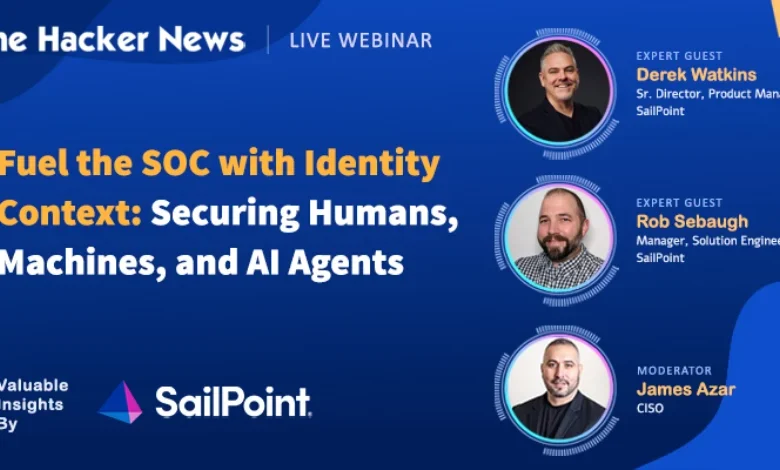
To help security teams navigate these challenges, experts are hosting a series of technical deep-dives and webinars, such as the upcoming session titled "Fuel the SOC with Identity Context: Securing Humans, Machines, and AI Agents." These initiatives aim to provide actionable frameworks for integrating IAM data into existing incident response workflows, allowing for faster, more confident decision-making.
The objective is clear: security teams must stop viewing identity and operations as distinct silos. By infusing the SOC with the context of who is doing what and why, organizations can transform their security posture from a reactive, alert-heavy environment into a proactive, intelligence-driven defense. The technology is available, but the success of the modern enterprise hinges on the ability to bridge the operational gap before the next identity-based threat emerges.
Related posts: