BYD Takes Aim at Rolls-Royce and Maybach with Ultra-Luxury Yangwang Altior Flagship EV Featuring Suicide Doors and Advanced Tech


The global automotive landscape is witnessing a seismic shift as Chinese manufacturing giant BYD prepares to redefine the pinnacle of ultra-luxury electric mobility. Positioned to compete directly against legendary marques like Rolls-Royce and Mercedes-Maybach, BYD’s elite subsidiary, Yangwang, has officially previewed its upcoming flagship executive sedan: the Yangwang Altior. Slated for an anticipated global debut in Dubai around November 5, this vehicle represents a bold departure from traditional volume-selling electric cars, aiming instead at the ultra-exclusive echelon of the global automotive market where price tags routinely cross the six-figure threshold.
As BYD steadily transitions from a dominant mass-market EV manufacturer into a multi-tiered automotive powerhouse, the Yangwang brand serves as the technological spearhead of the corporation. Offering a glimpse into the future of high-end automotive engineering, the Altior combines grandiose styling cues, such as dramatic suicide doors and a gemstone-inspired grille, with cutting-edge propulsion systems. Industry insiders and automotive analysts are closely monitoring the rollout, viewing the Altior not merely as a regional novelty, but as a deliberate challenge to the established European aristocracy of ultra-luxury transport.
Brand Hierarchy and Strategic Positioning
To understand the magnitude of the Yangwang Altior, one must examine the brand hierarchy that BYD has meticulously constructed. Yangwang occupies the absolute apex of the company’s portfolio, operating in a conceptual space analogous to BMW Group’s stewardship of Rolls-Royce or Mercedes-Benz’s oversight of Maybach. While BYD’s core lineup focuses on accessibility and volume—ranging from affordable urban hatchbacks to competitive family crossovers—Yangwang was engineered specifically to showcase the zenith of Chinese automotive research and development.
Prior to the introduction of the Altior, the Yangwang brand had already established a formidable reputation for mechanical and electronic excess. The portfolio includes the U7 executive sedan, the rugged U8 off-road SUV equipped with extreme amphibious capabilities, and the U9 electric supercar capable of challenging traditional European track titans. These vehicles have consistently served as testbeds for BYD’s most proprietary, disruptive technologies. Among these innovations are the quad-motor e4 platform capable of delivering upwards of 1,300 horsepower, the second-generation Blade Battery architecture paired with ultra-fast Flash Charging capabilities, and the DiSus-X intelligent body control system, which allows vehicles to execute localized maneuvers and maintain extraordinary ride stability over severely uneven terrain.
The Altior, however, pivots away from track performance or extreme off-roading, returning instead to the traditional tenets of ultra-luxury: supreme comfort, imposing presence, pristine craftsmanship, and avant-garde technology designed to pamper executive occupants.

Chronology and Teaser Campaign
The rollout of the Yangwang Altior has been executed through a carefully orchestrated digital and public relations campaign designed to maximize anticipation ahead of its official unveiling.
The timeline of the vehicle’s emergence underscores BYD’s calculated approach to global marketing:
- Late September: Automotive intelligence circles and early spy photographs capture a heavily disguised, massive executive sedan undergoing road testing. Observers immediately note its imposing proportions, comparing its silhouette directly to established benchmarks like the Mercedes-Benz Maybach S-Class and the Rolls-Royce Phantom. Simultaneously, executive interviews, including commentary from BYD executive vice president Stella Li, hint at broader corporate timelines regarding next-generation energy storage integration.
- Late October: BYD officially registers and announces the name of its new flagship sedan: the Yangwang Altior. This announcement transitions the vehicle from a speculative engineering project into a formalized market contender.
- Early November (Approaching): Yangwang general manager Hu Xiaoqing utilizes social media and official corporate channels to release preliminary design details. Hu confirms the integration of suicide doors swinging open nearly 90 degrees and debuts previews of the vehicle’s front fascia, highlighting a dot-matrix gemstone grille and crystal-inspired headlight arrays.
- November 5 (Anticipated): According to regional reports originating from outlets such as CarNewsChina and corroborated by industry insiders, BYD has targeted Dubai, United Arab Emirates, as the host city for the Altior’s global premiere, bypassing its domestic market in China for the initial international reveal.
This deliberate choice of location—unveiling a flagship Chinese luxury vehicle in the UAE—signals an aggressive intent to capture market share within the Middle East’s lucrative ultra-high-net-worth demographic, a traditional stronghold for European luxury marques.
Exterior Design and Engineering Specifications
In the ultra-luxury segment, visual gravitas is paramount. Measuring approximately 5,500 millimeters (216 inches) in length, the Yangwang Altior occupies a commanding physical footprint on the road. Its proportions mirror those of the most revered limousines in automotive history, providing an expansive cabin space optimized for rear-seat passengers.
The defining exterior characteristic confirmed by general manager Hu Xiaoqing is the incorporation of rear-hinged suicide doors. Historically associated with classic coachbuilding and ultra-exclusive modern flagships like the Rolls-Royce Phantom, these doors swing open nearly 90 degrees. This design choice not only creates a dramatic, theatrical entrance and exit for passengers, but also offers practical ergonomic advantages, allowing executives and dignitaries to step directly into and out of the cabin with minimal physical contortion.
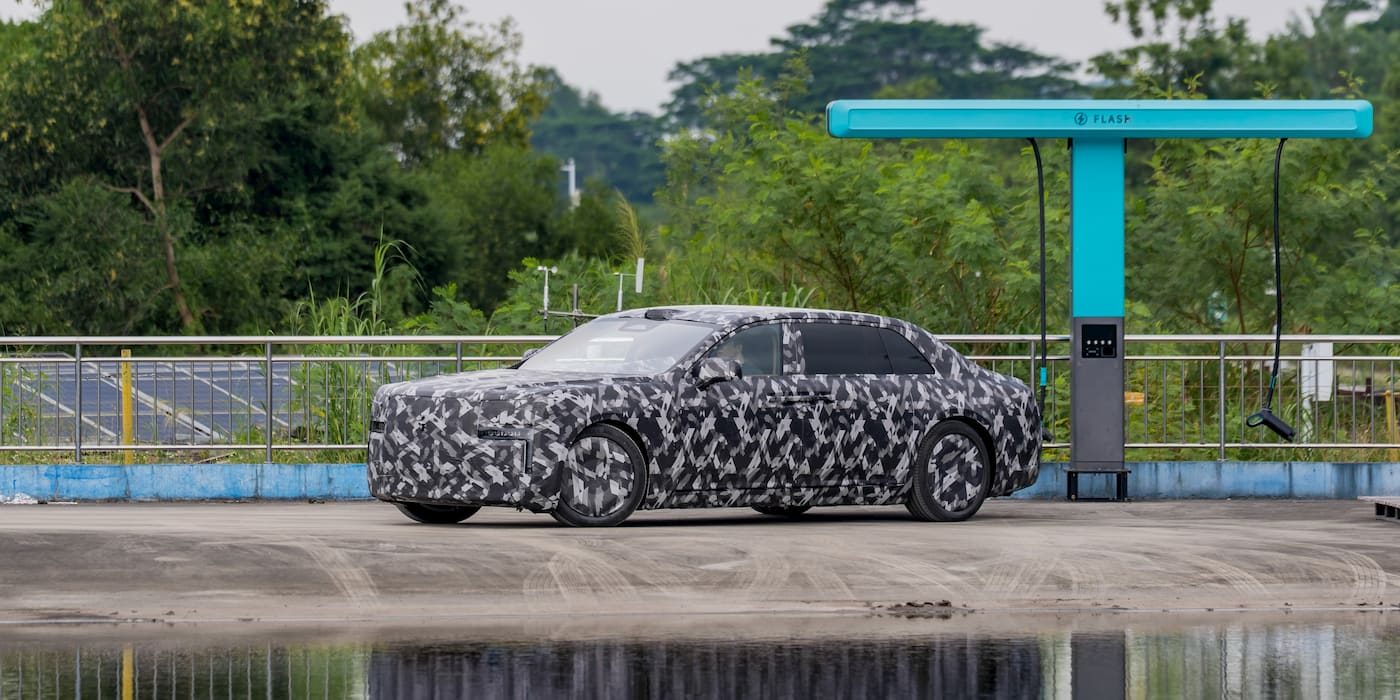
Complementing the structural silhouette is a striking front fascia. The Altior features a dot-matrix gemstone grille that radiates a sense of bespoke craftsmanship, flanked by crystal-inspired headlight clusters designed to refract light dynamically. Photographic evidence captured during early testing phases also places the vehicle in proximity to BYD Flash Charge infrastructure, suggesting that the Altior will leverage the latest iterations of the company’s proprietary charging ecosystem to minimize downtime.
Powertrain, Battery Technology, and Performance Rumors
While official technical datasheets have not been fully published by BYD, executive statements and industry leaks provide a comprehensive picture of what will propel the Yangwang Altior.
The vehicle is expected to utilize BYD’s advanced hardware architectures, potentially incorporating an evolution of the quad-motor e4 platform to deliver effortless, silent acceleration paired with supreme traction management. Furthermore, visual evidence of the vehicle utilizing BYD Flash Charge stations strongly indicates the integration of the second-generation Blade Battery system, which supports ultra-rapid replenishment times capable of recovering substantial driving range in mere minutes.
Perhaps the most significant technological speculation surrounding the Altior involves energy storage chemistry. Industry analysts and supply chain reports have heavily rumored that the Altior could serve as the commercial launchpad for BYD’s long-anticipated solid-state batteries. These rumors gain substantial credibility from previous statements made by executive vice president Stella Li, who noted during an interview with Carwow.es that BYD’s inaugural vehicle featuring solid-state battery technology is slated to debut within the 2027 window. If the Altior incorporates an early iteration or a transitional phase of solid-state architecture, it would grant the sedan unprecedented energy density, extended thermal stability, and dramatically enhanced driving ranges, positioning it years ahead of many legacy competitors struggling to commercialize similar chemistry.
Pricing Strategy and Market Positioning
The financial tier targeted by the Yangwang Altior represents uncharted territory for contemporary Chinese automotive manufacturing, though it aligns with the pricing strategies of elite global competitors.
Current market intelligence suggests that the Yangwang Altior will carry a starting price in the range of 2 million Chinese yuan, which translates to approximately $300,000 USD. This pricing structure reflects a significant escalation compared to existing models within the Yangwang ecosystem. For context, the brand’s current electric sedan, the U7, starts at 658,000 yuan (approximately $98,000 USD), while the extended U8L SUV currently holds the title of the brand’s highest-priced mass-produced vehicle, commanding a base price of 1.45 million yuan (approximately $217,000 USD).
By pricing the Altior at the 2 million yuan threshold, BYD is directly challenging the entry and mid-tier pricing of ultra-luxury internal combustion engine vehicles from Bentley, Rolls-Royce, and Mercedes-Maybach, while offering an entirely electrified alternative underpinned by state-of-the-art software and hardware.

Broader Industry Implications and Analysis
The introduction of the Yangwang Altior carries profound implications for the global automotive industry, serving as a case study in the maturation of the Chinese electric vehicle sector.
For decades, the ultra-luxury executive sedan market has been the exclusive domain of legacy European manufacturers whose brand equity was built upon a century of internal combustion engine refinement, royal patronage, and bespoke craftsmanship. Established marques relied on heritage as an insurmountable moat against upstart competitors. BYD’s strategy with Yangwang—and specifically the Altior—demonstrates that technological supremacy, software integration, and manufacturing scale can rapidly erode traditional brand moats.
By choosing Dubai as the global launchpad rather than Beijing or Shanghai, BYD is also signaling a mature globalization strategy. The Middle East represents a neutral, high-disposable-income battleground where brand loyalties are fluid and consumers actively seek the absolute newest expressions of luxury and technological prowess. If the Altior successfully captures market share from traditional European flagships in regions like the UAE, it will validate China’s capacity to compete not just in volume and affordability, but at the absolute pinnacle of global luxury craftsmanship.
As the automotive world awaits the official November 5 unveiling, the Yangwang Altior stands as a tangible manifestation of the ongoing transition in high-end mobility: a vehicle where traditional coachbuilding elements like suicide doors meet speculative solid-state energy storage and quad-motor intelligence, signaling that the future of ultra-luxury is undeniably electric.
Related posts: