Fast Charging vs Battery Longevity The Surprising Resilience of a High Mileage Tesla Model Y Taxi

The long-standing consensus among electric vehicle (EV) enthusiasts and automotive engineers has traditionally favored slow, AC home charging as the gold standard for preserving battery health. Conventional wisdom suggests that the intense heat and high current associated with Direct Current (DC) fast charging accelerate the chemical degradation of lithium-ion cells, leading to a premature loss of range and performance. However, a recent real-world case study involving a high-mileage Tesla Model Y used as a taxi in the United Kingdom is challenging these assumptions, providing evidence that modern battery management systems and specific cell chemistries may be far more resilient to rapid charging than previously believed.
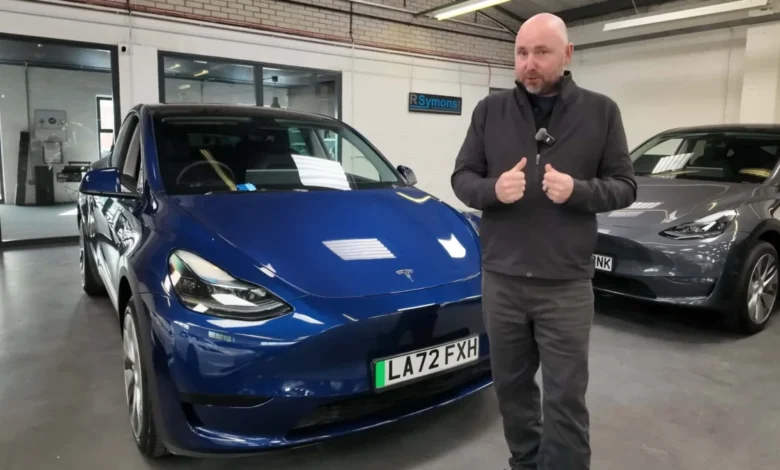
The vehicle in question, a pre-facelift Tesla Model Y, was recently examined by Richard Symons, a prominent electric vehicle specialist and YouTuber based in the UK. Having served as a commercial taxi, the vehicle accumulated significant mileage under conditions that are typically considered "worst-case scenarios" for battery longevity: near-exclusive reliance on public DC fast chargers. While most private owners utilize home charging for 80% to 90% of their energy needs, this Model Y’s operational history tells a different story, offering a unique data set for analyzing the impact of high-stress charging cycles.
Diagnostic Data and Charging History
To assess the true condition of the battery, Symons utilized the vehicle’s internal diagnostic port to extract granular data regarding its lifetime energy consumption. The findings were stark. The diagnostic logs revealed that the Model Y had consumed only 36 kilowatt-hours (kWh) of energy from AC home charging throughout its entire service life. In contrast, a staggering 32,684 kWh of energy had been delivered via DC fast chargers and the vehicle’s integrated regenerative braking system.
In a typical scenario involving older EV technology, such a heavy reliance on fast charging—where the battery is frequently subjected to high thermal loads—would be expected to result in significant "State of Health" (SoH) depletion. However, after subjecting the pack to multiple battery health assessments from various third-party providers and Tesla’s own onboard systems, the results indicated a State of Health of 92%. This means that after years of rigorous taxi service and tens of thousands of miles, the battery retained 92% of its original energy capacity compared to when it left the factory.
A Comparative Analysis: LFP vs. NMC Chemistries
The 92% health rating is particularly notable when compared to other high-mileage Teslas. A separate study conducted on a 2019 Tesla Model 3 Performance showed a 79% State of Health (21% degradation) over a similar mileage interval, despite that vehicle being charged predominantly at home via slow AC methods. The discrepancy between these two cases highlights a critical factor in EV longevity: battery chemistry.
The Model 3 Performance utilized a Nickel Manganese Cobalt (NMC) battery. NMC batteries are prized for their high energy density, allowing for longer driving ranges and higher power output in a lighter, more compact package. However, NMC chemistry is more sensitive to high states of charge and thermal stress. Manufacturers generally recommend that NMC-equipped vehicles be limited to an 80% charge for daily use to mitigate the stress on the cathode and anode materials.
The Model Y taxi, conversely, is equipped with a Lithium Iron Phosphate (LFP) battery pack. LFP batteries have gained significant traction in the industry, particularly in "Standard Range" or "Rear-Wheel Drive" models, due to several inherent advantages:
- Cycle Life: LFP cells can typically handle thousands more charge-discharge cycles than NMC cells before showing significant degradation.
- Thermal Stability: They are less prone to thermal runaway and can operate more safely at higher temperatures.
- Charge Tolerance: Unlike NMC batteries, LFP packs are recommended to be charged to 100% regularly. This helps the Battery Management System (BMS) calibrate the voltage and maintain an accurate range estimate without damaging the cells.
While LFP batteries are heavier and less energy-dense than their NMC counterparts—and can struggle with slower charging speeds in extreme cold—this case study suggests they are the superior choice for high-utilization commercial applications where frequent fast charging is unavoidable.
The Role of Thermal Management Systems
Beyond chemistry, the resilience of the Model Y battery can be attributed to Tesla’s advanced thermal management system. When an EV is connected to a DC fast charger, the battery’s internal resistance generates significant heat. If this heat is not dissipated, it can lead to "lithium plating" and the breakdown of the electrolyte, both of which permanently reduce capacity.
Tesla’s software-driven approach includes "pre-conditioning," a feature that warms or cools the battery to the optimal temperature before the vehicle even arrives at a Supercharger station. By ensuring the cells are at the ideal electrochemical state to receive a high-current charge, the system minimizes the physical stress on the battery. In the case of the UK taxi, the consistent use of the Supercharger network likely meant the battery was frequently managed by these automated thermal protocols, preventing the "spikes" in degradation often seen in vehicles with less sophisticated cooling systems.
Economic and Fleet Implications
The data from this ex-taxi has significant implications for the ride-hailing and logistics industries. As cities worldwide implement "Clean Air Zones" and "Zero-Emission Mandates," taxi fleets are under pressure to electrify. A primary concern for fleet operators has been the total cost of ownership (TCO), specifically the potential need for expensive battery replacements after three to five years of heavy use.
If an LFP-equipped EV can maintain 92% of its range after years of exclusive fast charging, the economic argument for electrification becomes much stronger. High residual values depend on battery health; a vehicle that retains over 90% of its capacity is a far more attractive asset on the used market than one with 75% or 80%. This suggests that for commercial operators who do not have access to overnight depot charging, the "fast-charge only" model is a viable operational strategy that does not necessarily destroy the vehicle’s long-term value.
The "Degradation Curve" Phenomenon
The study also reinforces observations made by battery researchers regarding the "degradation curve" of lithium-ion cells. Modern batteries typically experience a relatively sharp initial drop in capacity during the first 20,000 to 30,000 miles as the Solid Electrolyte Interphase (SEI) layer stabilizes on the anode. After this initial "settling" period, the rate of degradation tends to plateau, becoming much slower and more linear.
This explains why many EVs, including the Model Y taxi, appear to "level off" at around 90-92% health. Current data suggests that most modern EV batteries are likely to outlast the chassis of the car itself. With the average lifespan of a vehicle in the UK and US being roughly 12 to 15 years, a battery that loses only 1% of its health per year after the initial drop will still provide ample range for the vast majority of drivers well into the second decade of the vehicle’s life.
Industry Reactions and Future Outlook
The automotive industry is taking note of these real-world findings. Major manufacturers including Ford, Rivian, and Volkswagen have begun shifting their entry-level and commercial-grade vehicles to LFP chemistry. This shift is driven not only by the lower cost of iron and phosphate compared to nickel and cobalt but also by the growing body of evidence regarding LFP’s durability.
Experts in the field of battery diagnostics suggest that the narrative surrounding EV charging is shifting. While home charging remains the most convenient and cost-effective method for the average consumer, the "fear" of fast charging is increasingly viewed as a vestige of early EV technology. As long as the vehicle employs an active liquid-cooling system and a robust BMS, the detrimental effects of DC charging appear to be well-contained.
The story of the 92% health Model Y serves as a pivotal data point in the transition to electric mobility. It provides a counter-narrative to the skepticism regarding EV longevity and offers a blueprint for how high-utilization fleets can operate efficiently without sacrificing the integrity of their most expensive component. As battery technology continues to evolve with the advent of sodium-ion and solid-state batteries, the lessons learned from the resilience of current LFP cells will likely inform the next generation of transport infrastructure and vehicle design.