Inside Tesla’s Giga Texas Factory: How the Radical Unboxed Manufacturing Process Powers the Cybercab

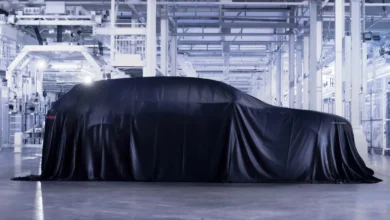
The automotive industry has operated under largely the same foundational manufacturing playbook for over a century, relying on linear assembly lines where a bare metal chassis slowly picks up mechanical parts, wiring harnesses, and interior components as it moves down an extended sequence of workstations. For years, Tesla has spoken publicly about its ambition to completely upend this paradigm through an innovative production strategy known as the "unboxed" process. Today, that vision is no longer theoretical. Tesla has successfully operationalized this manufacturing methodology at its sprawling Giga Texas facility to build the autonomous Cybercab, providing unprecedented insights into a system that engineering experts believe could permanently alter how the world builds automobiles.
Recent media footage released by the renowned engineering firm Munro & Associates offered a rare, behind-the-scenes look at the Cybercab’s active production line. Guided by Tesla Engineering Chief Lars Moravy and Cybercab Lead Eric Earley, the comprehensive factory tour detailed the inner workings of a streamlined, highly automated manufacturing ecosystem. The revealed processes demonstrate how Tesla has decoupled traditional vehicle assembly to eliminate bottlenecks, reduce factory footprints, and dramatically improve production efficiency.
The Genesis and Evolution of the Unboxed Process
The intellectual origins of Tesla’s unboxed manufacturing strategy trace back approximately six years. During the initial development phases of previous high-volume models, Tesla engineering teams faced persistent challenges when attempting to fully automate traditional vehicle designs. Rather than continuing to force automation onto a conventional architecture, leadership concluded that the underlying vehicle architecture itself was the primary obstacle to true manufacturing innovation.
In a conventional factory, workers and automated tools must frequently reach inside the confined spaces of a partially assembled car body to install components, restricting the speed and physical layout of the assembly line. Tesla’s unboxed process solves this limitation by dividing the vehicle into distinct, modular sub-assemblies—specifically the front, rear, sides, and floor sections. Each module is constructed and fully equipped on separate, parallel assembly tracks before converging at the final stage of production. This decentralized approach allows robotic systems and human operators to work on smaller, highly accessible components in an open environment, maximizing throughput and reducing cycle times. According to company disclosures, the Cybercab production line achieves an impressive automation rate of approximately 78 percent.
Anatomy of an Unboxed Vehicle Assembly
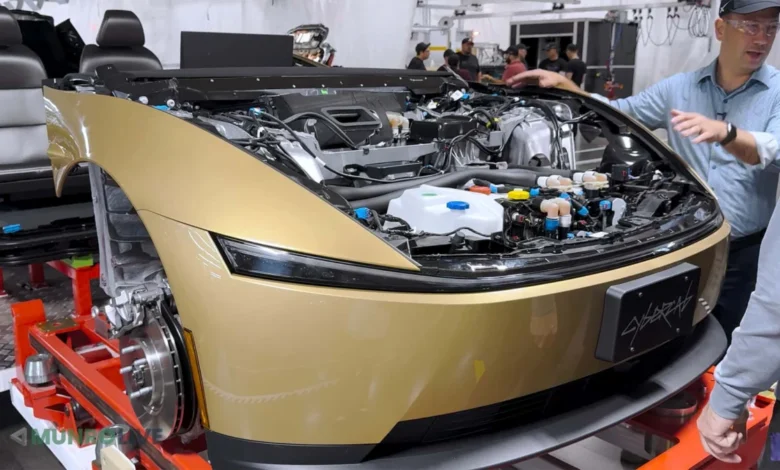
The physical architecture of the Cybercab is uniquely tailored to this modular philosophy. The vehicle’s front structural module, which carries roughly half of the car’s total parts and functional content, is assembled on a dedicated positioning pallet. Components such as the drive unit, suspension architecture, and thermal management hardware are installed directly onto the pallet, after which the front structural casting—pre-equipped with the vehicle dashboard—is lowered directly over them.
Concurrently, manufacturing teams assemble the vehicle’s side sections flat on specialized workstations. Overhead components are installed at ergonomic, comfortable working heights rather than overhead inside a cramped cabin shell. Meanwhile, essential interior elements like seats and carpeting are integrated directly into the structural battery pack, with the top cover of the battery functioning simultaneously as the cabin floor.

Once these independent modules are fully provisioned—complete with pre-routed wiring harnesses, fluid hoses, and electronic systems—they converge onto an automated framing line. Advanced robotic systems precisely position and permanently join the sections together.
The resulting vehicle then enters a significantly shortened final assembly line consisting of roughly 25 stations. By comparison, traditional high-volume vehicles like the Tesla Model Y require a final assembly line roughly five to ten times that length. In the Cybercab’s streamlined process, the wheels are installed at the penultimate station, and the vehicle officially stands on its own wheels as it rolls off the line near the final inspection zone. A substantial portion of the labor traditionally performed during final assembly is thus shifted upstream into the modular sub-assembly phases.
Rigorous Stage-by-Stage Quality Control
A vital advantage of the unboxed process lies in its decentralized quality assurance methodology. In a conventional linear assembly plant, complex sub-systems are frequently installed deep within a vehicle body, making the detection of a faulty component difficult and its removal labor-intensive.
Tesla’s modular strategy fundamentally alters this dynamic by enforcing rigorous testing at every stage of production. Individual components are evaluated before being incorporated into larger assemblies, and those sub-assemblies undergo comprehensive diagnostic testing before final integration. For example, when the front module arrives at the framing line, its onboard computers are already connected, and its electrical and thermal systems have been pre-validated. This staged verification drastically minimizes the probability of discovering manufacturing defects after structural integration, streamlining overall quality control and reducing rework rates.
Innovations in Surface Finishing and Paint Shop Elimination
One of the most capital-intensive, environmentally demanding, and space-consuming aspects of traditional automobile manufacturing is the automotive paint shop. Traditional assembly processes dictate that a vehicle body must be welded together first, subjected to electrocoating for corrosion protection, and then moved through extensive painting and curing ovens before interior components can be added.
The Cybercab bypasses this traditional bottleneck entirely. The vehicle’s exterior plastic panels are infused with distinct color pigments directly during the initial molding process, eliminating the need for a conventional liquid paint shop. Furthermore, while the structural steel side members receive traditional electrocoating for maximum structural integrity, the front and rear structural casting modules skip the process altogether.
While Tesla explored alternative surface treatments, including specialized adhesive films, the chosen color-infused molding approach delivers a durable, repairable finish. Tesla engineers confirm that surface scratches sustained during operation can be successfully repaired using techniques analogous to traditional automotive paint touch-ups. This mirrors similar innovations across the emerging EV landscape; for instance, other forward-thinking manufacturers have similarly explored unpainted, color-infused composite body panels to drastically simplify manufacturing logistics and lower production costs.

Broader Industry Context and Competitive Landscape
Tesla is not alone in recognizing the limitations of century-old assembly lines. Across the automotive sector, legacy manufacturers are aggressively rethinking vehicle architecture to remain competitive in an increasingly software-defined, cost-sensitive market.
Ford Motor Company, for instance, has invested heavily in developing a similar modular manufacturing framework for its next-generation Universal Electric Vehicle platform, which kicks off with an anticipated affordable electric pickup. Ford has publicly adopted the terminology of an "assembly tree" rather than a linear assembly line, emphasizing the parallel construction and convergence of major vehicle modules.
Economic Implications and Production Scalability
Despite the high efficiency of the Giga Texas unboxed line, Tesla executives note that the facility does not currently operate on a continuous daily schedule. This is largely a reflection of supply-demand dynamics and the deliberate pace of Tesla’s regulatory approvals and public deployment strategy for its autonomous ride-hailing fleet, rather than a technical limitation of the manufacturing process itself.
When operating at peak capacity, however, the dedicated Cybercab unboxed line is engineered to churn out approximately 125,000 vehicles annually. This localized efficiency is a crucial building block toward CEO Elon Musk’s ambitious long-term corporate targets. During recent earnings disclosures, leadership reiterated a goal of achieving 5 million annual vehicle deliveries by the year 2030—a figure that would more than double the company’s current output volume.
Outlook for Autonomous Mobility and Manufacturing
The successful execution of the unboxed process at Giga Texas represents a watershed moment for advanced manufacturing engineering. By proving that a vehicle can be constructed via modular convergence rather than linear accumulation, Tesla has established a blueprint that other automakers will likely study, adapt, and implement in the years ahead. As autonomous transportation models like the Cybercab transition from development phases to widespread commercial deployment, manufacturing innovations of this scale will play a definitive role in determining which companies successfully achieve both mass-market affordability and sustainable long-term profitability.