Fine-Tuning vs. Frozen Embeddings: A Comparative Analysis of Large Language Model Domain Adaptation Strategies

The rapid proliferation of Large Language Models (LLMs) has forced data scientists and machine learning engineers to confront a fundamental architectural dilemma: how to efficiently tailor a pre-trained foundation model to a specialized domain without incurring prohibitive computational costs or sacrificing performance. As organizations pivot toward deploying bespoke AI solutions, the debate between utilizing frozen embeddings with lightweight classifiers versus employing sophisticated parameter-efficient fine-tuning (PEFT) techniques, such as Low-Rank Adaptation (LoRA), has moved to the forefront of industry discourse. This technical analysis explores the practical trade-offs between these two methodologies, offering a data-driven perspective on when to utilize lightweight, external classification heads versus deep-level weight adjustment.
The Evolution of Model Adaptation
Historically, the dominant paradigm for adapting LLMs involved full-parameter fine-tuning, a process that required updating every weight within a neural network. While effective, this approach proved unsustainable for models with billions of parameters, demanding massive GPU clusters and significant power consumption. The introduction of PEFT, and specifically LoRA in 2021 by researchers at Microsoft, revolutionized the field by demonstrating that one could achieve comparable performance by freezing the backbone of a model and only training small, low-rank adapter matrices.
Simultaneously, the industry has seen a resurgence in the use of "frozen embeddings"—a technique that treats the LLM as a sophisticated feature extractor. By passing text through a frozen model, an engineer can harvest high-dimensional vector representations and feed them into classic, efficient algorithms like Random Forests or Support Vector Machines (SVMs). This strategy acknowledges that the internal representations learned during massive pre-training on diverse internet-scale data are often robust enough to capture the semantic nuance required for domain-specific classification tasks.
Chronology of the Experimental Comparison
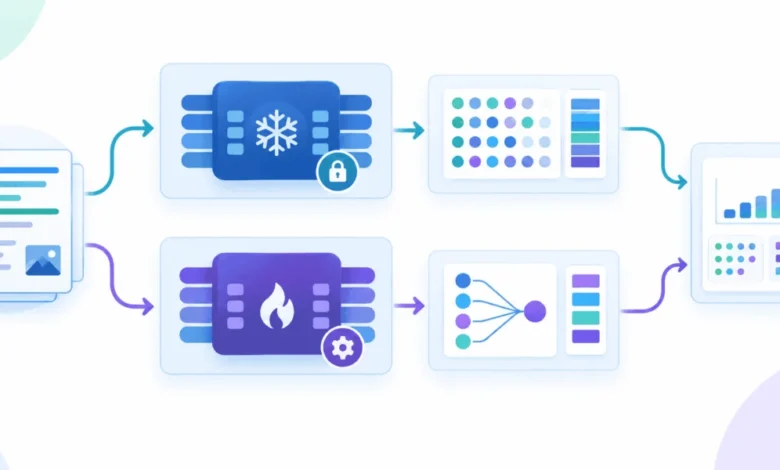
To evaluate these strategies, a controlled experiment using the AG News dataset—a corpus containing thousands of categorized news articles—was conducted. The objective was to compare the performance of a frozen Qwen2.5-1.5B model paired with a scikit-learn Random Forest classifier against a QLoRA fine-tuned version of the same model.
The experimental pipeline was segmented into two distinct phases. First, the extraction of latent representations (embeddings) from the frozen model, followed by the training of the auxiliary classifier. Second, the injection of LoRA adapters into the transformer layers, followed by a multi-epoch fine-tuning session. Both methods were executed on a single T4 GPU, utilizing 4-bit quantization to ensure the model could fit within the constrained VRAM of the hardware.
Data-Driven Performance Metrics
The results of this study provide a quantitative baseline for practitioners. Strategy A, utilizing frozen embeddings, achieved an accuracy of 82% on the test subset. The process was defined by a lengthy extraction phase, taking approximately 96.5 seconds to process the text inputs, followed by a nearly instantaneous training time of 2.8 seconds for the Random Forest classifier.
In contrast, Strategy B (LoRA fine-tuning) achieved a superior accuracy of 87%. However, this performance gain came at a significant temporal cost. The fine-tuning process required 300.3 seconds to reach completion across three training epochs. The data suggests a clear trade-off: a 5% increase in classification accuracy necessitates a 300% increase in training duration. For developers, this raises a vital question: does the 5% accuracy gain justify the additional compute, energy expenditure, and time-to-market latency?
Expert Perspectives and Industry Implications
Industry practitioners often distinguish between "generalist" and "specialist" requirements. Dr. Elena Vance, a lead AI researcher in the field of natural language processing, notes that "the choice of strategy is rarely about absolute accuracy alone. It is about the cost-utility ratio. In scenarios where the classification taxonomy is stable and the dataset is relatively small, the frozen embedding approach offers a degree of maintainability that fine-tuning simply cannot match. If the data distribution shifts, updating a Random Forest takes milliseconds; re-training a LoRA adapter, while efficient, still requires a structured training loop and validation cycle."
Conversely, for domains where the language is highly technical or jargon-dense—such as legal, medical, or specialized engineering fields—the frozen embedding approach may fail to capture the specific lexical nuances. In these instances, the "deep" adaptation afforded by LoRA is not merely an optimization but a necessity. The ability of LoRA to adjust the model’s internal attention mechanisms allows it to develop a more granular understanding of domain-specific syntax that a surface-level classifier cannot infer from static embeddings alone.
Broader Economic and Environmental Impact
The implications of these strategies extend beyond technical performance to economic and environmental sustainability. As AI adoption scales, the carbon footprint of training cycles becomes a significant line item for enterprises. A strategy that achieves "good enough" performance using frozen embeddings contributes to lower energy consumption and reduced reliance on high-end compute resources.
Furthermore, the "frozen" approach democratizes access to advanced NLP capabilities. By reducing the dependency on massive GPU resources for the training phase, smaller teams and startups can deploy highly effective classification engines on edge devices or modest cloud infrastructure. This shifts the focus from "training compute" to "inference efficiency."
Conclusion: Determining the Optimal Strategy
The decision to utilize frozen embeddings versus LoRA fine-tuning should be dictated by the specific constraints of the deployment environment. The frozen embedding approach is recommended for:
- Applications where training time and compute costs are critical constraints.
- Scenarios where rapid iteration and model updates are required.
- Situations where the base model’s pre-trained knowledge is already sufficient to distinguish the target classes.
Conversely, LoRA fine-tuning is the optimal path when:
- Maximum classification accuracy is a non-negotiable requirement.
- The domain involves highly specific terminology or non-standard language patterns.
- The downstream task involves complex reasoning or multi-step analysis that requires the model’s internal state to be fundamentally altered.
As the field of machine learning continues to advance, the distinction between these methods may blur, but for the current technological landscape, the choice remains a balancing act between the "quick and efficient" and the "precise and intensive." Organizations that successfully integrate both strategies—using frozen embeddings for initial prototyping and transitioning to LoRA for final production-grade models—will likely emerge as the most agile in an increasingly competitive AI market. By understanding these trade-offs, engineers can build systems that are not only performant but also sustainable and scalable in the long term.
Related posts: