AI Workflows vs. Agents: A Strategic Framework for Enterprise Architecture and Development

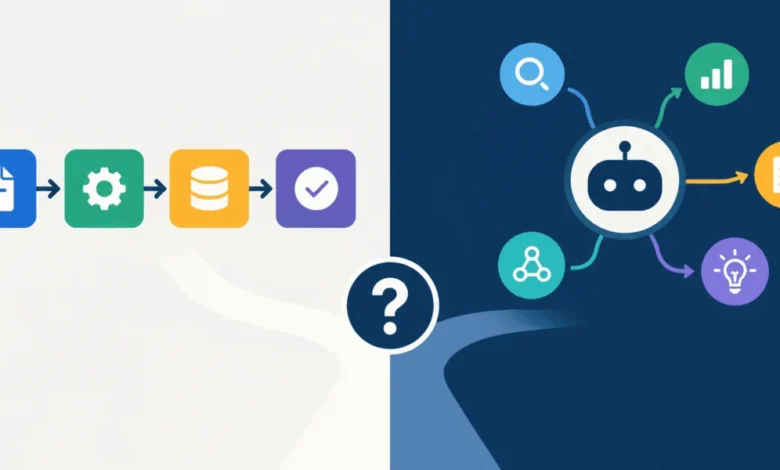
The rapid proliferation of large language models (LLMs) has introduced a linguistic crisis within the software engineering community, specifically regarding the classification of automated systems. As organizations rush to integrate generative AI into their operational stacks, the term "agent" has been applied indiscriminately to everything from rudimentary script-based automations to complex, autonomous reasoning engines. This ambiguity creates significant technical debt, as development teams often deploy over-engineered agentic architectures when a deterministic workflow would offer superior performance, lower latency, and reduced cost. To navigate this landscape, it is essential to distinguish between the rigid, design-time control of workflows and the dynamic, runtime-adaptive nature of autonomous agents.
The Evolution of Automation: From Pipelines to Agents
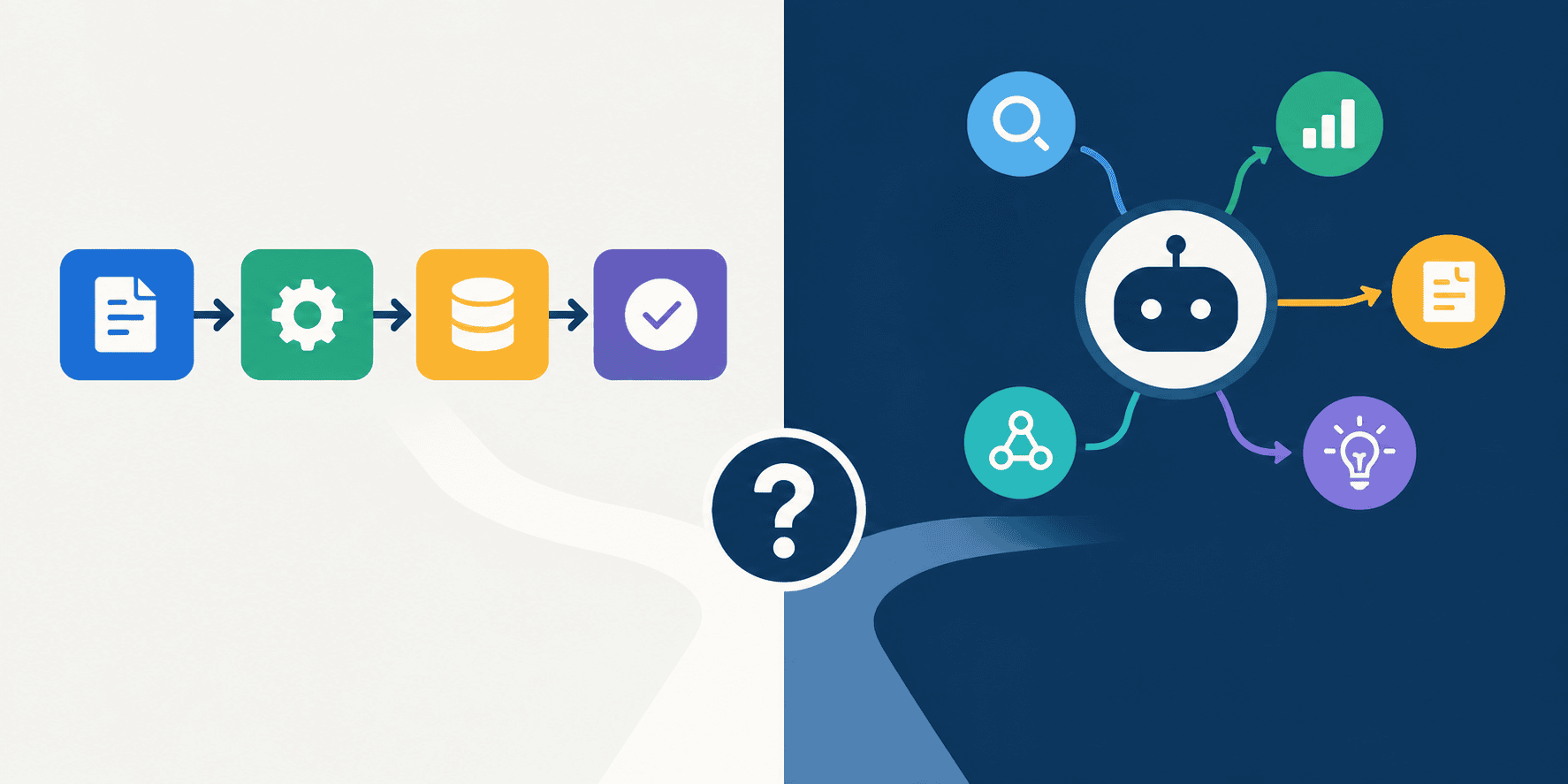
The historical trajectory of automation began with static, rule-based systems—the classic software pipelines—where developers explicitly defined every possible branch and exception. These systems, while reliable, struggled with unstructured data. The emergence of LLMs in the early 2020s allowed these pipelines to incorporate semantic intelligence, enabling the transition to "Hybrid Workflows." In these systems, an LLM acts as a component within a fixed, predefined chain. The developer retains control over the path, while the model manages the interpretation of data within specific nodes of that path.
In contrast, the concept of the "AI Agent" gained prominence in late 2023 and 2024 as researchers began to shift the control flow from the developer to the model. An agent is defined by its ability to perceive its environment, formulate a plan based on a goal, select tools to execute that plan, and observe the results to iterate or refine its strategy. While a workflow is a closed system with a predictable state machine, an agent is an open-ended system that generates its own state machine in real-time.
The Anatomy of a Workflow: Deterministic Design
A workflow, often categorized as a pipeline or a chain, is characterized by its reliance on a "design-time" control flow. When a system is built as a workflow, the developer assumes the role of an architect, mapping out the logic, stop conditions, and branching scenarios before the code is ever executed.
For instance, in a standardized customer refund process, the workflow is typically linear: the system ingests a request, uses an LLM to extract the order ID and reason for return, cross-references that data with a database of store policies, and triggers an approval or rejection signal. Even if the LLM is used at every step to process natural language, the decision-making structure remains rigid. If the system encounters a scenario not accounted for in the flowchart, it is programmed to stop or route to a human, rather than attempting to self-correct. This predictability is the hallmark of enterprise-grade software.
The Agentic Paradigm: Runtime Autonomy
The agentic model represents a fundamental departure from deterministic software. In an agentic system, the LLM functions as the "brain," possessing a set of tools (such as web search, code interpreters, or API callers) that it invokes at its own discretion. The control flow is not hardcoded; instead, the agent evaluates the current context against its long-term objective and decides which tool to utilize.
Consider a complex incident management scenario, such as diagnosing a sudden increase in checkout failures. A deterministic workflow would likely fail to cover the near-infinite permutations of technical errors. An agent, however, can be provided with a suite of diagnostic tools. It might first inspect recent deployment logs; observing no changes, it might then query database latency metrics. Upon discovering a regional spike in latency, it might then pivot to examine CDN status. The agent effectively "discovers" the diagnostic path during runtime, adjusting its strategy based on the observations made at each step. This capability is invaluable for high-entropy tasks but introduces significant risks, including "hallucinated" tool usage and infinite loops.
Practical Decision Matrix: A Strategic Checklist
Before committing resources to an agentic architecture, engineering leads should apply a rigorous diagnostic test: "Can a complete, logical flowchart of the process be drawn before the application is deployed?" If the answer is yes, the system should almost certainly be built as a workflow.
Industry analysis suggests that the over-adoption of agents is currently driving up operational costs by 30% to 50% for many firms, primarily due to the "token tax" of excessive reasoning cycles. To assist in this decision-making process, architectural teams are increasingly utilizing a five-point evaluation rubric:
- Process Predictability: Can the major steps be mapped in advance? If so, prioritize a workflow.
- Input Variability: Is the input structured enough to fit into a decision tree? If the inputs are highly varied and unpredictable, an agent may be required to handle the ambiguity.
- Resource Constraints: Agents consume significantly more tokens and compute time because they require multiple "thought" cycles per step. In high-volume, cost-sensitive environments, workflows are the standard.
- Compliance and Auditability: Regulated industries require deterministic, repeatable results. Agents, by their nature, are probabilistic and can take different paths to reach the same conclusion, which complicates compliance auditing.
- Iterative Improvement: Have you attempted a workflow with LLM-based classification? Most processes can be effectively automated by placing an LLM at the start of a traditional workflow to categorize intent, rather than deploying a full-scale agent.
Implications for Enterprise AI Strategy
The broader implication for the technology sector is a shift toward "constrained autonomy." The industry is moving away from the "agent-for-everything" hype cycle toward a more nuanced appreciation of deterministic systems. Recent performance data from large-scale enterprise deployments indicate that systems utilizing a hybrid approach—where a rigid, high-performance workflow handles 90% of requests and routes only the "edge cases" to an agent—achieve significantly higher reliability metrics than systems built entirely as autonomous agents.
Furthermore, the maintainability of these systems is a critical factor. Workflows are inherently easier to debug; a developer can examine the state machine, identify exactly where a step failed, and patch the logic. Debugging an agent, which may have chosen an irrational path due to a nuanced prompt interpretation, is significantly more labor-intensive and often requires "prompt engineering" fixes that do not guarantee the same error will not recur.
Conclusion: The Path Forward
The distinction between agents and workflows is not merely a semantic debate; it is a fundamental architectural decision that dictates the reliability, cost, and scalability of an AI application. While the concept of an autonomous agent is a significant milestone in machine learning, its utility is restricted to specific, open-ended problem domains. For the majority of business-critical applications, the most efficient and robust path remains a well-designed, deterministic workflow enriched with LLM judgment. As the industry matures, the focus will likely shift toward these hybrid architectures, balancing the creative power of generative models with the structural integrity of traditional software engineering. By choosing the right tool for the task, organizations can avoid the complexities of uncontrolled agentic behavior while still reaping the benefits of modern AI innovation.