Gemini 4 Argon Unlocks New Frontiers in Robotics and Physical AGI Through Advanced Multimodal Spatial Reasoning

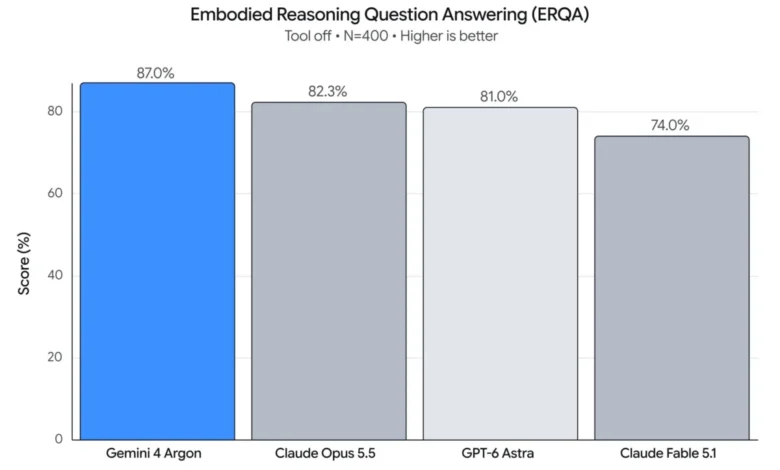
The artificial intelligence landscape has reached a significant milestone with the unveiling of Gemini 4 Argon, a general-purpose physical reasoning model designed to bridge the gap between digital cognition and physical actuation. Representing a fundamental leap forward in physical understanding, code generation, and visual-semantic reasoning, Argon unlocks complex workflows across the entire robotics stack. Demonstrating its advanced capabilities, the model achieves an 87% score on the Embodied Reasoning (ERQA) benchmark—a rigorous testing framework measuring spatial problem-solving in complex 3D environments—thereby outperforming every other frontier model currently available.
Background and Technological Evolution
The development of Gemini 4 Argon arrives at a critical juncture in the evolution of artificial intelligence and robotics. For years, vision-language models (VLMs) have excelled in digital domains, processing text, images, and audio with high proficiency. However, translating this digital intelligence into physical manipulation has historically proven challenging due to the complexities of contact physics, real-time spatial reasoning, and closed-loop control. Traditional robotics pipelines often require heavily engineered, task-specific heuristics that struggle to generalize in unstructured real-world environments.
Gemini 4 Argon addresses these limitations by natively reasoning over multi-view video, 3D geometry, contact mechanics, and proprioceptive telemetry. Rather than simply identifying objects in a scene, the model comprehends how those objects physically interact with agents and their surroundings. This capability represents a crucial step change toward physical Artificial General Intelligence (AGI), enabling artificial systems to operate seamlessly alongside humans in dynamic, unpredictable workspaces.
Real-World Robot Control and Manipulation
Argon’s versatile architecture allows for direct application across diverse robotic platforms, ranging from quadrupedal mobile manipulators to multi-axis industrial arms and humanoid systems. Its operational capacity spans four primary areas: robot control, real-to-simulation (Real2Sim) translation, deep physical understanding, and autonomous self-improvement.
In mobile manipulation tasks, Argon has been deployed to control Boston Dynamics Spot quadruped systems equipped with 12-degree-of-freedom legs and a 6-degree-of-freedom arm. In practical demonstrations, the model manages complex, multi-step procedures such as locating soda cans, utilizing a wrist-facing camera for close inspection, practicing tripod balance in MuJoCo digital twins, and precisely stepping on foot pedals to deposit waste into bins. This real-to-sim-to-real workflow ensures that physical maneuvers are thoroughly practiced and optimized in simulation before execution on physical hardware.
Similarly, in zero-shot control evaluations utilizing standard robotic arms, Argon reasons through visual coordinate harnesses and action primitives to manipulate objects like fallen mugs and crumpled napkins over multiple turns. By leveraging calibrated wrist cameras and projected 2-centimeter world coordinates, the model executes closed-loop corrections without prior task-specific training.
Bridging the Real-to-Simulation Divide
One of the most persistent bottlenecks in robotics research is the creation of accurate simulation environments that mirror real-world physics. Argon streamlines this process through advanced Real2Sim translation capabilities. By ingesting real robot teleoperation episodes or egocentric human video feeds, the model automatically constructs calibrated 3D scenes in MuJoCo.

When presented with human manipulation videos, Argon identifies task-relevant objects, replaces crude bounding boxes with compound convex-decomposed meshes for concave containers, and retargets human hand trajectories onto high-degree-of-freedom bimanual humanoids. This allows researchers to generate 500 Hz multi-view physics simulations that faithfully replicate real-world contact forces, friction, and inertia. Furthermore, developers can utilize Argon to translate rough hand-drawn pen-and-paper sketches into fully realized, GPU-accelerated simulation environments complete with whole-body balance and projectile trajectories.
Enhancing Data Quality and Physical Understanding
Beyond direct control and simulation, Argon functions as a sophisticated engine for hindsight labeling, data curation, and value function estimation. In complex bimanual tasks—such as folding paper into origami or performing intricate sorting operations—the model evaluates synchronized multi-camera feeds to generate multi-granularity hindsight annotations. It segments episodes into overarching goals, semantic subtasks, and atomic contact primitives while automatically identifying fumbles, pauses, and retries. This quality control mechanism allows for the automated reweighting of training data, directly improving the efficiency of behavior cloning algorithms.
Argon also demonstrates advanced deductive reasoning in classical physical puzzles. When tasked with solving the traditional 12-ball balance scale weight puzzle using a dual-arm Franka FR3 setup, the model builds the physics environment, programs a closed-loop vision-only solver, reads scale tilts via stereo pixel disparity, and successfully isolates the anomalous ball within three weighings.
Research Implications and Self-Improvement Frameworks
The implications of Gemini 4 Argon extend deeply into AI research methodology and autonomous self-improvement. By leveraging simulation environments generated from single overhead photographs, Argon can synthesize thousands of domain-randomized training episodes. In empirical testing, this synthetic data generation boosted a vision-language-action model’s real-world success rate from 56% to 75% while reducing task completion time from 35 seconds to 24 seconds.
Additionally, the model exhibits iterative self-improvement capabilities on hardware platforms. On visual pick-and-place tasks, Argon analyzes its own execution logs, diagnoses operational errors, refines its motion planning, and optimizes execution speed. In benchmark tests, the system successfully doubled its operational velocity while maintaining high placement accuracy.
Furthermore, Argon demonstrates the unprecedented ability to reproduce landmark robotics research papers from scratch. By reading academic manuscripts and accompanying codebases, the model ports complex physics models and closed-loop controllers—ranging from hierarchical locomotion frameworks to whole-body model predictive control—into self-contained MuJoCo WebAssembly browser labs, verifying their functionality through automated headless testing.
Industry Outlook and Future Trajectory
As Google rolls out Gemini 4 Argon across its developer platforms, industry analysts note that the model establishes a new benchmark for embodied AI. By integrating advanced perception, physics-based simulation, code generation, and closed-loop control into a unified architecture, Argon addresses many of the foundational challenges that have historically bottlenecked robotics commercialization.
While challenges remain in scaling these capabilities universally across highly unstructured and hazardous industrial environments, the empirical gains demonstrated by Argon—higher success rates, accelerated task completion, and automated simulation synthesis—signal a maturing paradigm in robotics. The transition from heavily scripted automation to autonomous, reasoning-driven physical agents continues to accelerate, bringing the broader scientific community closer to the realization of practical, deployment-ready physical AGI.