The act of creation, whether through the lens of a camera or the carefully chosen cadence of prose, presents a profound and often elusive challenge. For years, the question has lingered: is the demanding nature of writing more arduous than that of photography, or vice versa? While initial impressions might suggest a stark contrast, a deeper examination reveals a shared landscape of intellectual and emotional exertion, a constant negotiation with uncertainty and a relentless pursuit of meaning. This exploration delves into the intertwined nature of these two powerful mediums, examining their inherent difficulties, their surprising parallels, and the unique insights they offer into the human experience.
The Deliberate Pace of the Written Word
The writer’s struggle is often an internal one, a wrestling match with language itself. Mornings can be consumed by the meticulous placement of a single comma, a minute adjustment that reconfigures the entire emotional architecture of a sentence. This is not the fatigue of physical labor, but a deep, almost existential exhaustion that arises from prolonged self-scrutiny. It is the residue of hours spent constructing and deconstructing arguments, of battling the elusive perfect phrase, and of striving to articulate thoughts that often feel just beyond reach. This internal dialogue, this constant refinement, underscores the profound effort required to imbue words with clarity, resonance, and emotional weight. The process demands an almost surgical precision, where every punctuation mark, every word choice, carries significant implications for the overall message.
The Unpredictable Canvas of Street Photography
From an external perspective, street photography might appear as a more liberating pursuit. The image of a photographer with a camera slung over their shoulder, navigating the urban environment, can evoke a sense of escape and effortless artistry. However, this perception belies the inherent complexities of the medium. The street, in its raw and unscripted reality, serves as a constant reminder of the photographer’s limited control. The serendipitous appearance of subjects, the capricious dance of light and shadow, and the fleeting confluence of human interactions are all elements that lie beyond direct manipulation. The photographer is an observer, an arrivee, compelled to accept and interpret the unfolding narrative presented by the day. While some days may yield a torrent of compelling images, others can be marked by a profound visual silence, a testament to the capricious nature of inspiration and opportunity.
The question of planning in street photography is frequently raised. While meticulous preparation in terms of location scouting and understanding public spaces is certainly beneficial, the ultimate photographic moment remains largely a product of chance. The photographer can influence the context – choosing a specific time of day, a particular neighborhood – but the ephemeral essence of the photograph itself is intrinsically linked to the unpredictable currents of life. This reliance on chance, this constant negotiation with uncertainty, is precisely what sustains the photographer’s engagement over time.
A Case Study: The Rome Demonstration and the Search for Deeper Truths
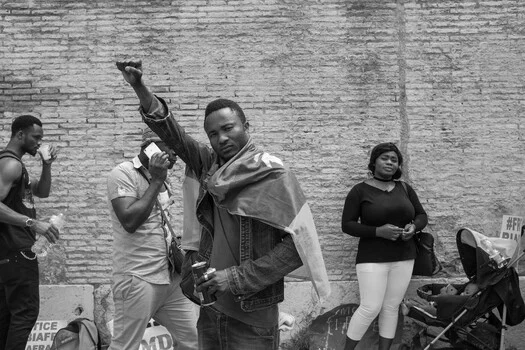
Consider the instance of a demonstration in Rome, years ago. The scene was a maelstrom of thousands of people, vibrant banners, uniformed police, impassioned speeches, and an overwhelming cacophony of sound. While many photographers might have focused on documenting the overt spectacle of the event, the photographer’s interest lay elsewhere. The objective was not merely to record the event, but to uncover its quieter, almost invisible dimensions. This involved seeking out gestures that resonated with the stillness of classical paintings, fleeting expressions that isolated a face for a fraction of a second, or compositional arrangements that could transform political chaos into visual order without distorting the fundamental truth of the situation. The pursuit of such nuanced perspectives requires a profound understanding of visual language and a keen ability to perceive the extraordinary within the ordinary. Resources like "The Well-Rounded Photographer: 8 Instructors Teach 8 Genres of Photography" offer valuable insights into developing such a broad visual vocabulary.
These are the moments that linger in memory, not for their dramatic impact, but for their ability to distill profound truths into ephemeral instants. They reveal the transient nature of existence and the fleeting manifestations of human emotion and experience.
The Subconscious Influence: Shaping Vision Through Accumulated Experience
The act of seeing, particularly through the photographic lens, is never a passive endeavor. Our visual perception is profoundly shaped by a lifetime of encountered images – admired photographs, impactful films, and evocative literature. These influences, though often unconscious, inform our instincts and subtly guide our decision-making processes. Originality, rather than being an absence of influence, emerges when these myriad impressions become so deeply integrated into our personal experience that they are no longer distinguishable from our own unique way of seeing. They cease to belong to others and become an intrinsic part of our vision.
The technical aspects of photography, such as mastering exposure and composition, are indeed crucial but are ultimately learnable skills. The more profound challenge lies in accepting that every photograph is an intimate revelation of the photographer’s inner world. Each frame serves as a confessional, not necessarily of explicit beliefs, but of what the photographer chooses to observe. This act of noticing, of selecting what commands attention, speaks volumes about the individual, often more eloquently than any artist’s statement.
The Reciprocal Nature of Writing and its Reception
The same holds true for writing. Upon publication, an article inevitably encounters a spectrum of reactions. Some readers will disagree, others will misunderstand, and many will skim and forget. This is an inherent aspect of creative expression, a willingness to expose oneself to the unpredictable currents of interpretation. The artist is not engaged in a battle with the external world, but rather in a more subtle, internal conflict. This is the struggle between the vision of what could be created and the reality of what is produced, between the imagined photograph and the captured image, between the intended sentence and the one that ultimately appears on the page. This inherent distance between intent and execution is a constant companion, and perhaps, a necessary one, driving further refinement and exploration.
The Synergy of Disciplines: A Path to Deeper Understanding
The enduring fascination with both writing and photography stems from their complementary nature. Photography offers an immediate, visceral connection to the world, capturing moments before language can intervene and alter perception. Writing, conversely, provides the space for reflection, for dissecting those captured experiences and understanding their underlying significance. One discipline captures the dynamism of life in motion, while the other allows for a deliberate engagement with its aftermath. Together, they transcend mere professional pursuits, evolving into profound methods of paying attention to the world.
While acknowledgments of photographic work are always appreciated, a reader’s statement about a paragraph’s lasting impact, its ability to evoke forgotten aspects of self, resonates on a different, deeper level. This may be rooted in a lifelong affinity for words, a feeling of returning to a foundational element of personal expression.
Ultimately, the attempt to delineate these two creative endeavors becomes futile. They are inextricably linked, integral components of a singular process that leads to the formation of identity. Whether traversing the urban landscape with a camera or sitting in solitary contemplation before a blank page, the fundamental act remains the same: an endeavor to comprehend why certain moments hold an indelible grip on our consciousness, and the aspiration to imbue those moments with a form that might resonate with others. The photographs accompanying this essay, capturing a demonstration by members of the Biafran community in Rome, serve as a powerful testament to this principle. These images, devoid of explicit sentences, encapsulate the very essence of the discourse presented here: the inherent uncertainty of observation, the ceaseless quest for order within chaos, and the acute awareness that each meaningful frame exists for but an ephemeral instant. In essence, these photographs are the essay, articulated before the words took shape.