Asus Googlebook shows off a big trackpad and plenty of ports in leaked images [Gallery]

Design Specifications and Hardware Layout
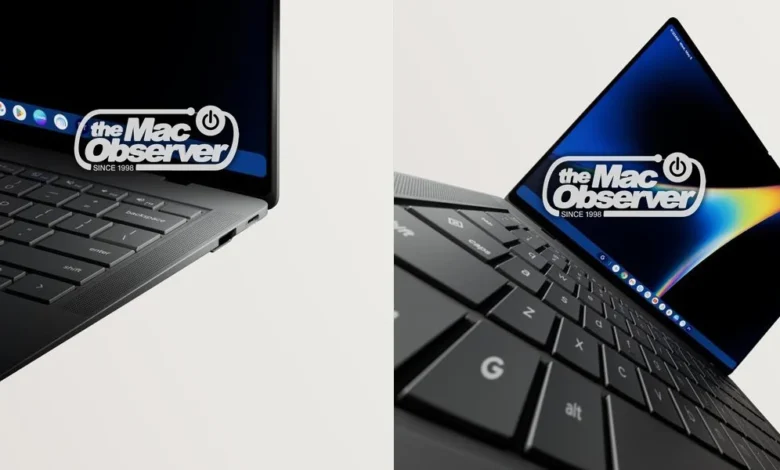
The leaked imagery reveals a chassis that balances modern design trends with legacy utility. One of the most prominent features identified in the new photos is the selection of ports. The device appears to be equipped with at least two USB-C ports, suggesting support for modern charging standards and high-speed data transfer, alongside a pair of USB-A ports. The inclusion of legacy USB-A ports is a notable design choice, as many manufacturers have pivoted entirely to USB-C, effectively forcing users into dongle-dependent workflows. By maintaining these ports, Asus is likely targeting productivity-focused users who continue to rely on external peripherals like mice, keyboards, or legacy storage drives.
![Asus Googlebook shows off a big trackpad and plenty of ports in leaked images [Gallery]](https://9to5google.com/wp-content/uploads/sites/4/2026/09/asus-googlebook-leak-6.jpg?quality=82&strip=all&w=1200)
The visual inspection of the device also highlights a substantial trackpad, which appears to occupy a significant portion of the palm rest area. This design decision often correlates with a high-precision glass surface, typically found in high-end laptops, meant to facilitate complex gesture controls and multi-touch navigation. The keyboard deck, which looks to be of a standard chiclet-style layout, appears to offer a tactile typing experience with sufficient key travel, avoiding the ultra-shallow feel of some competing ultrabooks. Additionally, a dedicated fingerprint sensor is visible, pointing toward an emphasis on biometric security for both local logins and enterprise-grade authentication.
Perhaps the most unique design flourish is the presence of an external lightbar on the lid. While such features are frequently associated with gaming hardware—specifically from Asus’s ROG line—its integration here suggests that the Googlebook may occupy a niche that bridges the gap between a high-end workstation and a consumer lifestyle device. The display bezels appear thin, with the screen extending close to the corners, providing an immersive viewing experience that aligns with current industry standards for premium displays.
![Asus Googlebook shows off a big trackpad and plenty of ports in leaked images [Gallery]](https://9to5google.com/wp-content/uploads/sites/4/2026/09/asus-googlebook-leak-3.jpg?quality=82&strip=all)
The Integration of the Dedicated G-Key
Beyond the external chassis, the keyboard layout features a dedicated "G" key. Positioned in the space typically occupied by the Windows key on traditional PCs or the Command key on Apple’s MacBook lineup, this button represents a significant departure from standard hardware paradigms. While official software mappings have not been disclosed, it is reasonable to infer that this key will serve as a system-wide trigger for Google Assistant, a quick-launch shortcut for Google’s suite of productivity applications, or a context-sensitive command hub for the underlying operating system.
The presence of an active cooling fan is another critical detail confirmed by the new imagery. Unlike many fanless laptops that prioritize silence at the expense of sustained performance, the inclusion of an active thermal solution suggests that the Googlebook is designed to handle more demanding workloads, such as local AI processing, software development, or complex multitasking, which typically generate sustained heat.
![Asus Googlebook shows off a big trackpad and plenty of ports in leaked images [Gallery]](https://9to5google.com/wp-content/uploads/sites/4/2026/09/asus-googlebook-leak-4.jpg?quality=82&strip=all)
Timeline of the Googlebook Development
The journey of the Googlebook has been marked by a series of controlled leaks and strategic disclosures. The following timeline outlines the evolution of the project:
- August 4, 2026: Initial reports surfaced providing the first concrete look at the device, confirming that Asus was the manufacturing partner for this project.
- Late August 2026: Rumors regarding the technical specifications began to circulate, focusing on the potential integration of custom silicon and advanced thermal management.
- September 2026: High-resolution leaks provided by The Mac Observer revealed the final industrial design, including port selection and the unique "G" key configuration.
- Late September 2026: Google officially confirmed that the pre-order window for the device will commence next week, marking the transition from the rumor phase to commercial availability.
Context and Market Strategy
The partnership between Google and Asus is not new, but the "Googlebook" branding suggests a shift in strategy. Historically, Google has utilized the Chromebook moniker for its budget-to-mid-range education and consumer laptops. By branding this device as a "Googlebook," the company appears to be distancing this specific hardware from the lower-end perception often associated with the Chromebook ecosystem.
![Asus Googlebook shows off a big trackpad and plenty of ports in leaked images [Gallery]](https://9to5google.com/wp-content/uploads/sites/4/2026/09/asus-googlebook-leak-5.jpg?quality=82&strip=all)
This move mirrors the strategy seen in the smartphone market with the Pixel line. By controlling the hardware-software vertical integration, Google aims to provide a more cohesive user experience. The inclusion of high-quality materials and a more robust internal cooling system suggests that Google is targeting the professional market—specifically power users who have previously gravitated toward Windows workstations or macOS.
Implications for the Laptop Market
The introduction of the Googlebook poses several questions regarding the future of the operating system landscape. If the device runs a version of ChromeOS that is more heavily integrated with local processing—made possible by the hardware features leaked—it could threaten the market share of traditional Windows laptops in the enterprise sector.
![Asus Googlebook shows off a big trackpad and plenty of ports in leaked images [Gallery]](https://9to5google.com/wp-content/uploads/sites/4/2026/09/asus-googlebook-leak-2.jpg?quality=82&strip=all)
Furthermore, the "G" key signifies a desire to create a proprietary hardware-software ecosystem. Just as Apple utilizes the Command key for system-level operations that are deeply integrated into macOS, Google’s dedication of a physical key to its own branding indicates a commitment to a unified user interface. If this hardware proves successful, it may compel other manufacturers to adopt similar custom keys, potentially standardizing a new category of "Google-first" hardware.
Analytical Perspective: The Challenge of Performance
While the hardware looks promising, the success of the Googlebook will ultimately rest on its software capabilities. A machine with an active cooling fan and a high-performance keyboard is only as good as the software it runs. If the operating system remains limited to web-based applications, the hardware may be perceived as over-engineered. However, if the device is designed to support more robust local applications, containerized environments, or advanced AI-driven features, it could redefine the expectations for what a non-Windows, non-macOS laptop can achieve.
![Asus Googlebook shows off a big trackpad and plenty of ports in leaked images [Gallery]](https://9to5google.com/wp-content/uploads/sites/4/2026/09/asus-googlebook-leak-1.jpg?quality=82&strip=all)
The cooling system is particularly telling. Modern ultrabooks often struggle with thermal throttling, which degrades performance during long tasks. By opting for a fan, Asus and Google are signaling that they intend for this machine to be a reliable workhorse. This puts the device in direct competition with high-end business laptops like the Dell XPS series or the Lenovo ThinkPad line.
Conclusion and Looking Forward
As the pre-order date approaches, the industry is closely watching how Google will price the device. To compete effectively with established giants, the Googlebook must offer a compelling value proposition that balances its premium build quality with a price point that justifies the transition for power users currently committed to legacy platforms.
![Asus Googlebook shows off a big trackpad and plenty of ports in leaked images [Gallery]](https://9to5google.com/wp-content/themes/ninetofive/dist/images/google-preferred-source-badge-dark.png)
With official details set to arrive within the coming days, the market will soon know whether the hardware’s impressive aesthetics and unique feature set are matched by the performance and software utility necessary to disrupt the current laptop hierarchy. For now, the leaked images confirm that the Googlebook is a serious attempt at a flagship-grade computing experience, marking a pivotal moment in the evolution of Google’s hardware ambitions.