The Engineering Marvel Behind Sony’s New Telephoto Lenses: Inside the FE 400mm and FE 600mm GM OSS Twins


In the competitive landscape of modern digital imaging, optical manufacturers face constant pressure to deliver higher performance, reduced weight, and greater versatility without escalating research and development expenditures to unsustainable levels. Sony’s introduction of the FE 400mm f/4.5 GM OSS and the FE 600mm f/6.3 GM OSS lenses represents a masterclass in efficient optical engineering and manufacturing economics. At first glance, these two super-telephoto prime lenses appear to be separate developments tailored for distinct wildlife and sports photography niches. However, a deeper examination of their internal anatomy reveals that Sony has leveraged shared architectural design to an unprecedented degree, utilizing nearly identical optical foundations to produce two distinct focal-length offerings.
Striking Physical and Operational Parallels
The visual and physical similarities between the Sony FE 400mm f/4.5 GM OSS and the FE 600mm f/6.3 GM OSS extend far beyond surface aesthetics. When placed side by side, the lenses share a remarkably uniform design language, mirroring the signature build quality and ergonomics associated with Sony’s elite G Master (GM) lineup.
Quantitatively, the physical disparities are almost negligible. The weight differential between the two models is a mere single gram—equivalent to the mass of a standard paper clip, a single dollar bill, or a minor pinch of salt. Furthermore, the longer 600mm f/6.3 variant stretches out physically by less than an inch compared to its 400mm counterpart.
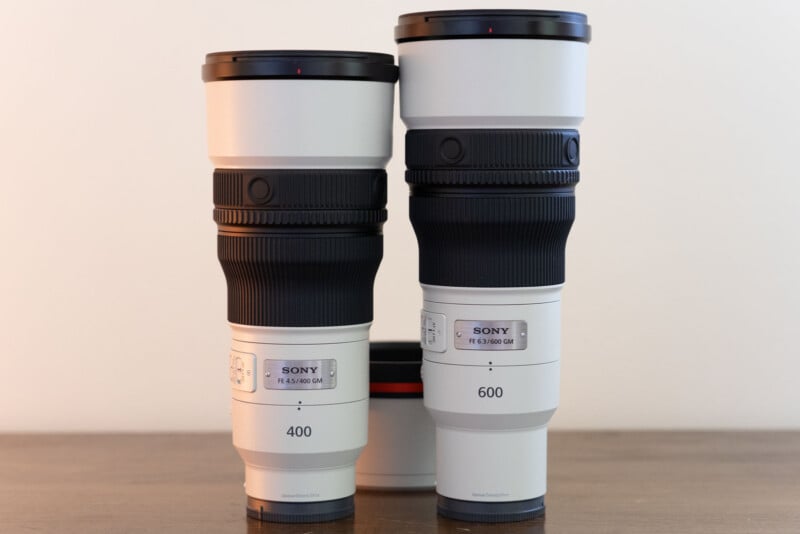
Operational parity matches this structural symmetry. Both lenses integrate the same advanced autofocus motor systems, ensuring rapid, silent, and highly accurate subject tracking essential for fast-paced action and wildlife documentation. They share identical minimum focusing distances, ensuring that macro-like close-ups of flora and fauna remain equally accessible on either barrel. Additionally, users will find the same physical control layouts on-barrel, identical levels of weather-resistant sealing against dust and moisture, and virtually indistinguishable high-tier optical sharpness across the frame. For the end-user in the field, handling characteristics remain consistent, removing the learning curve typically associated with switching between different focal lengths.
Unpacking the Internal Architecture: Fraternal Optical Twins
While external ergonomics provide a seamless user experience, the true innovation lies hidden within the lens barrels. Optical design in super-telephoto lenses normally requires bespoke engineering for every focal length to manage chromatic aberration, field curvature, and light transmission effectively. Sony, however, adopted a modular approach for roughly half of the optical train in these two models.

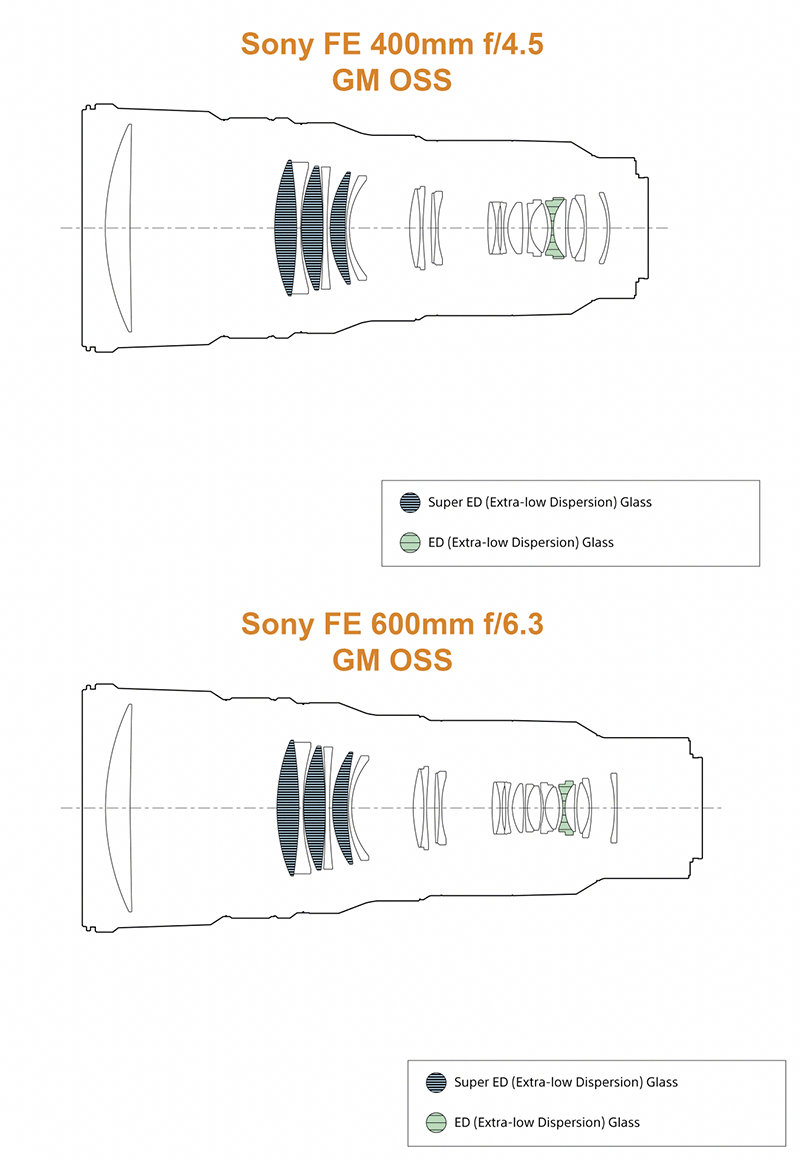
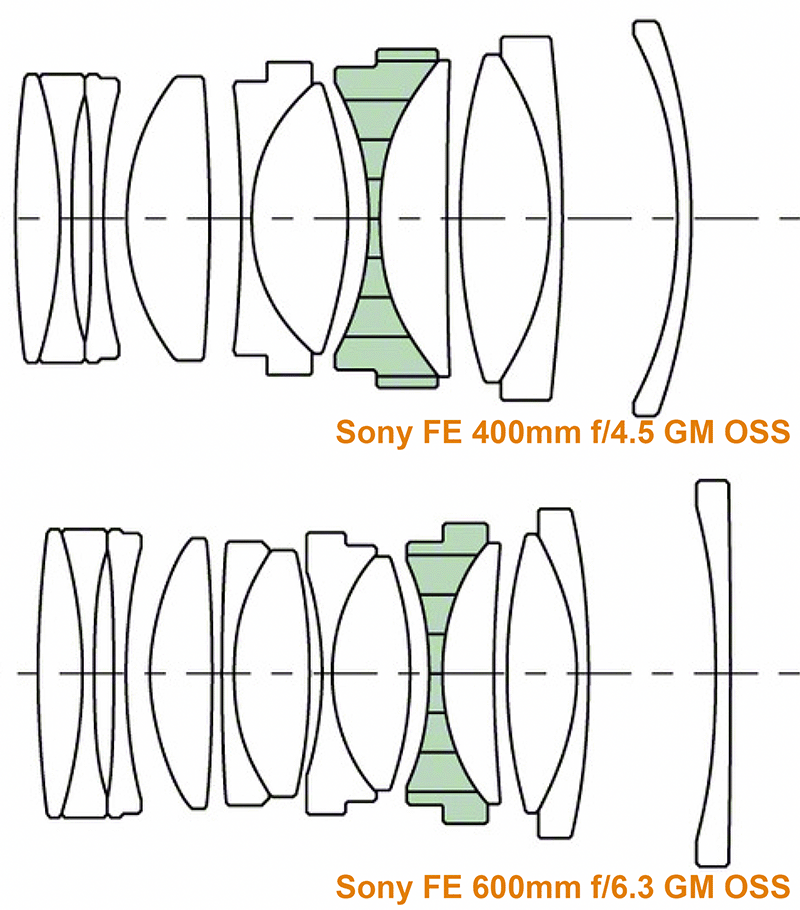
From the single large front element extending backward through the focusing group positioned near the center of the chassis, the FE 400mm f/4.5 GM OSS and the FE 600mm f/6.3 GM OSS are structurally identical. This shared optical assembly incorporates the same specialized Super ED (Extra-low Dispersion) glass elements, which are critical in mitigating color fringing and delivering the high contrast and resolution characteristic of the G Master designation.
As the internal layout approaches the camera mount, divergences naturally begin to appear to accommodate the distinct optical physics required for a longer focal reach. The FE 600mm f/6.3 GM OSS integrates two additional elements housed within a single extra group, bringing its total configuration to 24 elements arranged in 17 groups. This supplementary group provides the necessary magnification increase.

The divergence in maximum aperture—f/4.5 on the 400mm versus f/6.3 on the 600mm—is a direct mathematical consequence of maintaining a compact physical profile. To achieve a 600mm reach without drastically increasing the size of the entrance pupil, the physical aperture must scale accordingly, resulting in a slightly slower maximum light-gathering value at the longer focal length.
Industry Context and Historical Precedents
Sony’s strategic execution in developing these lenses aligns with a broader industry trend toward maximizing R&D efficiency. Designing a high-end super-telephoto prime lens demands substantial investments in computational optics, glass manufacturing tolerances, and mechanical prototyping. By engineering a core optical chassis that can serve multiple focal lengths, manufacturers can mitigate the financial risks associated with niche product development.
This methodology recalls similar innovations across the photographic sector. A notable parallel occurred when Fujifilm introduced the Fujinon GF 500mm f/5.6 R LM OIS WR lens for its medium-format GFX system. By subsequently adapting the optical formulas and mechanical housings to fit the smaller X Series sensor platform—creating a 750mm full-frame equivalent field of view—Fujifilm demonstrated the commercial viability of cross-platform optical utilization.
Sony’s approach within a single lens mount ecosystem, however, presents a distinct manufacturing strategy. By releasing two lenses that share a substantial portion of their tooling, parts inventory, and optical design, Sony has effectively secured the portfolio benefits of two specialized super-telephotos while streamlining production lines.
Economic Implications and Consumer Considerations
The hybridization of lens design carries significant implications for both corporate balance sheets and consumer purchasing dynamics. From a manufacturing perspective, sharing core lens groups significantly reduces unit production costs by scaling the volume of specialized glass elements and mechanical barrels ordered from suppliers.
For the consumer market, the implications are nuanced. Critics and industry observers note that while manufacturing efficiencies are largely absorbed by the manufacturer, retail pricing reflects the distinct market positioning of each lens. Photographers opting to purchase both focal lengths are essentially investing in duplicate optical foundations for the front half of the lens, paying a premium for the specialized rear grouping and engineering required for the 600mm configuration.

Nevertheless, field evaluations suggest that neither lens suffers from performance compromises. The image quality, stabilization performance via Optical SteadyShot (OSS), and build reliability remain uncompromised in both units. Consequently, whether a photographer selects the agile 400mm f/4.5 for dynamic wildlife tracking or the extended reach of the 600mm f/6.3 for distant subjects, the resulting output meets the rigorous demands of professional image-makers.
Ultimately, Sony’s development of the FE 400mm f/4.5 GM OSS and FE 600mm f/6.3 GM OSS highlights a pragmatic evolution in lens design. By prioritizing modular optical architecture, the company has demonstrated that engineering efficiency and optical excellence can coexist, setting a new benchmark for how super-telephoto lineups may be conceptualized in the future.