Tool Calling vs. Code Execution for AI Agents: Choosing the Right Action Primitive

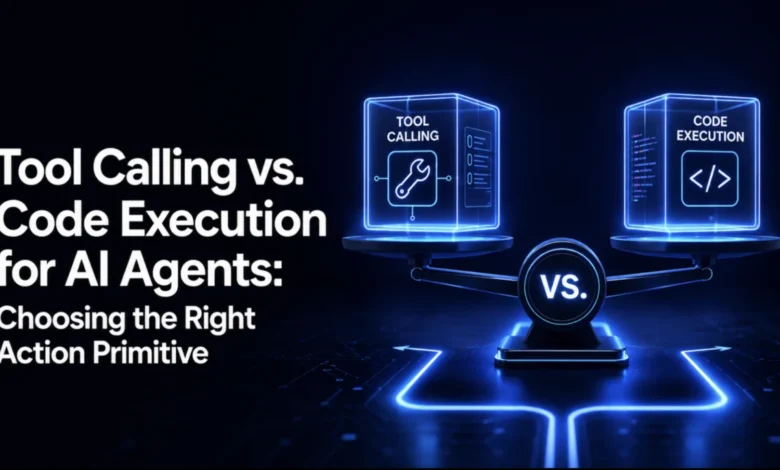
The evolution of autonomous AI agents has reached a critical juncture where the mechanism used to interact with the external world—known as an action primitive—defines the boundary between a functional prototype and a production-grade system. As enterprises transition from simple chat interfaces to complex, multi-step agentic workflows, developers are increasingly forced to choose between two primary architectures: traditional tool calling and modern code execution. While both allow a Large Language Model (LLM) to bridge the gap between internal reasoning and external utility, they differ significantly in their approach to latency, cost, and structural reliability.
At its core, an action primitive is the technical bridge that allows an AI model to exert influence over digital environments, such as querying a database, invoking an API, or reading from a file system. For years, the industry standard has been tool calling, a process wherein the model generates a structured JSON request that is intercepted by a host application, executed, and fed back into the context window as a response. However, the emergence of programmatic code execution—where models write and run sandboxed scripts to perform multiple operations—represents a paradigm shift in how agents manage complexity.
The Mechanics of Traditional Tool Calling
The traditional tool calling workflow is defined by its discrete, iterative nature. When a model determines that a specific action is required, it outputs a set of special tokens that the host environment recognizes as an instruction. The process is strictly linear: the model proposes a tool, the environment executes it, and the output is returned to the model as a text string or data object.
This methodology prioritizes transparency and auditability. Because every action is logged as a distinct event, developers can easily track the "thought process" of the agent. For simple, single-step tasks—such as fetching a weather report for a single city or retrieving the current status of an order—this approach is highly efficient. The model sees the exact output of the tool, enabling it to adjust its reasoning immediately based on the data retrieved. However, this design creates a "context bloat" problem. When an agent is tasked with a complex operation, such as auditing twenty employees’ Q3 travel expenses, the model must process every individual receipt. This can result in thousands of lines of raw data flooding the model’s context window, leading to significant increases in latency and token-based costs, even when the model only requires a summary or a comparison.
The Rise of Programmatic Code Execution
The limitations of traditional tool calling, particularly regarding data handling and orchestration, catalyzed the development of programmatic code execution. Championed by organizations like Anthropic through their Model Context Protocol (MCP) and similar frameworks, this approach allows the model to write and execute code in a sandboxed environment. Instead of the model requesting a single action and waiting for a response, it can generate a script—utilizing loops, conditional logic, and error handling—that performs multiple actions in sequence or parallel.
The critical differentiator is the "allowed_callers" architecture. By designating specific tools as callable from within an execution environment, the developer enables the model to manage its own orchestration. For example, if an agent needs to calculate the average temperature across fifteen different global locations, a code-execution-capable agent can write a Python script to fetch all fifteen values, compute the average internally, and return only the final result to the chat interface. In this scenario, the model never sees the fourteen intermediate, irrelevant data points, thereby saving massive amounts of compute time and context tokens.
Data-Driven Performance and Benchmarking
The shift toward code-driven agents is supported by empirical data. Benchmarks conducted during the development of these systems show that offloading logic to a sandboxed environment produces measurable performance gains. According to reports on the implementation of Advanced Tool Use, complex research tasks saw token usage drop by approximately 37%—from an average of 43,588 tokens to 27,297—when utilizing programmatic execution.
More importantly, the accuracy of these agents on complex benchmarks, such as GAIA, has shown marked improvement. Research indicates that models are prone to arithmetic and logic errors when forced to hold numerous intermediate variables in their "working memory" during a conversation. By offloading these tasks to a Python interpreter, the model acts as an architect rather than a manual calculator, reducing the likelihood of "hallucinated" calculations. The foundational 2024 CodeAct research further supports this, finding that agents utilizing executable code outperform those limited to simple JSON tool calls by up to 20% in multi-step, complex problem-solving environments.
Comparative Framework: Selecting the Correct Primitive
Choosing the right primitive requires a granular analysis of the task at hand. Organizations must evaluate their requirements against the following criteria:
- Task Complexity: If the task requires a simple lookup, tool calling remains the optimal choice due to its simplicity and low overhead. For tasks involving "fan-out" (fetching data from multiple sources) or data aggregation, code execution is superior.
- Context Sensitivity: When the agent needs to "reason" about the nuances of the retrieved data—such as detecting a specific sentiment in a text document—tool calling is necessary, as it keeps the data visible to the model.
- Infrastructure Maturity: Code execution requires a secure, sandboxed environment. If an organization lacks the capability to manage containerized or sandboxed code runners, the operational cost and security risks may outweigh the efficiency gains.
- Auditability: Standard tool calling provides a clear, step-by-step audit log of every request. Code execution obscures intermediate steps, which can complicate debugging in highly regulated industries where every action must be explicitly logged.
Broader Implications for AI Architecture
The industry is moving toward a hybrid reality. Modern production agents do not strictly adhere to one primitive; they utilize both. A high-performing agent might use a standard tool call to authenticate a user, and then switch to code execution to perform a deep-dive analysis on a database of financial records.
This hybrid approach acknowledges that AI agents are, at their core, limited by the bandwidth of their context windows and the cost of token consumption. By strategically deciding when to let the model "think" and when to let the model "calculate," engineers can build systems that are not only more cost-effective but also more reliable.
The transition to code-aware agents marks the end of the "black box" era of AI orchestration. As these frameworks become more standardized, the focus of AI development will shift from simply connecting models to tools to architecting efficient, secure environments where the model functions as a sophisticated controller. For the developer, the goal is no longer just to make the agent "smarter," but to build the infrastructure that allows the agent to be more efficient, accurate, and scalable in real-world application. As the technology continues to mature, the distinction between these two primitives will likely blur, but the fundamental architectural trade-offs—latency, context, and cost—will remain the primary variables determining the success of the next generation of autonomous agents.