Introducing WeatherNext 3, our most advanced and accurate global weather AI model

Every day, the atmospheric conditions overhead dictate the rhythm of human civilization. From simple decisions like carrying an umbrella to massive logistical planning for agriculture, maritime navigation, international trade, and emergency disaster relief, reliable meteorological forecasting is a cornerstone of modern society. In recent years, the intersection of artificial intelligence and atmospheric science has drastically shifted how humanity anticipates natural phenomena. Traditional numerical weather prediction (NWP) models, while foundational, have historically relied on heavy supercomputer simulations that require massive amounts of energy and time, often introducing critical data lags. Today, Google DeepMind and Google Research are fundamentally altering this landscape with the official introduction of WeatherNext 3, hailed as their most advanced and accurate global weather artificial intelligence model to date.
Independent live evaluations conducted by Brightband confirm that WeatherNext 3 stands at the cutting edge of global meteorological forecasting. By bridging the gap between traditional physics-based simulations and modern deep learning, the model is engineered to ingest live, raw observational data, circumventing the traditional multi-hour latency that has plagued forecasters for decades. The rollout of this technology marks a pivotal evolution in how hyper-localized weather data is processed, analyzed, and distributed across global consumer and enterprise products, including Search, Gemini, Maps, Google Maps Platform, and Cloud infrastructure.
The Evolution of Meteorological AI and the Push for Real-Time Precision
The journey toward AI-driven weather forecasting has accelerated rapidly over the last several years. Historically, meteorological agencies relied exclusively on numerical weather prediction models, which simulate the physical laws governing fluid dynamics and thermodynamics using massive supercomputing clusters. While these models produced robust macro-level forecasts, they suffered from significant structural limitations. They were computationally expensive, required up to six hours of data processing lag just to initialize a forecast run, and frequently struggled to capture fast-moving, localized weather events like sudden convective storms, flash floods, and microclimates.
Earlier iterations of machine learning weather models improved upon computation speed by learning from historical reanalysis datasets, drastically reducing prediction times from hours to mere seconds. However, these models still inherited some of the biases of the underlying NWP data used to train them and often lacked the spatial resolution necessary to map weather patterns across complex topographies, such as narrow valleys, coastal regions, and mountain ranges. Furthermore, previous systems struggled to directly assimilate raw, high-frequency geostationary satellite imagery, leaving a blind spot for rapidly evolving atmospheric phenomena.
WeatherNext 3 directly addresses these historical shortcomings. By transitioning from secondary training data to direct ingestion of live, raw observations, the system achieves a continuous feedback loop with the atmosphere. This architectural breakthrough allows the model to issue comprehensive global forecasts every single hour, providing meteorologists, emergency managers, and everyday citizens with unprecedented lead times during severe weather outbreaks.
Architectural Innovations: High-Resolution Grids and Functional Generative Networks
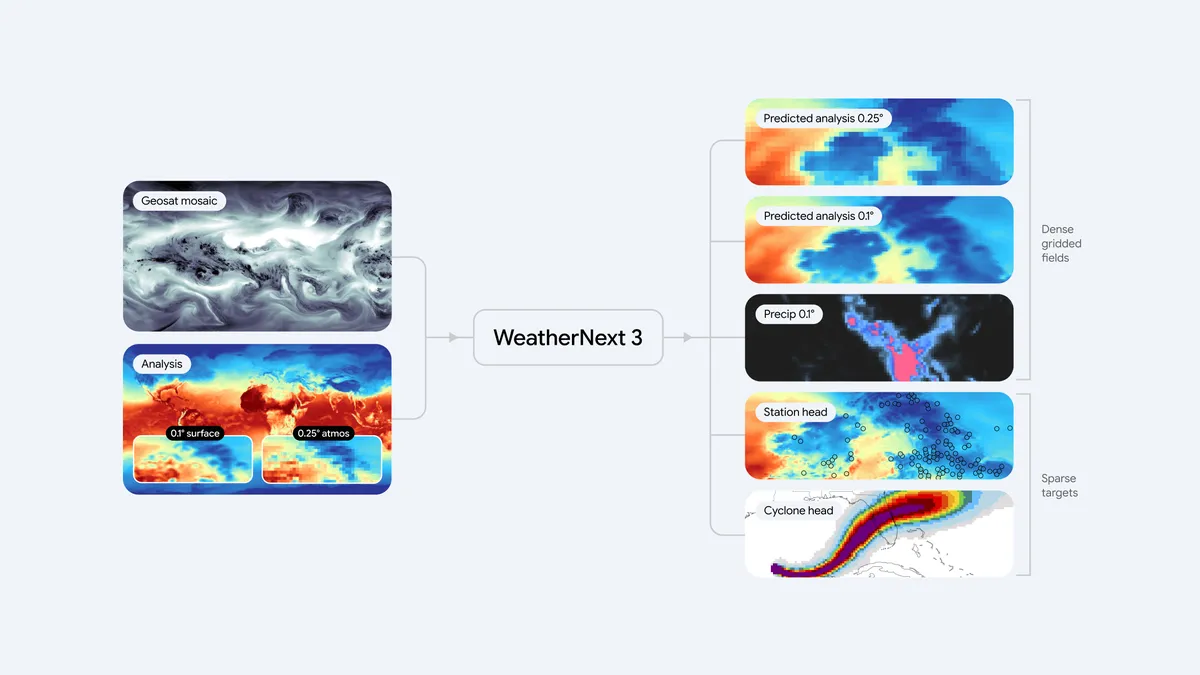
At the core of WeatherNext 3 is a sophisticated end-to-end system architecture powered by a flexible Functional Generative Network (FGN) mesh transformer. This deep learning framework is uniquely designed to process multiple layers of atmospheric data simultaneously while maintaining strict physical consistency across varying spatial and temporal scales—seamlessly transitioning from macro-level global wind patterns down to minute, localized topographical nuances.
The granularity of WeatherNext 3 represents a massive leap forward compared to its predecessor, WeatherNext 2, which operated on a uniform 25-kilometer grid with six-hour update increments. WeatherNext 3 introduces a multi-tiered resolution hierarchy tailored to specific atmospheric variables:
- Surface Temperature and Moisture: Visualized at a sharp 5-kilometer spatial resolution, allowing for precise tracking of thermal boundaries and localized humidity shifts.
- General Surface Variables: Mapped at a 10-kilometer resolution to capture broader regional climatic trends.
- Upper-Air Atmospheric Variables: Wind speeds and related metrics are tracked at a 25-kilometer resolution to maintain high-altitude dynamical accuracy.
This tiered approach delivers a global weather visualization roughly five times sharper than previous Google models. In comparative analyses over regions like the United Kingdom, WeatherNext 3 successfully resolves intricate coastal boundaries and valley elevations, eliminating the pixelated and over-smoothed thermal representations that historically plagued machine learning forecasts.
Moreover, the model incorporates sparse weather station observation data natively into its training pipeline. This capability is exceptionally vital for developing regions across Latin America, Africa, and the Asia-Pacific. Historically, these areas were underserved by high-resolution regional forecasting due to the prohibitive supercomputing costs associated with traditional localized NWP models. WeatherNext 3 democratizes access to high-fidelity meteorological intelligence, extending life-saving insights to billions of people and local economies previously left out of advanced forecasting frameworks.
Solving the Longstanding Challenge of Precipitation Forecasting
One of the most persistent hurdles in global meteorology has been the accurate prediction of precipitation. Rain, snow, and severe convective storms are driven by highly complex, fast-moving cloud microphysical processes that occur on spatial scales extremely difficult for traditional macro-models to simulate. Consequently, previous AI weather models frequently produced overly diffused, blurry precipitation footprints or missed the sharp boundaries of severe storms altogether.
To overcome this structural barrier, Google’s research teams trained WeatherNext 3 on two exceptionally robust and high-resolution precipitation datasets: NASA’s satellite-based Integrated Multi-satellite Retrievals for GPM (IMERG) and advanced global precipitation reanalysis derived from satellite radar.
The resulting accuracy gains are striking. In rigorous medium-range global forecast evaluations, WeatherNext 3 demonstrated remarkable improvements in the Continuous Ranked Probability Score (CRPS). The model achieved up to a 60% improvement when benchmarked against IMERG data, a 30% improvement against radar-based Multi-Radar Multi-Sensor (MRMS) metrics, and a 10% improvement against traditional rain gauge measurements during early lead times. Visual comparisons of precipitation probability forecasts (PoP > 1mm) illustrate that while older models like WeatherNext 2 display fragmented, pixelated boundaries, WeatherNext 3 generates sharp, convective bands that closely mirror actual satellite ground-truth observations.
Empowering Clean Energy and Global Economic Infrastructure
Beyond traditional public forecasting, WeatherNext 3 has been strategically engineered to support the global transition toward renewable energy. As wind and solar power generation scale up to meet international climate goals, grid operators and energy developers require hyper-precise meteorological data to balance supply and demand in real time.
WeatherNext 3 introduces specialized predictive variables tailored directly to the renewable energy sector. The model computes 100-meter wind speeds—the precise operational height of modern utility-scale wind turbines—allowing energy firms to forecast wind power output with unprecedented accuracy. Simultaneously, it provides high-resolution cloud cover and solar radiation mapping to help photovoltaic solar farms anticipate ground-level light fluctuations caused by transient cloud formations.
These capabilities are critical for modern power grids, where minor miscalculations in energy output can lead to grid instability, localized blackouts, or wasted electricity. By providing dependable, hourly clean energy forecasts, WeatherNext 3 equips utilities with the analytical foresight necessary to integrate intermittent renewable sources smoothly into national power grids.
Ecosystem Integration and Practical Implications
The unveiling of WeatherNext 3 is not merely an academic milestone; it represents a comprehensive operational deployment designed to impact daily life on a global scale. Google has confirmed that the model is being systematically integrated across its primary digital ecosystem. Users will encounter enhanced weather insights seamlessly embedded within Google Search, Gemini conversational AI agents, consumer mapping tools via Google Maps, enterprise solutions through Google Maps Platform, and advanced cloud analytics via Google Cloud.
This broad integration serves diverse sectors. Emergency responders tracking erratic wind shifts during wildfires, commercial aviation dispatchers optimizing flight paths to avoid turbulence, maritime captains navigating storm tracks, and small-scale agriculturalists planning irrigation schedules all stand to benefit from the democratization of high-resolution weather intelligence.
Despite these technological leaps, experts and developers behind the model emphasize the enduring complexity of Earth’s atmosphere. Weather systems retain an inherent degree of unpredictability, and severe meteorological events will always demand caution. Google maintains a clear advisory stating that for official weather forecasts, severe weather warnings, and public safety directives, individuals and organizations should always defer to their local meteorological agencies and national weather services.
As climate volatility increases the frequency and severity of extreme weather events worldwide, the deployment of tools like WeatherNext 3 marks a transformative step forward. By successfully marrying raw, real-time satellite telemetry with advanced neural network architecture, Google DeepMind and Google Research have pushed the boundaries of what is possible in atmospheric science—ushering in an era where digital forecasts finally match the dynamic, rapidly changing reality of the world on the ground.