The Growing Complexity of LLM Integration
In traditional machine learning, model versioning primarily involves tracking hyperparameters and training datasets. However, the integration of large language models introduces a new layer of complexity. An LLM-driven pipeline depends not only on the training data but also on the underlying model architecture, the specific weights, the quantization level, and the prompt engineering strategies utilized. When developers switch from a lightweight model like Orca Mini to a more robust variant like Falcon, they are fundamentally altering the behavior of their inference pipeline. Without a centralized tracking mechanism, such transitions often lead to "model drift" and reproducibility crises where the provenance of a specific model output becomes impossible to verify.
The emergence of the Scikit-LLM library has been a watershed moment for data scientists accustomed to the scikit-learn API. By encapsulating complex API calls and local model execution within standard fit/predict methods, it enables the construction of complex pipelines. Yet, the library alone does not provide the historical record necessary for auditability. This is where MLflow, an industry-standard open-source platform, acts as the definitive system of record. By logging these pipelines as artifacts, teams can maintain a granular history of every model iteration, including failed attempts and experimental benchmarks.
Establishing a Robust Development Environment
The implementation of a versioned pipeline begins with a structured setup. Engineers must ensure compatibility across environments, particularly when utilizing local LLM backends via gpt4all. The initial configuration involves initializing the Scikit-LLM framework with the necessary environment variables—often dummy keys for local execution—and establishing a persistent database backend for the MLflow Model Registry. Using a SQLite database for the registry provides a lightweight yet effective way to maintain an audit trail of model versions without requiring heavy infrastructure overhead.
The chronology of a standard experiment begins with the definition of a baseline pipeline. For example, a zero-shot classification task—a common requirement in customer feedback analysis—can be established using an Orca Mini model. By utilizing the mlflow.start_run context manager, developers can programmatically link specific metadata, such as the model file path and backend configuration, to the serialized model artifact. This process creates an immutable snapshot of the model at the exact moment of its creation, which is essential for debugging and rollback scenarios.
Chronology of Experimentation and Model Evolution
A typical development lifecycle follows a clear progression:
- Baseline Creation: The initial model is trained and logged to establish a performance benchmark.
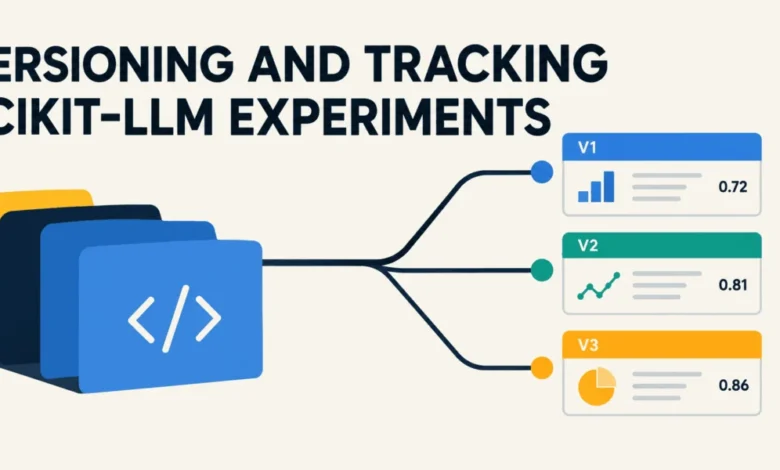
- Iterative Upgrading: As requirements evolve, developers test larger or more specialized models. Each iteration is logged as a distinct run within the same experiment.
- Audit and Review: The team uses the MLflow Search API to aggregate metadata across all runs. This allows for a side-by-side comparison of different model versions, helping to identify which configurations yielded the most stable results.
- Formal Registration: Once a candidate model demonstrates superior performance, it is promoted to the Model Registry. This transition signifies that the model is ready for staging or production, moving from an experimental "run" status to a versioned, deployable asset.
This workflow is not merely a technical preference but a strategic necessity. In a corporate environment, the ability to trace a classification error back to a specific model version—and by extension, the specific LLM weights used during that run—is a mandatory requirement for regulatory compliance and quality assurance.
Supporting Data and Technical Nuance
Technical evidence suggests that using cloudpickle as a serialization format is superior to standard pickle for complex LLM-based pipelines. Because these pipelines often include custom object wrappers and complex dependencies, standard serialization can fail or result in broken model files. By explicitly overriding the default serialization, developers ensure that the model object, including its internal state and configuration, is preserved perfectly.
Furthermore, the integration of performance metrics—such as accuracy, precision, or inference latency—into the MLflow tracking dashboard provides quantitative justification for model selection. When the search results are exported to a pandas DataFrame, the data reveals a clear picture of the project’s history. It documents the evolution from initial, perhaps unsuccessful, attempts (often marked as "FAILED" in the tracking system) to the final, high-performing model. This level of transparency effectively prevents the "black box" phenomenon that often plagues AI development.
Implications for Enterprise AI Deployment
The shift toward "registering" models represents a significant maturity milestone for engineering teams. Registering a model into the production registry, such as "Production_ZeroShot_Classifier," locks that specific version of the pipeline. From this point forward, downstream applications can call the registered version, ensuring consistency across the entire production environment.
The broader implication of this structured approach is the democratization of model governance. When every model is tagged with its origin, its parameters, and its performance history, the technical barrier to entry for team collaboration is significantly lowered. New engineers joining a project can immediately audit the experiment history to understand why specific architectural choices were made.
Expert Perspectives on Lifecycle Management
Industry analysts and machine learning engineers have frequently noted that the greatest bottleneck in AI adoption is not the quality of the models themselves, but the lack of operational discipline. By codifying the "logging-to-registering" transition, organizations are effectively building an insurance policy against technical debt. The ability to automatically sort and retrieve models based on specific metrics—such as querying for the highest accuracy across all registered versions—allows for a data-driven approach to model promotion.
This, in turn, facilitates a culture of continuous integration and continuous deployment (CI/CD) for AI. When the model registry is treated as a source of truth, automated pipelines can trigger testing and deployment scripts based on the registration of a new version. This eliminates manual errors and significantly accelerates the time-to-market for new features powered by large language models.
Final Assessment
As LLM-integrated pipelines become more pervasive, the tools that manage their lifecycles will become as critical as the models themselves. The combination of Scikit-LLM for model execution and MLflow for lifecycle management offers a comprehensive, scalable, and highly auditable framework for modern AI development. By focusing on reproducibility, versioning, and rigorous auditing, teams can successfully navigate the complexities of generative AI, transforming experimental code into reliable, production-ready software systems that can be updated, compared, and deployed with confidence. The future of enterprise AI lies in this intersection of agility and rigor, ensuring that the next generation of language-aware applications is built on a foundation of observable and manageable performance.