Electric Truck Maker Harbinger Secures $240 Million in Series D Funding Following Landmark FedEx Contract and Military Expansion

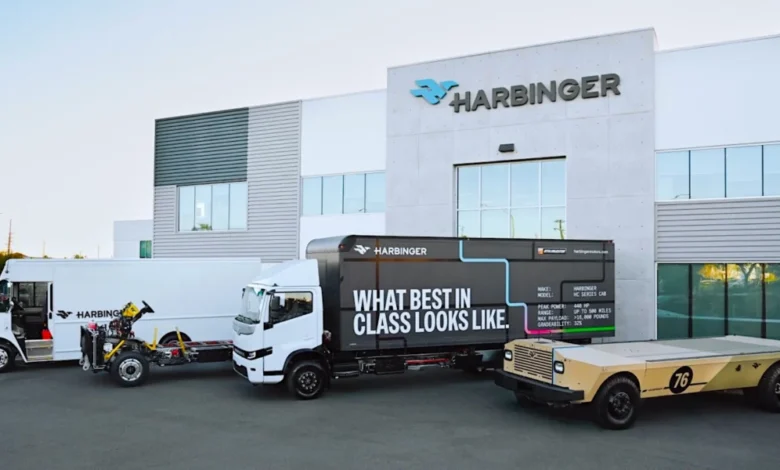
The commercial electric vehicle sector has reached a significant milestone as Harbinger, an emerging medium- and heavy-duty electric truck manufacturer, successfully closed a $240 million Series D funding round. This latest financial injection comes on the heels of several major operational victories for the company, including a historic binding fleet order from international logistics leader FedEx and strategic defense contracts with the United States military. With this newest capital raise, Harbinger’s total venture funding has surpassed $650 million since the company’s inception in 2021, signaling growing market confidence in the viability and necessity of commercial fleet electrification.
The Series D round was co-led by prominent investment firms Tiger Global, the Capricorn Technology Impact Fund, and Ridgeline. According to company leadership, the fresh capital will not only accelerate the scaling of Harbinger’s proprietary medium-duty vehicle manufacturing capacity but also fund critical diversification efforts. These include research and development for stationary energy storage systems, next-generation power generation technologies, autonomy software integration, and specialized defense applications.
A Massive Validation: The FedEx Partnership
The catalyst for Harbinger’s recent surge in market valuation and investor confidence is its landmark agreement with FedEx. In late 2026, the global shipping conglomerate committed $300 million to purchase 2,000 medium-duty electric delivery trucks from Harbinger. Industry analysts widely regard this transaction as one of the largest binding orders for medium- or heavy-duty commercial electric vehicles in history.
For logistics operators like FedEx and Amazon, fleet electrification is no longer viewed merely as a corporate sustainability initiative, but as a critical financial strategy. Major shipping fleets are aggressively working to decarbonize operations while simultaneously insulating themselves from the volatile and escalating costs of diesel fuel. Industry projections indicate that massive capital expenditures on electric delivery fleets can yield hundreds of millions of dollars in long-term operational savings by bypassing traditional fuel and heavy maintenance costs.

FedEx’s massive investment in Harbinger’s platform serves as a powerful endorsement of the startup’s technology, effectively demonstrating to the broader logistics and supply chain sector that purpose-built electric commercial vehicles are ready for large-scale, real-world deployment.
Strategic Vision and Leadership Perspective
Harbinger was founded on the principle that existing commercial vehicle architectures were ill-equipped for a seamless transition to electrification. Traditional legacy truck manufacturers often retrofitted internal combustion engine platforms with electric motors and batteries—a compromise that frequently led to weight penalties, payload restrictions, and reduced reliability. Harbinger took a ground-up approach, designing its proprietary medium-duty electric vehicle architecture from first principles.
John Harris, Co-Founder and Chief Executive Officer of Harbinger, emphasized the company’s mission to redefine industrial expectations during the announcement of the Series D funding.
"Harbinger exists to challenge what industry has learned to accept, and reinvent the critical systems the world depends on," said Harris. "By rethinking critical systems from first principles, we aim to unlock better performance, greater reliability, safer operations, and more room to grow. Electrification is at the core of everything we do, and increasingly, electrification is at the core of industry, defense, mobility, and AI. Harbinger’s role is not simply to give customers another option. It is to reset expectations for what critical systems should deliver."
By focusing on proprietary powertrain components, high-voltage battery architecture, and scalable chassis designs, Harbinger has positioned itself uniquely in a competitive market populated by both legacy automotive giants and heavily funded EV startups.

Broadening Horizons: Defense and Energy Infrastructure
While commercial delivery trucks remain the immediate bread and butter of Harbinger’s business model, the $240 million Series D funding round highlights the company’s broader technological ambitions. The commercial vehicle manufacturer is systematically expanding its footprint into sectors that extend far beyond last-mile logistics.
1. Defense Applications and Autonomous Systems
Earlier in 2026, Harbinger made waves by securing a specialized contract with the United States military to develop autonomous electric truck solutions. Military logistics require rugged, high-torque, and highly reliable platforms capable of operating in austere environments without relying on fragile civilian supply chains. Harbinger’s heavy-duty electric architecture offers distinct advantages in this arena, including silent mobility, high thermal efficiency, and the ability to serve as a mobile microgrid (exportable power). The new funding will fast-track the integration of autonomy software and ruggedized defense variations of its platform.
2. Energy Storage and Power Generation
As the grid struggles to keep pace with the rapid electrification of transportation and the surging power demands of artificial intelligence data centers, decentralized energy solutions are becoming paramount. Harbinger plans to channel a portion of its newly acquired capital into energy storage systems (ESS) and distributed power generation. By leveraging its proprietary high-voltage battery technology, the company aims to supply stationary storage units that can support fleet charging depots, commercial real estate, and emergency grid stabilization.
Chronology of Growth: Harbinger’s Rapid Ascent
The trajectory of Harbinger over the past five years illustrates the accelerating pace of the commercial EV transition:
- 2021: Harbinger is officially founded by a team of veteran automotive engineers and executives aiming to build commercial-grade electric vehicles from scratch.
- 2023–2024: The company develops and unveils its proprietary medium-duty EV chassis, focusing on a modular design capable of supporting step-vans, delivery trucks, and cutaway chassis applications.
- Early 2025: Harbinger secures initial pilot programs with regional fleets, validating its proprietary battery management systems and custom electric motor configurations.
- Mid-2026: The company enters the defense sector, securing a contract with the US military for autonomous electric truck development.
- Late 2026: FedEx announces a historic $300 million binding order for 2,000 electric delivery trucks, marking a watershed moment for the startup.
- Late 2026 (Current): Harbinger closes its $240 million Series D funding round, co-led by Tiger Global, Capricorn Technology Impact Fund, and Ridgeline, pushing its total capital raised past $650 million.
Industry Implications and Market Analysis
The success of Harbinger’s Series D round offers several key insights into the current state of the green technology and commercial vehicle sectors.

First, venture capital and institutional investors are increasingly discriminating, moving away from consumer-facing EV startups that failed to achieve manufacturing scale, and instead doubling down on business-to-business (B2B) commercial operations with verified, binding purchase orders. Because commercial fleets operate on strict total-cost-of-ownership (TCO) metrics rather than consumer preference, a reliable, durable electric truck that reduces operational expenditure finds a readymade, eager market.
Second, the convergence of transportation electrification with defense technology and grid infrastructure represents a lucrative paradigm shift. Companies that can build modular, high-voltage vehicle platforms capable of pivoting into stationary energy storage and autonomous military applications possess multiple revenue streams that insulate them from traditional automotive market cyclicality.
As Harbinger scales its manufacturing footprint to fulfill the massive FedEx backlog and executes its broader diversification strategy, the company is rapidly transitioning from an ambitious startup into a formidable player in industrial technology. With over $650 million in total funding backing its operations, Harbinger is well-equipped to test whether first-principles engineering can successfully reshape the future of commercial transit, defense mobility, and energy infrastructure.