Google has officially announced the global release of Gemini 4 Argon, its newest frontier artificial intelligence model designed specifically to tackle exceptionally complex, multi-step tasks across fields such as software engineering, financial modeling, legal analysis, cybersecurity, and scientific research. Available immediately to developers, enterprise organizations, scientists, and everyday consumers, Argon aims to redefine the benchmark for deep reasoning, advanced visual perception, and domain-specific execution in real-world scenarios.
The model is accessible through several primary channels. Developers and enterprise clients can leverage the API via Google AI Studio and the Gemini platform. Meanwhile, individual users subscribed to Google AI Ultra can access Argon within Google Antigravity, while both Google AI Ultra and Pro subscribers can find the model integrated directly into the Gemini app and AI Mode in Search.
To encourage widespread adoption and experimentation, Google has launched the model with introductory pricing set at $2 per million input tokens and $10 per million output tokens, alongside a steep 95% discount for cached input tokens.
Unprecedented Benchmark Performance and Complex Problem-Solving
Argon’s architecture is optimized for sustained, deep work, allowing it to maintain context and logical consistency across intricate workflows. According to early evaluations, this depth and precision have enabled Argon to outperform other frontier models on multi-domain benchmarks. Notably, it has secured the number one ranking on the Vals Index, a standardized measure evaluating model efficacy across critical economic sectors, including legal documentation, financial accounting, coding, and tax preparation.
Within Google’s own internal engineering teams, the deployment of Argon has already yielded measurable efficiency gains. Over the preceding weeks, software developers utilizing Argon within Antigravity reported an increased capacity to ship high-quality code rapidly. Internal metrics indicate that Argon helped teams increase agentic code submissions by more than 35% while simultaneously reducing code rollbacks by nearly a third.
Beyond text-based programming, Argon demonstrates remarkable multimodal capabilities. In development demonstrations, the model coordinated multi-agent visual critique loops in Antigravity to autonomously model complex architectural structures—such as a detailed Pagoda—and sculpt photorealistic environments complete with lighting and foliage in Blender. Furthermore, it has shown the ability to translate static photographic data of a real-world office desk into a fully playable, physics-enabled miniature racing game using web-based tools like Three.js and Blender MCP.
Transforming Professional and Enterprise Workflows
The commercial release of Gemini 4 Argon follows an extensive early access period during which enterprise customers and startups tested the model across high-stakes professional environments. The model combines advanced reasoning, expanded domain knowledge, and refined writing capabilities to handle demanding administrative and creative workflows.
Google reports that Argon communicates with significantly higher directness than its predecessors. The model minimizes hedging language, avoids unnecessary repetition, and rejects cliches, adhering closely to custom style guidelines. Its capacity for deep multimodal document comprehension and longitudinal data analysis makes it well-suited for synthesizing massive volumes of unstructured data.
For instance, archaeologists and historical researchers have utilized Argon to synthesize approximately 50 gigabytes of airborne LiDAR scans, Geographic Information System (GIS) room vectors, Library of Congress Computer-Aided Design (CAD) drawings, and National Park Service archives. By processing these fragmented records, the model successfully reconstructed detailed 3D digital heritage models of historical sites like Chaco Canyon.
In the life sciences sector, partner organizations such as Isomorphic Labs have integrated Argon into drug discovery pipelines. By synthesizing dense scientific PDFs and patent filings within hours rather than weeks, the model accelerates the extraction of critical data points essential for biomedical research.
Advancing Cybersecurity, Science, and Robotics
The rollout of Gemini 4 Argon extends deeply into specialized technical fields. Security researchers and cyber defense specialists are leveraging the model’s reasoning capabilities to autonomously audit critical codebases, evaluate formal mathematical proofs, and identify subtle zero-day vulnerabilities or architectural logic flaws.
To expand these defensive capabilities, Google is extending access to hundreds of additional partners under its Fairwind Program. Cybersecurity firm Wiz is among the early beneficiaries, utilizing Argon for its "Scan for Good" initiative, a public-interest program designed to protect critical infrastructure from emerging digital threats.
In the scientific domain, Google has announced a dedicated initiative to accelerate research velocity. The company is offering 10,000 qualified scientists free access to the highest usage tier of Google Antigravity for a period of six months, with applications currently open on a rolling basis.
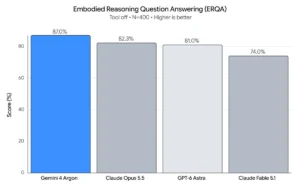
Perhaps one of the most prominent advancements showcased with Argon is its integration into the robotics stack, representing a significant step toward physical Artificial General Intelligence (AGI). Argon achieved an 87% score on the Embodied Reasoning (ERQA) benchmark, which evaluates a model’s aptitude for understanding and resolving physical and spatial challenges in three-dimensional environments.
Demonstrating this capability, Google researchers tested Argon’s ability to acquire physical skills through visual observation alone. After watching a raw video recording of a human playing the lawn game cornhole, Argon mapped the environmental spatial coordinates, calculated the requisite whole-body joint trajectories, and automatically generated the corresponding simulation code. When this generated code was deployed onto an Apptronik Apollo humanoid robot, the machine successfully executed the physical motion and sank seven consecutive shots during real-world trials. This "Video-to-Sim-to-Real" pipeline compresses what was previously weeks of manual simulation modeling into a matter of hours, establishing ordinary video feeds as scalable training environments for robotic systems.
Safety, Responsibility, and Technical Infrastructure
Given the advanced capabilities and autonomous potential of Gemini 4 Argon, Google implemented comprehensive safety protocols during its development lifecycle. The company collaborated with independent third-party evaluators to measure specific model behaviors and establish robust safeguards. The resulting metrics and containment strategies are detailed in the official Gemini 4 Argon Model Card, marking what the company describes as its most rigorous safety and security validation stack to date.
To support the heavy computational demands of long-form reasoning and complex agentic tasks, Argon supports an industry-leading unified input-output token limit of one million via the Gemini API. Developers and enterprise administrators are encouraged to review updated platform documentation regarding the new continuation protocol, designed to ensure optimal infrastructure setup for extended analytical sessions.
With the global release of Gemini 4 Argon now underway, Google officials emphasize that this deployment represents only the initial phase in the broader rollout of the Gemini 4 model family, signaling further updates and specialized releases in the near future.